
Crank Press For Automotive Stamping: The Technical Deep Dive into Mechanism and Design
Automotive stamping crank presses are vital for modern vehicle manufacturing systems. Each car distributes hundreds of stamped metal components. So what makes crank presses so prevalent for high-volume automotive production? And how does the GUANGDUAN Straight Side Double Point Multi-Station Press GD2 Series expand production horizons? This article examines crank presses and how the systems and components have advanced with automotive stamping.
1. The Essence: Linear Force from Rotation
Presses for automotive stamping revolve around a mechanical concept of linear and rotational transformations of motion. In this case, crank presses change the rotational movement of a motor to the linear, backward and forward motion of a slide/ram.
•Electric motor and flywheel: The motor spins a flywheel storing rotational energy. Stamping presses operate under high force for brief durations. The energy is released at the moment of impact, and the motor is not stressed thanks to the relatively constant operational speed.
•Clutch and brake system: The stroke initializing clutch connects the flywheel to the transmission. The slide is brought to a stop by the brake at the upper end of the stroke. This combination achieves controlled and safe cycling which is repeatable.
•Gear Transmission: A two-stage gear train is typically used in high-performance presses to achieve high stroke rates while still providing adequate forming energy. Gears will reduce motor speed while also increasing torque delivered to the crankshaft.
•Crankshaft and Connecting Rod: The crankshaft roatationally moves and pushes or pulls the connecting rod, causing the slide to traverse vertically along a fixed path.
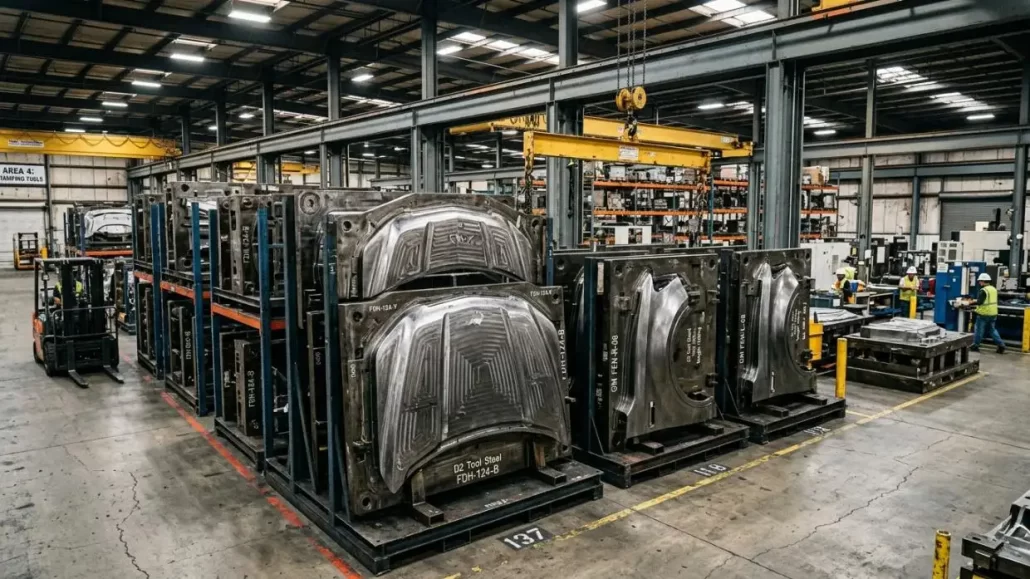
•Slide(Ram) and Die Set: The slide also called the ram, carries the top part of the stamping die. When the Slide descends, the blank is placed against the lower die, which causes the blank to deform the die in a plastic manner.
The entire process of engaging, disengaging, and braking continues within a single cycle of several fractions of a second. The press design allows the process to exceed a production rate of 15 to 30 strokes per minute.
2. Why the Crank Press Dominates Automotive Stamping Applications
The speed, precision, and durability required for Automotive stamping applications are best achieved through the use of a crank press. Crank press for automotive stamping excels in all three areas, making it the standard equipment for most sheet-metal forming operations.
•High stroke rates: Mechanical crank presses are much quicker than hydraulic presses. This increases throughput for most production lines.
•Uniform BDC accuracy: The mechanical connector guarantees the slide’s reach of the extreme bottom position for each stroke. This guarantees uniformity for each component.
•Energy efficiency: The flywheel stores energy during the idle portion of the cycle and releases this energy during the next cycle. This is more energy efficient than hydraulic systems that require constant energy to pump hydraulic fluid.
•Adaptability to automation: Most modern crank presses have interface systems for automated servo driven transfer systems and robots which allows for completely automated progressive and multi-station stamping lines.
Because of all of these advantages, crank presses are now the most used for stamping body-in-white, chassis, and all other high volume automotive applications.
3. Anatomy of a High-Performance Crank Press: Key Components Explained
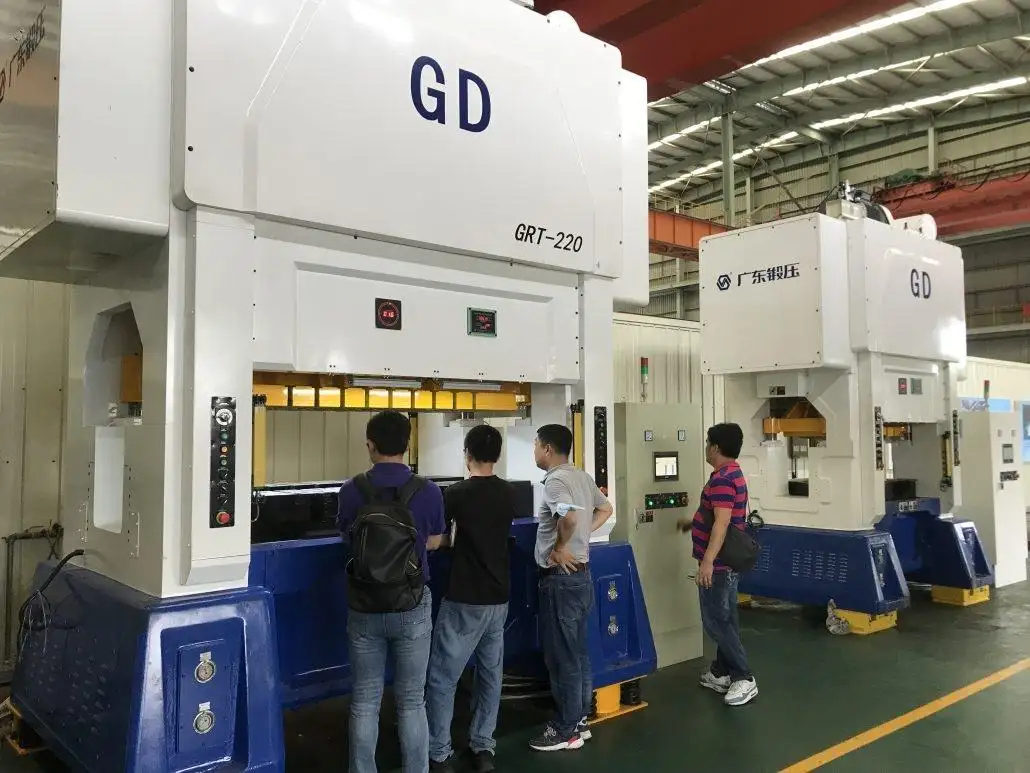
Here, we have to look at the key sub-systems in a modern crank press for automotive stamping, to understand how some innovations in engineering have improved performance of these systems.
3.1 Frame and Structure
•Welded steel plate construction: High quality steel plates are welded to form the main frame of the crank press. This gives excellent rigidity and damping of vibration. It is essential for alignment of the dies under high load.
•Split frame design for large tonnages: A split body with pull-rod pre-tensioning is designed for crank presses of more than 600 tons. This design aids transport and assembly at the location. The pre- tensioned, tie-rods keep the frame under tension, even with large forming forces. This helps long-term stability of the system.
3.2 Transmission and Drive System
•Two level gear transmission: This press has two stages of gear reductions. This helps maintain torque at high strokes per minute. This is advantageous for small parts of an automotive application, for instance, that require high speed production.
•Enlarged crank-to-connecting-rod interval: The distance between the crank center and the connecting-rod pivot point has been increased. This improves the press’s ability to cope with unbalanced and irregular loads, which are mostly experienced with progressive die operations and multi-station operations, since several stations tend to have varying resistance.
3.3 Slide Guidance System
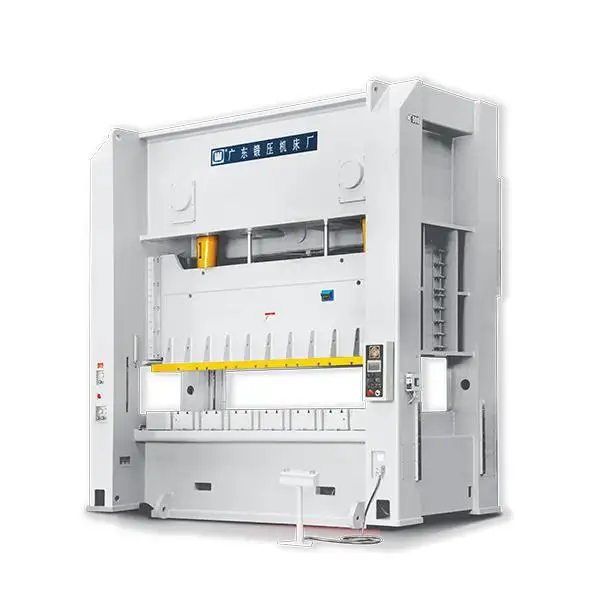
Eight-surface full-guideway guidance: Instead of conventional four- or six-way guides, the slide is supported by eight contact surfaces. This design minimises side forces, improves resistance to off-centre loading, and maintains high precision over millions of cycles. The result is better part quality and longer die life.
3.4 Clutch and Brake Unit
High-torque wet-type clutch: This clutch is composed of several friction discs and an oil supply. Its design principles make it extremely tough and increase its lifespan. It is excellent at avoiding engagement issues and is particularly useful on an assembly line due to its ability to start and stop frequently. It is quiet in operation, does not produce air pollution, and is safe for the environment.
3.5 Die Cushions and Knockout Systems
•Multi-section air cushions: Designed for multi-station machines, each of the multiple sections is adjustable and, as a result, large blank-holding forces are achievable in a small space.
•Upper knockout cylinder: This cylinder is built to the slide and helps in the ejection of formed pieces from the upper die, and helps to support uniformity of the cycle.
4. The GUANGDUAN GD2 Series: Engineering Excellence for Modern Stamping
The GUANGDUAN Straight Side Double Point Multi–Station Press GD2 series exemplifies the integration of all these advanced features into a single, production-ready machine. This line is specifically tailored for progressive die and multi-station stamping in the automotive industry.
| Model | GD2-300 | GD2-400 | GD2-500 | GD2-600 | GD2-800 | GD2-1000 |
| Bolster A | 300 | 350 | 380 | 420 | 450 | 480 |
| Bolster B | 30 | 30 | 30 | 30 | 303 | 30 |
| Bolster C | 5 | 5 | 5 | 5 | 6 | 6 |
| Slide Bolster D | 4 | 4 | 5 | 5 | 6 | 6 |
(Dimensions in the table represent key platen and slide sizes that accommodate a wide range of dies.)
•Multi-station transmission device: Incorporating an additional idler gear set enlarges the distance between the two pressure points, giving the GD2 exceptional resistance to eccentric loads. This also reduces the overall height of the press, making the structure more compact and saving valuable floor space.
•Automation-ready interfaces: The GD2 is supplied with mounting points for both 2D and 3D servo-driven production lines, allowing seamless integration into smart factories.
•Cushions used for upper/lower die: These cushions work excellently with very low pressure fluctuations. They allow complex automotive panel forming with large force and fast response.
5. Multi-Station and Progressive Die Stamping: Maximizing Productivity
Progressive dies and multi-station transfer presses are now the norm in automotive part manufacturing since they allow the entire process to happen in a single uninterrupted cycle. For instance, a single crank press for automotive stamping integrated with a multi-station die can complete all cutting, bending, drawing, and punching operations in a single cycle of the press.
•Progressive die: Each of the operations is performed by a station which the strip of metal advances through one step at a time. The last station performs the separation of the finished part from the strip.
•Transfer press: Each blank is mechanically moved to its station, enabling the forming of even larger pressings (like the door outer panel) in one press.
The demands of these applications have been clearly considered in the design of the GD2 series cushioned die. Its large bolster, the facility for independent adjustment of cushions, and high anti-eccentric-load capacity, allow consistently high quality to be achieved with varying forces at each station.
Final Words
From a simple crank-slider, the crank press for automotive stamping has developed into a sophisticated press with eight-surface guidance, wet clutches and split frames. It provides the speed, accuracy and reliability required by automotive manufacturers.
The latest designs (like GUANGDUAN GD2) have introduced flexibility and a degree of automation for Industry 4.0. These designs are capable of pressing anything from small brackets to full size automotive hoods and are compatible with the latest trends of EV lightweighting. The fundamental design (rotary motion into linear motion) remains unchanged.
FAQs
Q: What is a crank press and how does it work?
A: It performs high-force stamping operations via a motor, crank shaft, and connecting rod by converting rotary motion into linear reciprocating motion of the slide.
Q: What are the reasons for the preference of crank press to hydraulic press in automotive stamping?
A: It has greater stroke rate, improved bottom-dead-center consistency, and better energy efficiency for high-volume operations.
Q: What is a straight-side double-point press and what does “double-point” mean?
A: It indicates the press consists of two connecting rods with improved balance of forces and improved resistance to eccentric loading.
Q: What is the advantage of an eight surface full guideway?
A: It minimizes side forces, and improves guiding principles and the assurance of precision even with eccentric loading for millions of mechanical operations.
Q: What are the advantages of a wet-type clutch over a dry clutch?
A: A wet type clutch has better torque characteristics, longer life, quieter operation and allows for an increase in the frequency of the start-stop cycles with no clutch-related failures.
CONTACT US


Guangdong Metal Forming Machine Works Co., Ltd.
We are always providing our customers with reliable products and considerate services.
If you would like to keep touch with us directly, please go to contact us
-

Home
-

Tel
-

Email
-

Contact