
How Knuckle Joints Work: A Crankshaft Press Machine Supplier View
In metal forming, the confluence of the crankshaft and knuckle joint mechanism is undoubtedly one of the greatest, most ingenious combinations of engineering strikes. Together they convert plain rotary motion into the kind of stamping and extrusion that modern manufacturing processes require, which is precise and powerful. Anyone interested in a crankshaft press machine needs to be able to assess the intricate workings of a press machine and how these two components work together.
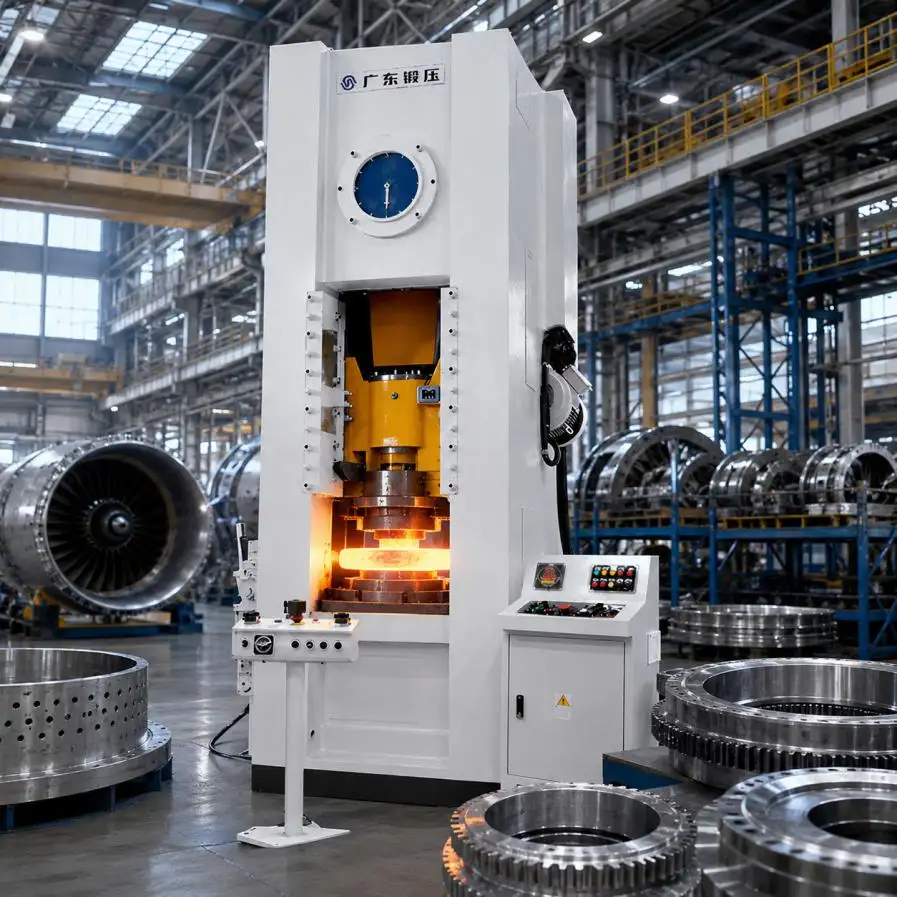
This article explains the crankshaft-toggle (knuckle joint) mechanism, the engineering component of the GK Series knuckle joint presses by GUANGDUAN, and describes the formalities of the crankshaft-toggle (knuckle joint) mechanism and why it is a particularly innovative design that excels in fine Stamping, Cold Forging, and Precision Extrusion.
The Crankshaft: Where Power Begins
Crankshafts form the basis of mechanical presses. In a crankshaft press machine, the electric motor powers a flywheel, which temporarily stores the energy of rotation. This stored energy is transferred through a gear train to the crankshaft. In the process, the flywheel’s rapid rotation and low working forces are transformed to a slower, higher working force of rotation.
Through its eccentric journal, the crankshaft provides a connection to a rotating assembly member. A rod is attached to the eccentric journal, and in a typical crank press, that circular motion is translated into the vertical linear motion of the slide (ram). In a knuckle joint press, the slide (ram) does not connect directly to the crankshaft assembly; a knuckle joint mechanism provides the connection.
The Knuckle Joint: Leveraging Force at the Precise Moment
A knuckle joint consists of two links at an angle connected via a pivot point. One of the links forms the connecting rod (which is driven by the crankshaft), and the other forms the slide (or ram).
Here is what happens:
• With the rotation of the crankshaft, the connecting rod moves the knuckle joint from an angled position to a straight position.
• As the joint moves to a straight position, the advantage of the mechanism increases. The resultant force on the slide becomes greater by many times than the force on the connecting rod.
• At the bottom dead center (BDC), which is the lowest position of the slide, the straightness of the knuckle joint increases, and the mechanical advantage is at its maximum.
This feature of the knuckle joint press mean that it focuses the maximum force at the most critical point of the stroke and for the most appropriate duration, ensuring that the metal has completely occupied the die.
The Synergy: The Reason for the Success of the Combination
The crankshaft and knuckle joint are parts of a single system, and are designed to work together for a particular purpose in the manufacturing process of providing the greatest force at the optimal location and the most appropriate time.
Dwell at Bottom Dead Center
In a standard crank press, the slide reaches bottom dead center and immediately begins its upward return stroke. There is virtually no pause. In a crankshaft-toggle mechanism, however, the geometry of the knuckle joint creates a natural dwell—a momentary pause at the bottom of the stroke.
The GK Series, for example, allows the slide to dwell at bottom dead center for approximately 1/18 of a cycle. This dwell is not a design flaw or an afterthought—it is the critical window that lets material settle, fill corners, and equalize internal stresses without spring-back.
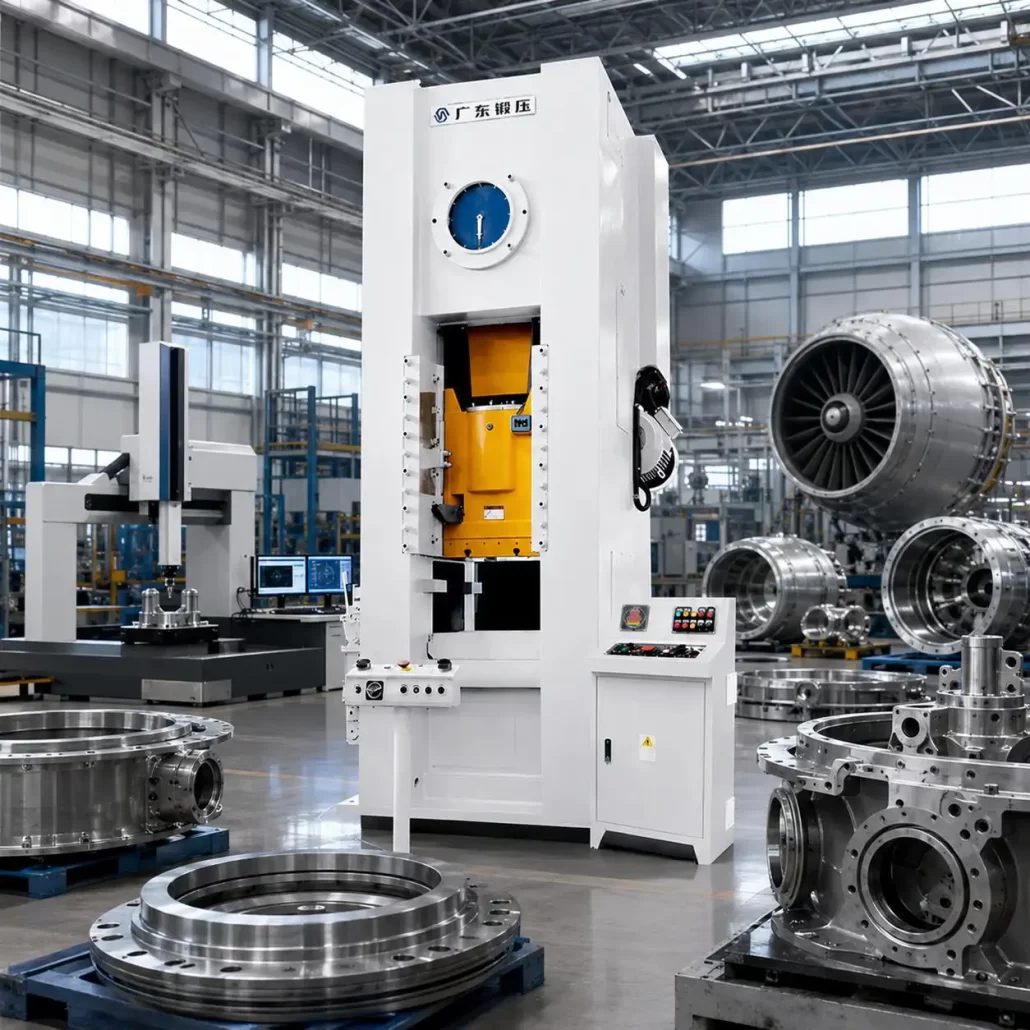
Force Multiplication
The mechanical advantage of the knuckle joint means that the press delivers its highest force at the very end of the stroke—exactly where it is needed for coining, embossing, extruding, and other precision forming operations. This is fundamentally different from hydraulic presses, which deliver consistent force throughout the stroke, or standard crank presses, where force decreases as the slide approaches bottom dead center.
Controlled Motion Profile
The crankshaft-toggle mechanism produces a motion profile that slows down where accuracy counts. During the approach stroke, the slide moves rapidly but slows down as it reaches bottom dead center. This, purposeful, slowing of the slide minimizes impact shock, elongates the lifespan of the tooling, and helps maintain repeatable quality of the parts.
GUANGDUAN’s Innovative Solutions to the Crankshaft-Toggle Mechanism
GUANGDUAN (Guangdong Metal Forming Machine Works Co., Ltd.), one of the foremost suppliers of crankshaft press machines, has improved the design of the crankshaft-toggle mechanism in the machines of the GK Series, in order to fulfill the requirements of contemporary, precision-based, manufacturing.
The range of GK Series knuckle joint presses spans from 6,300 kN to 25,000 kN, and from 700×700 mm to 1,200×1,200 mm bolster sizes. This range services presses used to manufacture all types of automotive components, up to aerospace components, large flanges and hubs, gear blanks, axle components, and more.
Integral vs. Split Structural Design
GUANGDUAN employs different design strategies for different press capacities:
• Integral for presses from 4,000 kN to 16,000 kN: These large capacity presses use a monolithic design to improve rigidity and maintain die alignment when pressing large runs.
• Split for the 12,000 kN model: This design was a compromise between rigidity and ease of maintenance, to allow for the transport and servicing of large capacity presses.
Clutch and Brake Systems
The duty cycle is the determining factor in the two clutch-brake designs offered in the GK Series.
• GK-630 series: Integrated pneumatic wet friction clutch brake. This design offers improved performance, while being optimally designed to dissipate heat for prolonged operation in a high-frequency context.
• GK-800 to GK-2500: Pneumatic dry split friction clutch brake—reliable performance under heavy loads with direct power transmission.
Precision Control
The die height indicator on GK Series presses displays with 0.01 mm accuracy. This level of precision matters when tool stacks are complex and tolerances are tight. Dwell at bottom dead center provides a consistent fit across dies and decreases dimensional drift during long production runs.
A mechanical lower ejector device is standard, providing consistent removal of parts after every cycle. All control of the machine is done via PLC (Programmable Logic Controller) which gives consistent and precise control with a user-friendly interface.
Why This Matters for Your Production Floor
With knowledge of the synergy of the crankshaft and knuckle joint, the knuckle joint press is superior in the following areas of production.
•Fine Stamping: Clean edges and consistent dimensions are a result of the controlled movement and high forces at bottom dead center.
•Cold Forging: Dwell at bottom dead center allows complete filling of the die with no spring back.
•Extrusion: Force multiplication at the end of the stroke allows near complete filling of the die with minimal material wastage.
•Coining and Embossing: Force at bottom dead center exceeds the required force to create well defined features.
The knuckle joint press is ideal for low profile parts where the working stroke is limited to the final portion of the press’ travel.
Conclusion
A commendable achievement in mechanical engineering is the crankshaft and knuckle joint mechanism. It demonstrates the ability to convert basic rotary motion into controlled, high-force linear action at specific instances during the motion cycle. Those on the search for a crankshaft press machine supplier with vast knowledge in this area will find examples in GUANGDUAN’s GK Series. This Series gives a snapshot of how such designs can be improved to satisfy market needs by offering high capacity, high precision, and high reliability over an extensive number of cycles.
The crankshaft-toggle mechanism illustrated in this Series is ideal for large, forged parts, intricate stamped components, or more complex extruded shapes, because modern manufacturing requires a high level of force, control, and consistency.
Frequently Asked Questions
Q: What is a knuckle joint press?
A: This is a type of crank toggle press. This type of press will apply the maximum amount of force during the bottom of the stroke with a short dwell time during the dwell for more control in the forming operation.
Q: What does the slide dwell at bottom dead centre?
A: This dwell time is about one eighteenth (1/18) of a full press cycle. This enables the metal to flow and fill the cavity of the die and minimize the amount of spring back. This is particularly important in the coining and extrusion operations.
Q: What capacity range does the GK Series cover?
A: This ranges from 6,300 kN to 25,000 kN, with bolster sizes varying from 700 x 700 mm to 1,200 x 1,200 mm.
Q: What is the difference between integral and split structure?
A: An integral structure is a frame for a press with a capacity of 4,000 to 16,000 kN, while split structures (≥12,000 kN) enable ease of transport and maintenance of larger presses.
Q: Which clutch types are used in the GK Series?
A: In the GK-630, a wet integrated clutch is used, while a dry split clutch is used for presses GK-800 to GK-2500, depending on the duty cycle and load.
CONTACT US


Guangdong Metal Forming Machine Works Co., Ltd.
We are always providing our customers with reliable products and considerate services.
If you would like to keep touch with us directly, please go to contact us
-

Home
-

Tel
-

Email
-

Contact