
When to Use Integral vs Split Frames?Heavy-Duty Crankshaft Press
Heavy-Duty Crankshaft Press decisions start with one big choice: an integral frame or a split frame. If you are setting up or upgrading a forging line, this choice affects accuracy, uptime, installation time, and total cost. As a manufacturer, Guangduan builds both frame types on our knuckle joint press platform, with capacities from 6,300 kN to 25,000 kN and bolster sizes from 700 × 700 mm to 1,200 × 1,200 mm. Here is a clear, practical guide to help you decide.
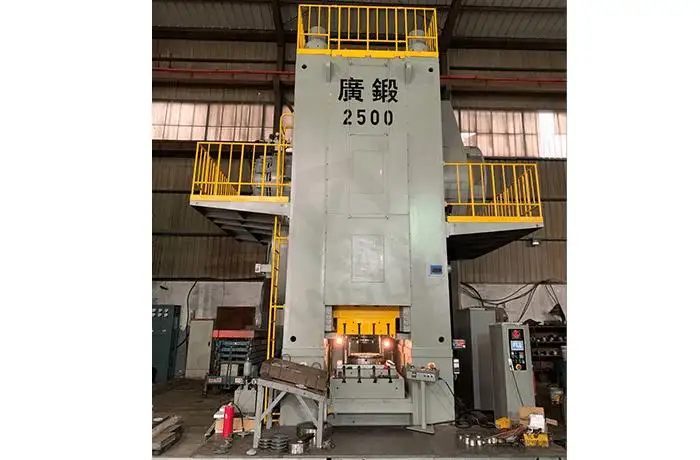
Understanding Heavy-Duty Crankshaft Press Frames
If you are new to press selection, start with the frame. The frame defines rigidity, alignment, service access, and installation effort. In a Heavy-Duty Crankshaft Press, those factors directly affect part accuracy, die life, and uptime.
Guangduan builds heavy-duty presses around a crank toggle (knuckle joint) mechanism. This architecture delivers a natural dwell near bottom dead center – about 1/18 of the cycle. That dwell gives more forming time under peak load. It stabilizes the die at the critical moment, which helps when forging crank webs, upsetting journals, fine stamping features, or performing precision extrusion on counterweights.
Integral and split frames both deliver strength. They differ in how that strength is assembled and preserved. Knowing the trade-offs helps you fit the press to your plant and your parts.
Integral Frame: When Rigidity and Accuracy Lead
What an Integral Frame Is
An integral frame is built as one solid piece. It is designed to keep the press columns, crosshead, and bed in fixed relation under heavy load. In practice, it minimizes deflection, preserves alignment, and resists vibration. That makes it the default choice when dimensional control and repeatability are the top priority.
Best-Fit Applications
Choose an integral frame when you need tight tolerances on crankshaft forms, small feature variation across large batches, and long die life. The stiffness reduces die misalignment and uneven wear. It also helps the press hold accuracy across shifts and seasons. In our range, most presses up to around 16,000 kN are integral because many shops can install them as one piece and benefit from the higher static rigidity. If your plant can accommodate the transport and floor loading, an integral frame is usually the simplest route to accuracy with fewer maintenance variables.
Split Frame: When Access and Installation Matter
What a Split Frame Is
A split frame is built in modular sections that bolt and pin together. It is engineered for transport in constrained routes and installation under tight floor-to-ceiling envelopes. The assembled frame still achieves high rigidity, but it offers different service and layout advantages.
Best-Fit Scenarios
Select a split frame when access is limited or when you plan frequent overhauls. It can be dismantled for major service, moved more easily between bays, and installed with smaller cranes. In some mid-capacity cases – such as around 12,000 kN – plants choose split frames to meet transport or doorway limits while still running heavy forgings. If your facility has structural constraints, a split frame may unlock capacity that an integral frame cannot practically deliver. With proper alignment and torqueing procedures, modern split frames reach repeatability targets comparable to integral designs.
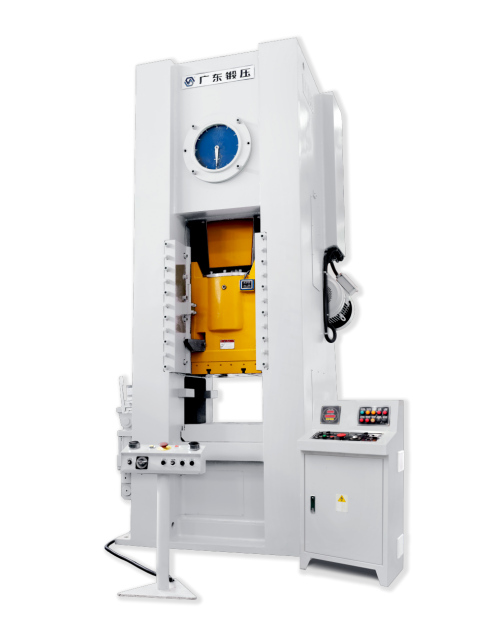
Capacity, Dwell, and Die Control: Data Behind the Choice
Capacity is the baseline. Guangduan heavy-duty knuckle joint presses cover roughly 6,300 – 25,000 kN, with bolster sizes from about 700×700 mm to 1200×1200 mm to fit typical crankshaft dies and extrusion tooling. As noted, most machines up to 16,000 kN are integral in our lineup, with specific exceptions configured as split to suit site conditions.
The crank toggle mechanism’s dwell of about 1/18 cycle enables cleaner shearing and more uniform metal flow in forging and extrusion. That gives you better surface finish at the fillet and web and reduces rework. A die height indicator with 0.01 mm display resolution helps your setup team hit target shut height and maintain it during changeover. A mechanical lower ejector is standard, a practical feature for removing hot parts and reducing cycle times without extra automation.
Clutch-brake options matter too. Guangduan offers pneumatic wet integrated clutch-brake systems for extreme duty runs and thermal stability, and pneumatic dry split clutch-brake designs for high-speed cycling and simpler service. PLC control manages motion, dwell timing, and interlocks, improving consistency, diagnostics, and operator safety. These controls make an integral or split frame press behave predictably across different jobs.
Practical Selection Checklist for Heavy-Duty Crankshaft Press Buyers
•Part Portfolio: Are you shaping full-length crankshafts, counterweights, or mixed forgings that require dwell at BDC?
•Tolerance Targets: Do you require fine stamping or precision extrusion features where 0.01 mm die height feedback supports repeatability?
•Die Life: Will higher rigidity and lower deflection reduce die wear and save tooling costs over the year?
•Plant Constraints: Do you have doorway, pit, crane, or route limits that favor a split frame for installation?
•Capacity Range: Is your required forming force within 6,300 – 25,000 kN, and does your bolster need fall between 700×700 and 1200×1200 mm?
•Changeover Rhythm: Do frequent die swaps benefit from PLC-managed setup and mechanical lower ejection to shorten cycles?
•Maintenance Strategy: Do you prefer one-piece rigidity with fewer joints, or modular sections that simplify deep service?
•Energy And Noise: Will a wet integrated clutch-brake reduce heat and noise in long runs, or does a dry split clutch-brake match your high-speed needs?
Why Choose Guangduan for Your Heavy-Duty Crankshaft Press
Guangduan crafts Heavy-Duty Crankshaft Press solutions calibrated for rigidity, serviceability, and control. Our engineering team helps you map the press to your plant constraints and part goals. We model deflection across the frame, recommend integral or split layouts, and match clutch-brake systems to your cycle demands. With the crank toggle mechanism and dwell control, you get reliable forming at bottom dead center, better surface quality, and more predictable die life.
We back every press with PLC-driven diagnostics, standard mechanical lower ejection, and precise die height indicators. We can support trials on representative crankshaft parts to verify throughput and dimensional capability before you commit.
Call to action: Talk to Guangduan today. Share your target capacity, bolster size, installation limits, and tolerance requirements. We will recommend an integral or split frame Heavy-Duty Crankshaft Press that fits your floor, protects your tooling, and lifts your productivity – then support you from commissioning to long-term service.
CONTACT US


Guangdong Metal Forming Machine Works Co., Ltd.
We are always providing our customers with reliable products and considerate services.
If you would like to keep touch with us directly, please go to contact us
-

Home
-

Tel
-

Email
-

Contact