
How Upset Forging Machine Shapes the Heart of the Automotive Engine
Introduction: The Most Challenging Engine Part
People usually think of pistons, valves, and crankshafts as the heart of the internal combustion engine, but connecting rods are also very critical. The connecting rod is a part of the engine that transfers the linear motion of the piston into rotary motion. Although connecting rods may look simple, they can withstand large tensile and compressive forces (several tons) per cycle, while they rapidly spin at several thousand times per minute. A failure of the connecting rod is catastrophic.
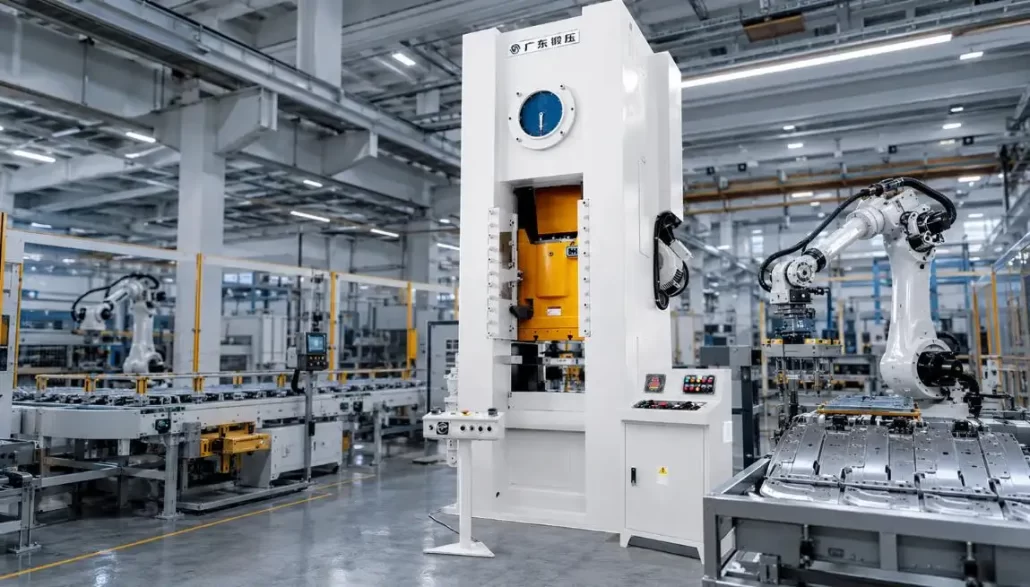
So how do manufacturers ensure each connecting rod is flawless, lightweight, yet immensely strong? The answer lies in upset forging technology. And at the forefront of this process stands the Upset Forging Machine Automotive solution from GUANGDUAN – specifically their GK Series Knuckle Joint Press.
What Is Upset Forging? A Quick Science Refresher
Unlike conventional stamping or casting, upset forging (also called heading or swaging) locally increases the cross-section of a metal bar by compressing its length. The metal is heated and then forced to flow into a die cavity, aligning the internal grain structure along the part’s contour.
For connecting rods, this is a game-changer. A simple machined bar would have cut grain boundaries – weak points. An upset-forged rod has continuous, unbroken grain flow, mimicking the part’s final shape. The result? Up to 30% higher fatigue strength.
✅ Key advantage: No material is wasted – upset forging delivers near-net shapes, reducing subsequent machining.
Why connecting rods are shaped by upset forging & not by casting or machining?
•Engine rods have integral properties that include;
•Ability to withstand high force and be durable.
•Superior fatigue resistance for millions of load cycles.
•Excellent impact toughness during sudden acceleration or knocking.
| Process | Grain Flow | Material Utilization | Fatigue Life |
| Casting | Random | High | Low |
| Machining (from solid) | Cut/Discontinuous | Very Low (chips) | Medium |
| Upset Forging | Continuous aligned | High (>90%) | Highest |
In practice, top automakers specify forged connecting rods for all turbocharged and high-performance engines – and increasingly for fuel-efficient downsized engines where every gram and every MPa matters.
How an Upset Forging Machine Automotive Works: Step by Step
A typical production line for connecting rods uses a hot upset forging process. Here’s the sequence:
•Bar heating – Steel alloy (e.g., C70S6) is induction-heated to ~1200°C.
•Shearing – A precisely cut billet is fed into the Upset Forging Machine Automotive.
•Upsetting – The billet is clamped in split dies, and a punch compresses it axially, causing metal to bulge into wider cavities – forming the big and small ends.
•Trimming & piercing – Flash is trimmed; the wrist pin hole and crank bore are rough-formed.
•Heat treatment and finishing – Normalizing, shot blasting, and final machining guarantee precise dimensions.
Throughout this process, the forging press’s rigidity, stroke control, and dwell time at bottom dead center (BDC) determine final quality. That’s where GUANGDUAN’s GK Series excels.
GUANGDUAN GK Series Knuckle Joint Press: Engineered for Automotive Upset Forging
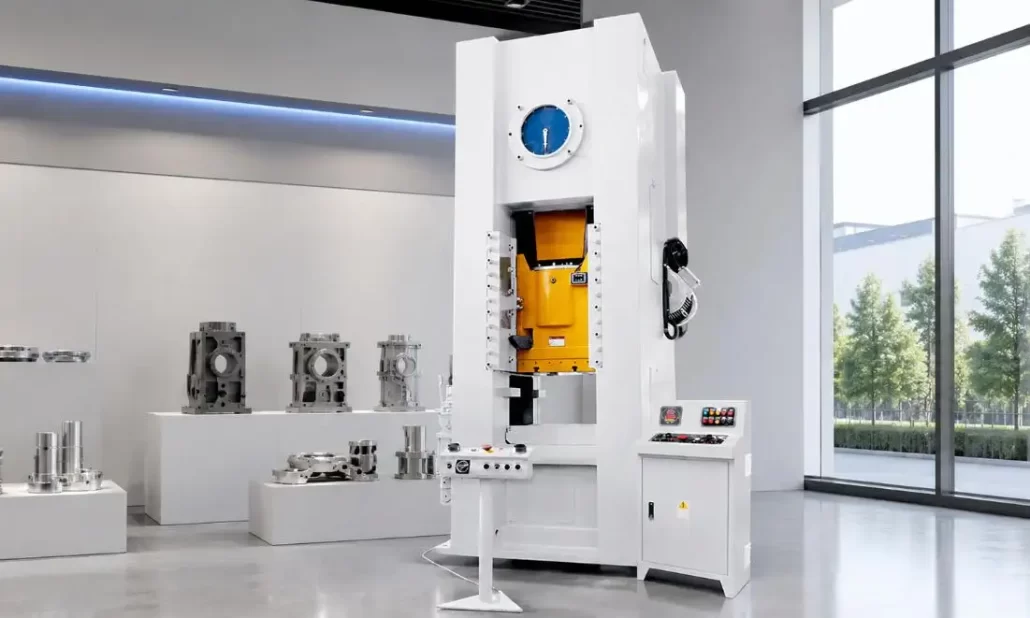
GUANGDUAN has designed its GK Series specifically for precision stamping and extrusion – tasks that include upset forging of connecting rods, ball joints, and other automotive safety parts. Let’s break down why this Upset Forging Machine Automotive solution stands out.
Capacity & Build – For Demanding Production
•Wide capacity range: from 6300 kN to 25000 kN (GK-630 to GK-2500 models). This covers everything from compact car rods to heavy-duty truck components.
•Bolster size (mm): 700×700 up to 1200×1200 – accommodating multi-impression dies for high-output forging.
•Integrated vs. split structure:
4000–16000 kN presses → integral structure for maximum rigidity.
12000 kN press → split structure for easier transport and maintenance in large plants.
Clutch & Brake – Reliable and Responsive
•GK-630 series: Pneumatic wet integrated friction clutch/brake – smooth engagement, less wear.
•GK-800 to GK-2500: Pneumatic dry split friction clutch/brake – higher torque capacity, ideal for heavy upsetting loads.
The Crank-Toggle Mechanism – A Key Advantage for Forging
Unlike conventional crankshaft presses, the GK Series uses a crank-toggle (knuckle joint) mechanism. This design allows the slide to dwell at the bottom dead centre for approximately 1/18 of the cycle.
•Why does that matter for upset forging?
The punch press applies peak pressure on the billet during dwelling, enabling the metal to completely fill the corners of the die before the metal retracts. This reduces internal voids and improves dimensional accuracy, a factor necessary for maintaining roundness in the big-end bores of a connecting rod.
Control of Die Height and Ejection
•The height control die ejection measurement tools achieve a precision level of up to +/- 0.01 mm. Operators can set and repeat die closure within microns, ensuring every rod has identical thickness and bore position.
•Mechanical lower ejector device – standard on all GK presses. After upsetting, the part is positively ejected, avoiding sticking or distortion.
Smart Controls – PLC Integration
The entire press is PLC-controlled, enabling:
•Real-time monitoring of tonnage, stroke, and temperature.
•Programmable slide motion for different forging stages.
•Data logging for ISO/TS 16949 traceability.
This intelligence turns the GK Series into a true Industry 4.0-ready Upset Forging Machine Automotive asset.
Real-World Results: What GUANGDUAN Brings to Your Forging Line
Automotive suppliers choosing the GK Series for connecting rod production report:
•Scrap rate reduction – from typical 3-5% to under 1.5% due to precise dwell and ejection.
•Die life extension – smoother load-unload cycle reduces thermal-mechanical fatigue on tooling.
•Energy savings – optimized clutch engagement lowers compressed air consumption by ~18% vs. older designs.
Conclusion: Upset Forging + GK Series = Reliable Engine Hearts
The connecting rod may be a silent worker, but its failure is deafening. By choosing the right Upset Forging Machine Automotive – specifically GUANGDUAN’s GK Series Knuckle Joint Press – manufacturers gain:
•Continuous grain flow for superior strength.
•High material yield (less waste, lower cost).
•Repeatable precision thanks to 0.01 mm die height control and BDC dwell.
•Flexible capacity from 6300 kN to 25000 kN.
•PLC intelligence for modern quality management.
Whether you’re forging connecting rods for a family sedan or a heavy-duty truck, the GK Series gives you the stiffness, accuracy, and reliability that upset forging demands. After all, a car’s heart deserves nothing less.
Frequently Asked Questions
1. Why is upset forging better than casting for engine connecting rods?
With upset forging, the internal flow of the metal’s grains is aligned with the shape and length of the rods. Therefore, upset forged rods have better strength and resistance to fatigue and better resistance to impact loads. When metals are cast, the grains are oriented randomly, and this may result in premature failure of the rods when used in high engine loads.
2. What is the tonnage coverage of the GUANGDUAN GK Series for automotive forging?
Coverage for the GK Series is from 6,300 kN to 25,000 kN. The models from 4,000 kN to 16,000 kN have a combined structure, while the 12,000 kN model possesses a separated structure, which accommodates varied capacities of production.
3. In what ways does the knuckle joint mechanism improve the quality of the part?
With the crank-toggle mechanism, the slide remains at bottom dead centre for a duration equivalent to about 1/18 of the cycle. Due to the extended dwell time, the cavity becomes completely filled, which eliminates voids and enhances the quality of the features of the die, such as the big-end bore.
4. Can the GK Series be used for automated forging lines?
Absolutely. Each press in the GK Series is PLC controlled, and therefore, can easily accommodate the use of automated robotic loaders, induction heaters, and trimming stations. Such versatility is advantageous for the mass production of components for the automotive industry, as part of the Industry 4.0 paradigm.
5. What are the benefits of the GK-800 to GK-2500 dry split clutches with respect to maintenance?Compared to wet clutches, dry split clutches have a higher torque capacity. They also provide easier inspection and replacement. Hence, the maintenance involved in upset forging becomes less burdensome and provides less downtime.
CONTACT US


Guangdong Metal Forming Machine Works Co., Ltd.
We are always providing our customers with reliable products and considerate services.
If you would like to keep touch with us directly, please go to contact us
-

Home
-

Tel
-

Email
-

Contact