
Automotive Forging Equipment Guide: How Flexible Production Supports Modern Auto Parts Manufacturing
Automotive Forging Equipment Guide is becoming less about choosing a press for one part family and more about building a forging line that can adapt to changing vehicle programs, tighter quality targets, and more automated production flows. For overseas buyers, the pressure is clear: automotive suppliers now need equipment that can support mixed production needs, faster setup response, and stable forming quality without turning every model change into a production risk.
That shift is happening for a reason. Global vehicle manufacturing is changing quickly, especially as electric vehicle output grows and part portfolios continue to evolve. The IEA reported that global electric car sales exceeded 17 million in 2024 and are expected to exceed 20 million in 2025, which means manufacturers are working in a market where model mix, platform strategy, and component requirements are moving faster than before.
Why Flexibility Has Become a Real Forging Pain Point
In the past, many forging investments were judged mainly by force capacity, speed, and basic output expectations. Today, that is no longer enough. Automotive suppliers are under pressure to handle more production variation while still protecting consistency, throughput, and operator safety.
That is especially relevant in a sector where materials, structures, and platform demands keep changing. WorldAutoSteel’s latest Advanced High-Strength Steel guidance highlights how the automotive industry is working with a broader and more sophisticated range of modern steel grades than just a few years ago, reinforcing the need for forming systems that can support more precise and controlled production conditions.
For many plants, the challenge is not whether a forge press can complete a stroke. The real challenge is whether the press can do all of the following in one production environment:
• Hold accuracy across repeated runs
• Support faster setup and die adjustment
• Fit into automated feeding and handling layouts
• Stay stable during demanding forming stages
• Adapt to different part requirements without excessive downtime
This is where a modern forge press creates value. It reduces friction between output targets and real shop-floor complexity.
What a Forge Press Contributes to Automotive Production
A forge press shapes metal by applying controlled pressure through a vertical ram onto a workpiece held in a die. Compared with hammer-style forging, this slower and more deliberate forming action allows deeper penetration into the material and more uniform plastic deformation.
That matters in automotive applications because the process can support:
• Stronger grain flow and improved strength-to-weight performance
• Reduced metallurgical defects such as porosity and segregation
• Better dimensional consistency for downstream machining
• Lower material waste than more subtractive production routes
• Better suitability for repeated, high-volume component production
For automotive manufacturers, these benefits are relevant across a wide range of parts, including fasteners, valves, bearing races, brake-related hardware, and many other metal components.

Why Modern Buyers Want Automation-Ready Equipment
The automotive industry is asking more from production systems than before. Equipment now needs to work as part of a broader digital and automated manufacturing logic, not as an isolated machine.
NIST’s smart manufacturing program emphasizes standards, best practices, and trusted approaches that help manufacturers adopt connected and model-based production more confidently. NIST also noted in its 2025 manufacturing outlook that automation and predictive maintenance are becoming more important because they help manufacturers improve accuracy, streamline repetitive work, and reduce costly downtime.
For forging buyers, that means equipment selection increasingly depends on questions like these:
• Can this machine support automatic feeding devices?
• Can it integrate more smoothly into line-based production?
• Can operators change setup efficiently across different jobs?
• Does the control structure support more consistent operation?
• Will the machine still perform well when production complexity rises?
These are not secondary concerns. They directly affect labor efficiency, uptime, and long-term return on investment.
How GUANGDUAN Supports Flexible Automotive Forging
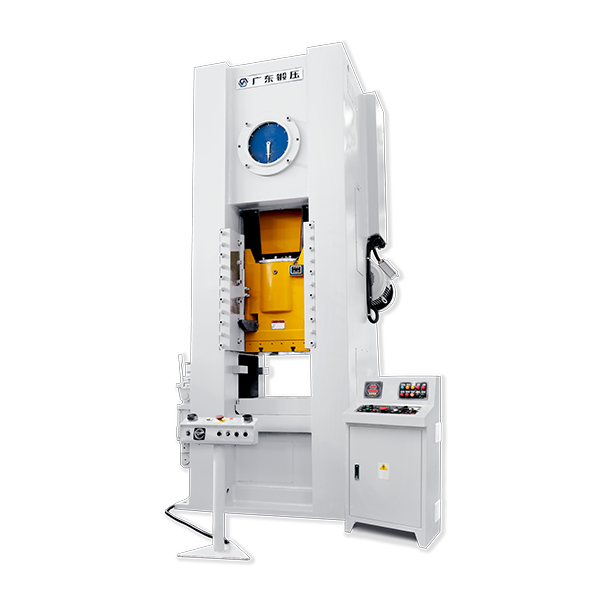
GUANGDUAN’s forge press solutions are well matched to this market direction because they address both forming performance and production adaptability.
- Closed Type Single Point Forge Press Machine JH31 Series
The JH31 Series range answers the flexibility related concerns for JH31 Series users.
The machine is purposely designed for high rigidity, so its monolithic box-type construction will help the machine remain stable under harsh working conditions. The eccentric shaft construction features large supportive capacities, while the four-surface full-guideway construction enhances guiding precision and retaining fidelity. In practical terms, this supports repeatable slide movement and helps maintain more stable production performance over time.
Several configuration details are especially relevant for automotive buyers:
• Mechanical die height adjustment with digital display
• Easy and rapid die calibration
• PLC and pneumatic combined control mode
• Continuous, single, and micro-motion stroke options
• Optional photo-electric protection
• Optional automatic feeding and uncoiling leveling devices
These features make the JH31 series attractive for factories that want to improve consistency today while preparing for more automation tomorrow.
- Knuckle Joint Press GK Series
The GK series is a strong fit for buyers that need better forming control in fine stamping and extrusion applications.
Its crank-toggle mechanism allows the slide to dwell near bottom dead centre for around 1/18 of a cycle. That motion characteristic is highly valuable in operations where controlled forming at the most critical point of the stroke can influence part precision, material flow, and process repeatability. The die height indicator accuracy of 0.01 mm also supports more precise setup and adjustment, while PLC control improves usability and production discipline.
For overseas distributors and procurement teams, this means the GK series is not simply a heavy-capacity machine. It is a press designed to support more demanding and more controlled forming tasks.
Why This Matters for Future Automotive Programs
As vehicle platforms diversify and electrification continues to expand, suppliers need production systems that can handle more variation without becoming harder to manage. The IEA’s 2025 outlook makes it clear that the pace of EV growth remains strong, and that puts more pressure on component manufacturers to stay responsive in both capacity planning and process capability.
At the same time, smart manufacturing practices are moving from discussion to implementation. NIST’s work around connected manufacturing systems and digital-thread thinking reflects the broader direction of industry: equipment must be ready to operate inside more traceable, data-aware, and automation-friendly environments.
That is why flexible press design matters so much. A forge press that supports stable guidance, fast setup response, and automation-ready options is better positioned for future automotive demand than one selected only for peak force.
Final Thoughts
The best Automotive Forging Equipment Guide for today’s buyers is not centered on one specification. It is centered on adaptability. Automotive suppliers need forging equipment that can support changing part programs, reliable forming quality, safer operation, and a smoother path toward automation.
GUANGDUAN’s JH31 series and GK series show how that requirement can be addressed in practice. By combining structural rigidity, guiding precision, practical control systems, and automation-compatible configurations, GUANGDUAN helps manufacturers respond to the real direction of the market: more flexible production, better operational control, and forging capacity that fits modern automotive manufacturing rather than yesterday’s assumptions.
CONTACT US


Guangdong Metal Forming Machine Works Co., Ltd.
We are always providing our customers with reliable products and considerate services.
If you would like to keep touch with us directly, please go to contact us
-

Home
-

Tel
-

Email
-

Contact