
How to Evaluate a Crankshaft Press Manufacturer
Two suppliers can quote presses with the same nominal capacity; but, only one might be appropriate for the crankshaft process. The variations in the deflection of the frame, slide guidance, usable force, die space, ejection and automation can make the difference between whether the project will enter stable production or not.
Choosing a crankshaft press manufacturer should therefore be an engineering audit – not a tonnage and purchase price comparison.
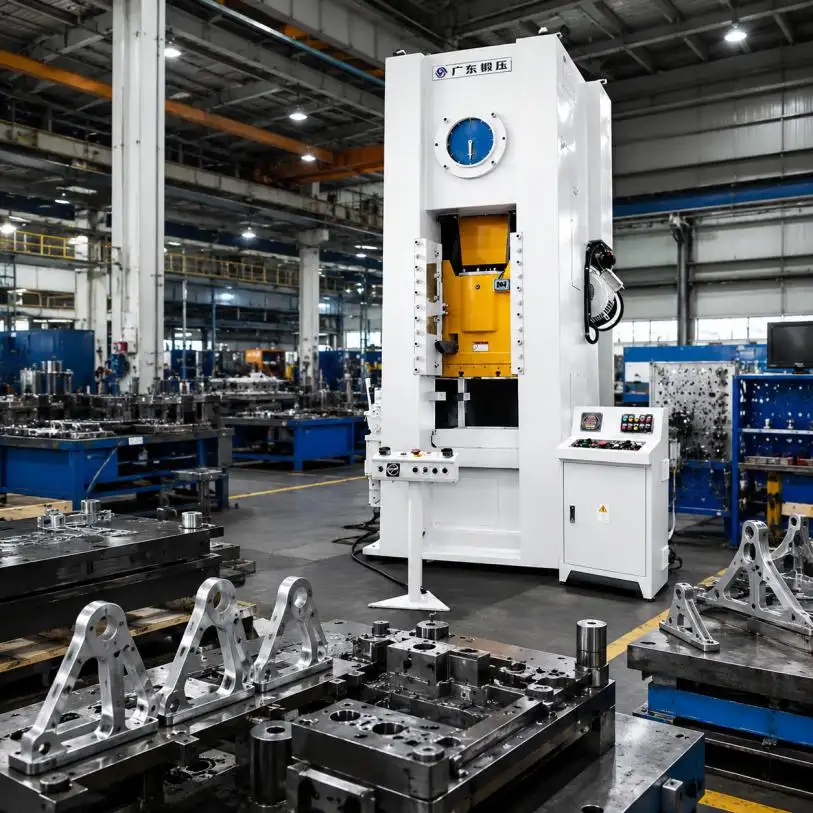
GUANGDUAN is established in 1958, design and manufacture mechanical, hydraulic and forging presses. It has a company profile that covers over 60 years of experience in press building and its machining and measurement resources.
Explain the meaning of ‘crankshaft press’.
Can refer to two different pieces of equipment.
In a crank-driven industrial press, a crankshaft is used to transform the rotary drive motion to linear motion of the slide. This can be used for cold extrusion, coining or stamping or precision forming.
A crankshaft forming or assembly press is a press that is used specifically for the production, calibration, straightening, fitting bearings or assembling of the component parts of an engine crankshaft.
The Buyer shall declare:
- Component being manufactured
- The forming, straightening or assembly process of metal objects.
- The original material / the initial situation
- The force, and the length of the stroke, needed to use the muscle.
- Die/fixture concept
- Annual production volume
- Dimensional acceptance criteria
If this is not clarified, it’s possible that suppliers will be able to offer technically different machines with the same name.
Start the Manufacturer Audit With the Process Route
An excellent crankshaft press manufacturer will ask for more than just a completed parts drawing.
Access to an engineering review may require the following for forged crankshafts:
- Billet or preform drawings or sketches are not required.
- Grade of material, temperature.
- Operation sequence
- Projected forming area
- Load–stroke curve
- Länge und Gewicht
- Temporary fill in and removal technique.
- Ejection requirements
In such uses as straightening or assembly, the manufacturer should instead request force–displacement limits, support-point locations, bearing fits, and shaft runout and requested data recording.
A supplier, which recommends a machine without understanding the process route, brings unnecessary technical risk.
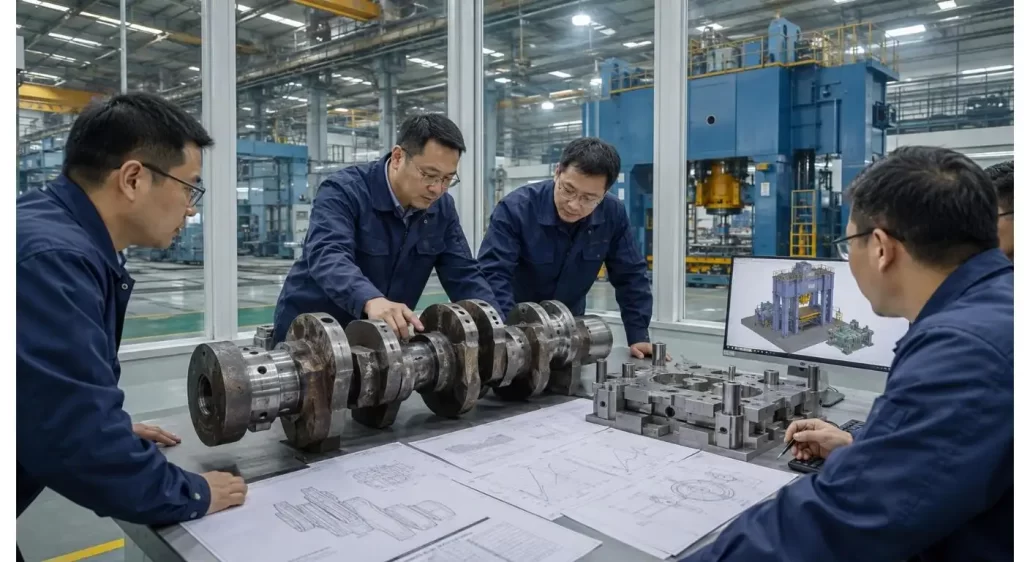
Checks if the force is verified where it is needed in the process.
The nominal press capacity is not a true measure of the forming capacity. Mechanical crank press offers varying pressure at various slide positions and hydraulic press offers controlled pressure over a longer stroke, but may have different production rate.
The manufacturer should check:
- Rated force position
- Peak forming/assembly load
- Energy per stroke
- Load duration
- Working stroke
- Cycle-time requirement
- Safety margin
- Overload-protection strategy
The crank-driven mechanism, defined bottom dead center and its use in precision extrusion and forming are explained in GUANGDUAN’s industrial crankshaft press guide.
The technical proposal should explain the reason for the chosen drive for the process and not just provide the next tonnage available on the machine.
Due to crankshaft geometry, there are different loads on the crank.
Crankshafts feature offset journals, counterweights and long asymmetric features. In the forging or calibration process, the pressure center and the machine center may not overlap.
Deflection that is too large can impact:
- Die-parting alignment
- Journal position
- Web thickness
- Shaft straightness
- Flash distribution
- Tool wear
Contact the manufacturer to request the allowable eccentric-load envelope and calculated or measured frame, slide and bolster deformation.
GUANGDUAN’s heavy-duty crankshaft press frame guide talks about integral and split structure of high capacity knuckle-joint press.
Just the frame type is not enough – loaded alignment and production trials are more helpful.
Assess Reviewing and Die Space and Ejection at the same time
The slide guidance ensures proper alignment of upper and lower tools and the working area indicates if the entire die and part handling system will fit.
The manufacturer should certify:
- Bolster and slide dimensions are crucial for the proper back support.
- Maximum die height
- Slide adjustment
- Working stroke
- Guide arrangement
- Side openings and openings in the side walls.
- Upper and lower ejector
- Part-removal direction
- Die-change method
If long crankshaft parts are required, they may require large handling clearance. During ejection the component should not be bent or damage to a journal or interference with the next transfer movement should not occur.
Review the Manufacturers Production Resources
Heavily machining & inspection capabilities are needed for a large one press frame, slide, crankshaft and gear set. While not necessarily bad, outsourcing should have clear ownership and quality responsibility.
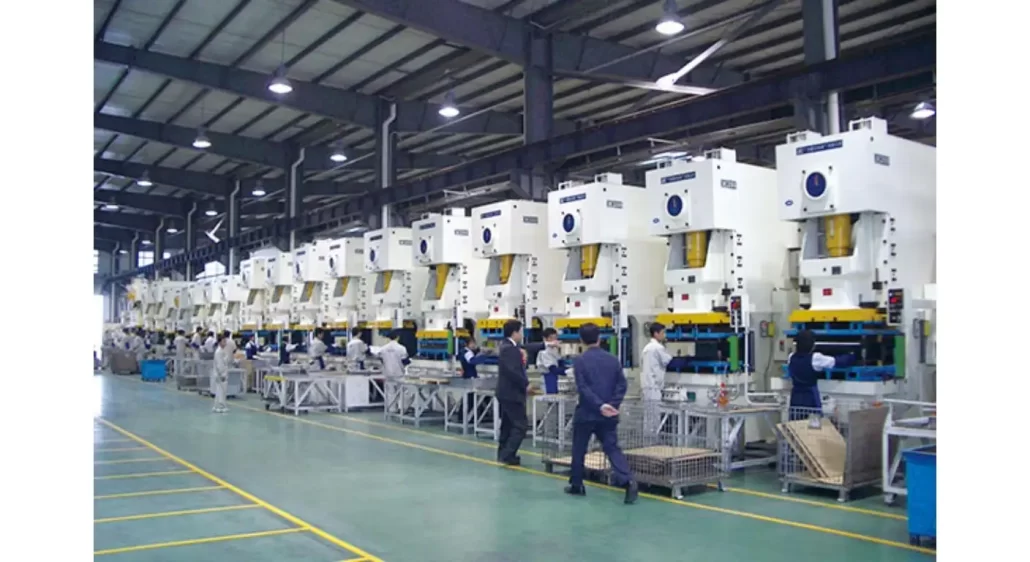
Audit evidence can comprise of:
- High capacity boring and milling on large CNC’s
- Machining of crankshafts, gears
- Welding and stress relief in frame.
- Slide and bolster machine operations
- Coordinate measurement
- Laser-tracker inspection
- Material traceability
- Assembly and load-testing facilities are available for this use.
The About Us page of GUANGDUAN introduces more than 30,000m² manufacturing site, more than 200 major production equipment and more than 1,000 measurement and testing equipment.
The buyer is to rely on these resources, not just the fact of the size of the factory.
| Quotation Item | Included Scope to Confirm | Common Hidden Gap |
| Main press | Frame, drive and controls | Incomplete auxiliary systems |
| Tool handling | Ejector and die-change equipment | Manual handling assumed |
| Automation | Robot and peripheral interfaces | Integration assigned to buyer |
| Installation | Supervision and alignment | Travel or lifting excluded |
| FAT | Load method and trial material | Only no-load testing included |
| Documentation | Drawings, backups and manuals | Limited maintenance information |
Prior to manufacturing, request a Design Review.
An engineering review by the supplier should be provided, covering:
- Press architecture
- Load path
- Frame analysis
- Slide-guidance design
- Main drive
- Clutch and brake
- Lubrication
- Ejection
- Automation interfaces
- Foundation loads
- Safety concept
When reviewing a crankshaft machine the reviewer should be able to see how the machine deals with the actual pressure center and transfer direction for crankshaft production.
Crankshaft Forging Machine Overview – Process Stability and Die Protection and Traceable Output from GUANGDUAN.
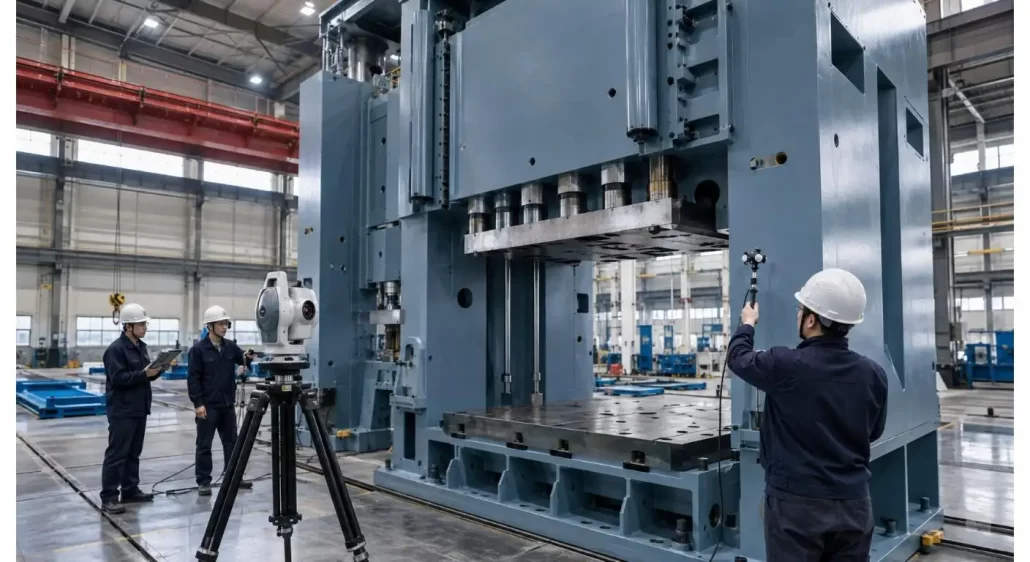
The purpose of FAT is to be reproduced, and this is a must.
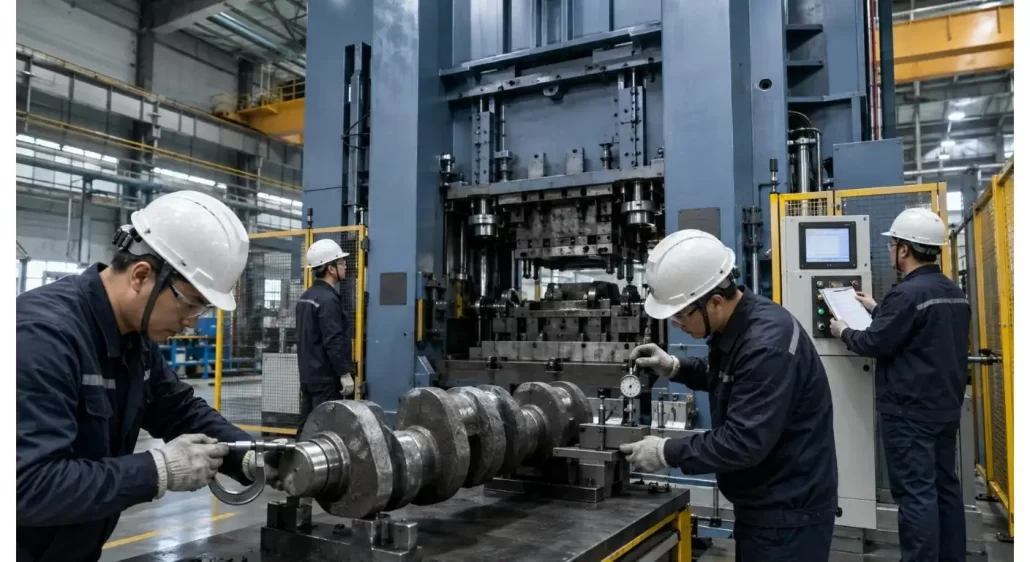
The no-load test is useful to demonstrate that the slide can move, but not that the machine can produce acceptable crankshaft parts.
The following should be checked by factory acceptance testing:
- Geometric accuracy
- Loaded deflection
- Force/load behaviour.
- Slide-position repeatability
- Ejection
- Continuous cycle time
- Automation communication
- The overload and safety response functions.
- Trial-part dimensions
- Fault recovery
If no production tooling is available, the manufacturer should utilize an agreed load test method that will simulate the force and conditions of the pressure center.
The FAT document should include specification of measurement equipment, acceptable ranges and who is responsible for corrections.
Analyse Automation as a Fully-fledged Cell
The processes of a crankshaft production cell can consist of billet heating, descaling, lubrication, robotic loading, preforming, final forming, trimming, ejection and inspection.
Through the press manufacturer, it is necessary to define:
- Interface boundaries
- Communication protocols
- Cycle sequence
- Part-presence detection
- Transfer-clearance conditions
- Alarm ownership
- Reject handling
- Restart logic
Uncertainty of responsibility between the press and the supplier of robot and furnace can cause delay in the process of commissioning. A single line specification for coordination should be designated for the entire cycle.
Documentation and Support has an impact on Lifecycle Cost.
The final quotation should include: which documents/services are included:
- General arrangement drawing
- The requirements for foundations and utilities.
- Hydraulic, pneumatic and electrical diagrams are used to describe the function of the system.
- Spare-parts list
- Preventive-maintenance schedule
- PLC backup
- Installation and commissioning
- Training for operation and maintenance
- Technical assistance by remote or on site.
- Warranty scope
Further information about crankshaft forming, fit and application to engines is provided by GUANGDUAN’s crankshaft press for the automotive industry.
| Quotation Item | Included Scope to Confirm | Common Hidden Gap |
| Main press | Frame, drive and controls | Incomplete auxiliary systems |
| Tool handling | Ejector and die-change equipment | Manual handling assumed |
| Automation | Robot and peripheral interfaces | Integration assigned to buyer |
| Installation | Supervision and alignment | Travel or lifting excluded |
| FAT | Load method and trial material | Only no-load testing included |
| Documentation | Drawings, backups and manuals | Limited maintenance information |
Final Supplier Decision
A competent crankshaft press producer should convert the part/process information into a defensible machine setting, produce vital structures to an acceptable precision and demonstrate performance through agreed acceptance tests.
By reading crankshaft drawings and tooling, loads and production targets, GUANGDUAN can make an application-based press proposal, and also provide manufacturing, testing and commissioning.
FAQ
Q1. What information do a crankshaft press manufacturer require?
State all of the following: Part, Process, Material, Force, Stroke, Tooling, Volume of Production. Other times, force displacement and runout evaluations might also be necessary for assembly applications.
Q2. Which is better, mechanical or hydraulic crankshaft press?
Mechanical presses are ideal for repeatable high volume forming. Hydraulic presses offer a choice of force, speed and stroke for assembly, calibration or longer cycle forming.
Q3. Why is it important to have an eccentric-load capacity?
Asymmetric loads as a result of crankshaft geometry. Slide tilting, die misalignment and dimensional variation can be caused by insufficient resistance.
Q4. What should be put in FAT?
FAT should check for Geometry, loaded perform, ejection, cycle time, controls, Safety and Trial part quality. Acceptance limits to be agreed prior to manufacture.
Q5. How to compare Crankshaft Press Manufacturers?
Ensure that all suppliers have the same RFQ and acceptance criteria. Look beyond price and consider engineering evidence, manufacturing resources and scope and lifecycle support.
CONTACT US


Guangdong Metal Forming Machine Works Co., Ltd.
We are always providing our customers with reliable products and considerate services.
If you would like to keep touch with us directly, please go to contact us
-

Home
-

Tel
-

Email
-

Contact