
Cold Metal Forging Press Selection by Process Load
Cold forging is capable of manufacturing components with a precise geometry, minimal material losses and a smooth surface. But the non-recrystallization heating in forming metal also means an increase in flow stress which leads to an increase in loads and severe pressure at the die–workpiece interface.
A cold metal forging press, therefore, needs to not only have high capacity, but also be able to ensure controlled movement, die alignment, lubrication, and ejection.
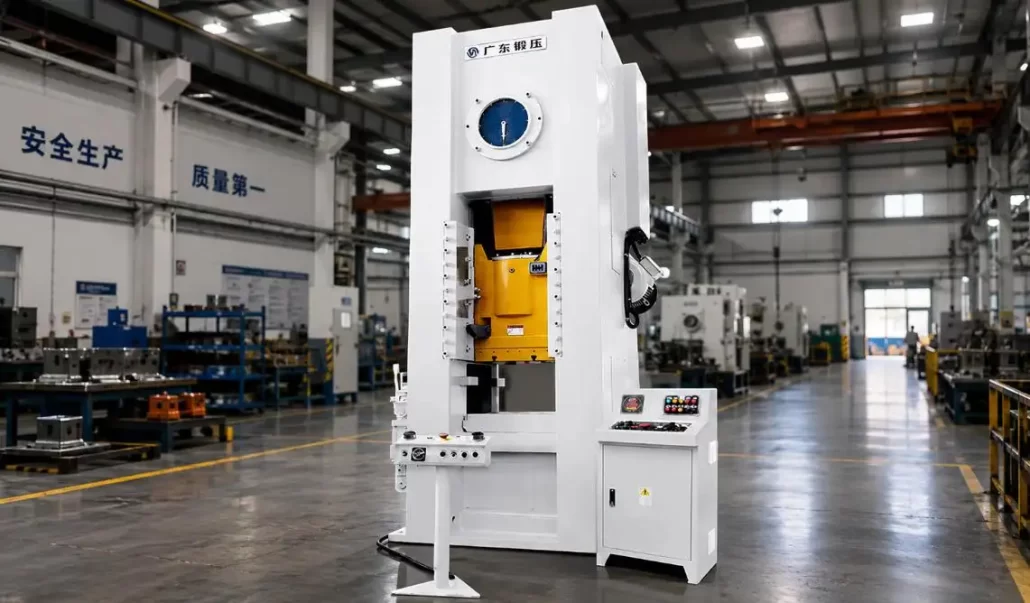
GUANGDUAN is engaged in providing forge press equipment to cold, warm and hot forming. Material, reduction ratio, operation sequence and production volume, must be considered and the correct solution must be selected.
The process of cold forging involves transforming the shape of the material by way of applying pressure.
Cold Forging is the forging process that is typically done at or near room temperature. As the material is plastically deformed it work-hardens. The strength will increase but so will the force needed for further deformation of the material.
Typical products that are cold forged are:
- Bolts, rivets and fasteners are all examples of permanent fasteners.
- Bearing races
- Splines and gears preforms
- Shafts and pins
- Metal cups and sleeves are used to prevent the bleeding.
- Flanges and fittings
- Automotive transmission components
Unlike many hot-forming operations, cold forging can lead to less machining, but is less tolerant of inappropriate billet volume, inadequate lubrication and misalignment.
When manufacturing cold forging press, the guide of GUANGDUAN is that the rigidity of the frame structure, the guidance of the slide and the protection of the die under concentrated loads are important.
This article investigates the material formability of the process route.
Not all alloys or geometry is possible to be cold forged in one shot. The ductility and the forming load is influenced by material grade, previous heat treatment, microstructure and surface condition.
Process engineer to consider:
- The type of material and hardness of the material
- Billet annealing condition
- Surface preparation
- Maximum area reduction
- Risk of cracking
- Work-hardening between stages
- Need for intermediate annealing
These are typically low-carbon steels, selected alloy steels, aluminum and copper alloys, but each material must be processed within a material-specific process window.
If the total deformation is greater than the deformation of one stroke, the part should be divided into an upsetting, forward extrusion, backward extrusion, heading or coining and sizing operations.
Preforming Controls Die Stress and Peak Load
Only the final cavity of a cold-forged component should not be used in designing. Material should be spread slowly to avoid the need for a lot of flow over a long distance by later operations.
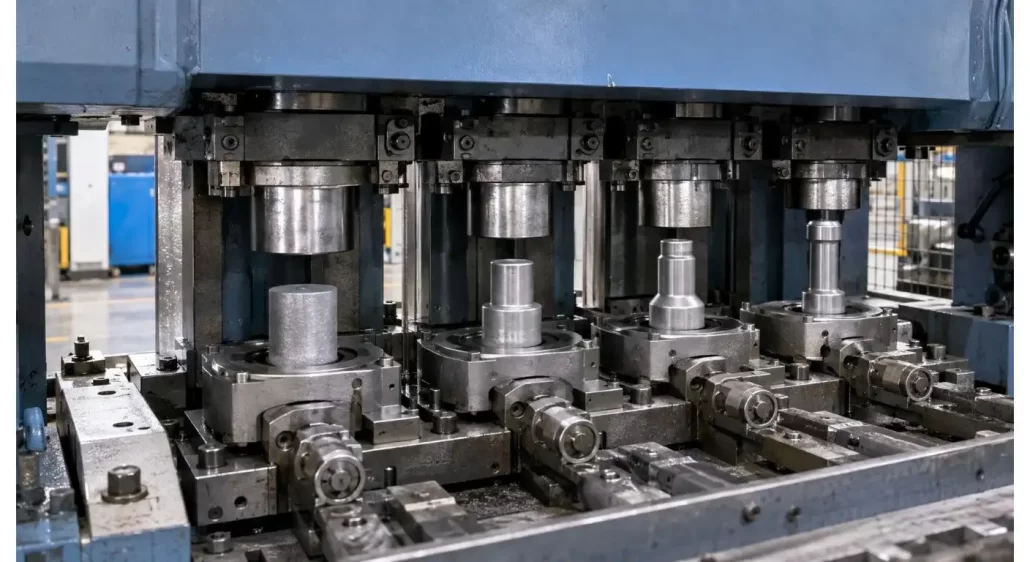
A multi-stage route could:
- Minimize “bursts” per operation.
- Improve cavity filling
- Avoid excessive folding/cracking
- Balance die pressure
- Control grain flow
- Improve tool life
Volume is a key aspect of billets. Too much material can cause very high pressure upon closing the cavity and too little material results in underfill.
The equipment RFQ should therefore not only contain the finished drawing, but also the billet, preforms and final part.
| Cold-Forging Operation | Material Movement | Main Process Risk |
| Upsetting | Increases billet diameter | Buckling or surface cracking |
| Forward extrusion | Material flows with punch direction | High punch load |
| Backward extrusion | Material flows around the punch | Punch wear or breakage |
| Heading | Forms an enlarged head | Off-center material flow |
| Coining | Defines fine surface geometry | Extreme contact pressure |
| Sizing | Calibrates final dimensions | Overload from excess material |
Capacity Must Follow the Complete Load – Stroke Curve
When the maximum amount of cold forging force is anticipated, it is at the end of the stroke where the material is getting harder and there is less flow space.
When choosing the equipment, attention should be paid to:
- Peak forming load
- On which day of the week was the peak load?
- Forming energy
- Load duration
- Number of Die Stations that are in use
- Ejection force
- Off-center load
- Engineering safety margin
Even if the nominal capacity of a press is high, there may be lack of energy and/or allowable force at the desired stroke position.
GUANGDUAN’s GK knuckle-joint press machine features a crank-toggle mechanism with 6300-25000KN capacity, the crank-toggle machine will dwell near the bottom dead center for about 1/18 of the cycle. This movement applies to a cold extrusion, coining and final sizing.
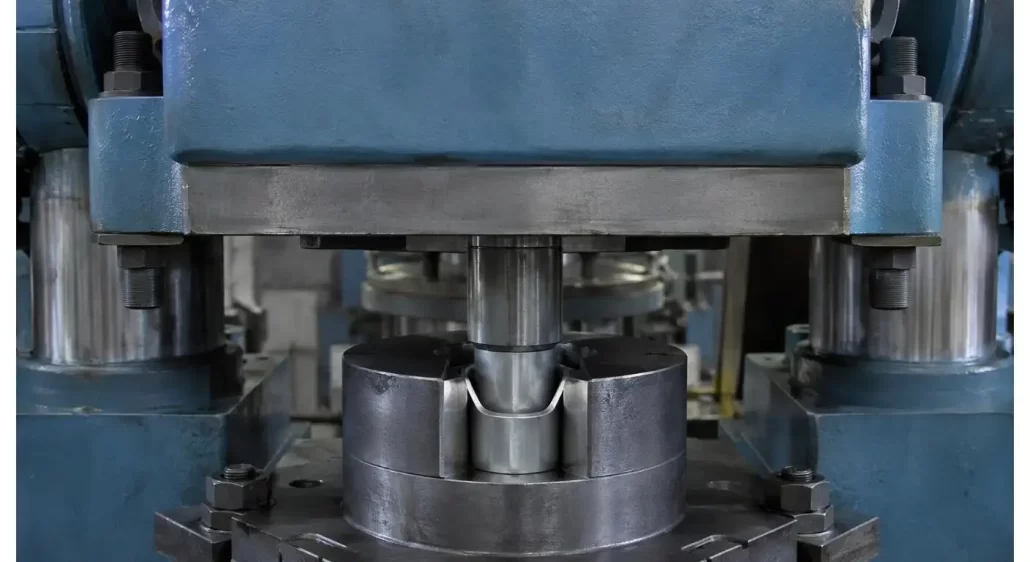
Cold Forging Dies Are Kept Aligned by Rigidity.
The loads during cold-forging are more localized in a small area of the tool. The slide tilt or deflection may cause punches or dies to become misaligned, resulting in uneven wall thickness, eccentric features or punch breakage.
Review:
Frame structure
Slide-guidance arrangement
Strengthen and flex motion of the toes.
Punch-to-die alignment
Permitted eccentric load
Loaded parallelism
Foundation stiffness
A closed frame will usually be more rigid than an open frame, but this will depend on the dimensions of the frame, the guidance and the deformation that has been verified.
GUANGDUAN’s JH31 is a closed-type single point press, which is a monolithic box-type body, eccentric-shaft crank and four-surface slide guideway press.
Lubrication is a load control variable, similar to the other lubrication variables.
The functions of cold-forging lubrication are to decrease friction, to avoid the pickup of material and to keep the work piece away from the surface of die. An unstable coating can lead to an increase in load and to scratching, poor filling or early die failure.
The process plan needs to specify:
- Cleaning and surface preparation work will be done on-site using a water-recovering system.
- Lubricant type
- Thickness of coating or amount of application
- Drying condition
- Reapplication frequency
- Ability to work with downstream cleaning.
- Lubrication monitoring
The choice of lubricant is dependent upon the material and extent of the deformations. Should be verified during production and not only by visual coverage.
When it comes to tooling, it must be able to withstand high contact pressure.
Cold-forging dies are subjected to compressive pressure, cyclic stress and local tensile stress at corners and inserts.
As part of the tooling design, the following may be needed:
- Prestressed die inserts
- Suitable carbide or tool-steel grades are available for the construction of the cutting tools.
- Smooth material-flow transitions
- Controlled corner radii
- Replaceable punches & inserts
- Accurate die alignment
- Cooling where necessary
Track the life of tools as well by operation as the first extrusion station and the final sizing station can fail for different reasons.
Several strokes with an increase of load may be used to determine if the lubricant is failing, there is a material change or if die damage is occurring.
Ejection Can Be a Restriction on Production Cycle
If the punch or die is cold forged, it can hold onto the punch or die due to the effect of elastic recovery and large contact surface area. Unstable ejection can cause damage to parts or to cause the automation to stop or allow a part to be ejected that would be needed for the next stroke of the die.
The ejection system must be the same as:
- Required release force
- Ejector stroke
- Part geometry
- Ejection timing
- Pickup position
- Robot or transfer sequence can be used to insert the parts.
According to GuangDUAN’s article on the industrial crankshaft press design, controlled lower ejection is helpful in removing the parts and protecting the die in the cold-forming process.
Preserving Billet Orientation is Essential for Automation.
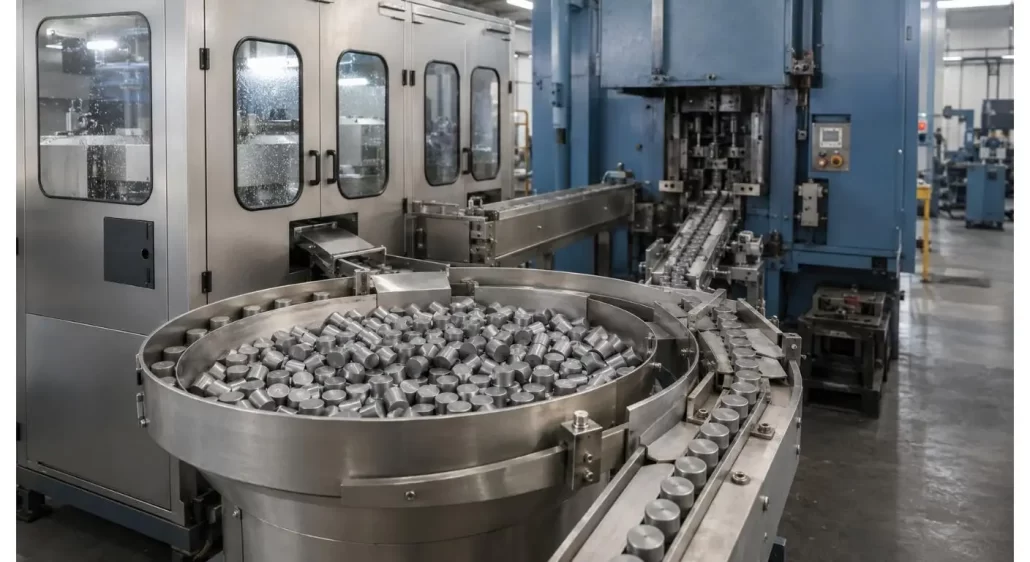
Automatic cold-forging lines can be comprised of billet cutting, billet feeding, billet orientation, billet lubrication, billet transfer, billet forging, billet ejection and billet inspection.
Sensors should verify:
- Billet presence
- Correct orientation
- Feed completion
- Die-area clearance
- Part ejection
- Lubrication status
- Forming overload
- Reject segregation
The press should not stroke if the billet is missing, doubled or not in position. Fault recovery must also be such that an untracked part is not allowed to re-enter the process.
Compare and validate the Process in Parts.
If a part is good, it does not mean that the cold-forging process is stable.
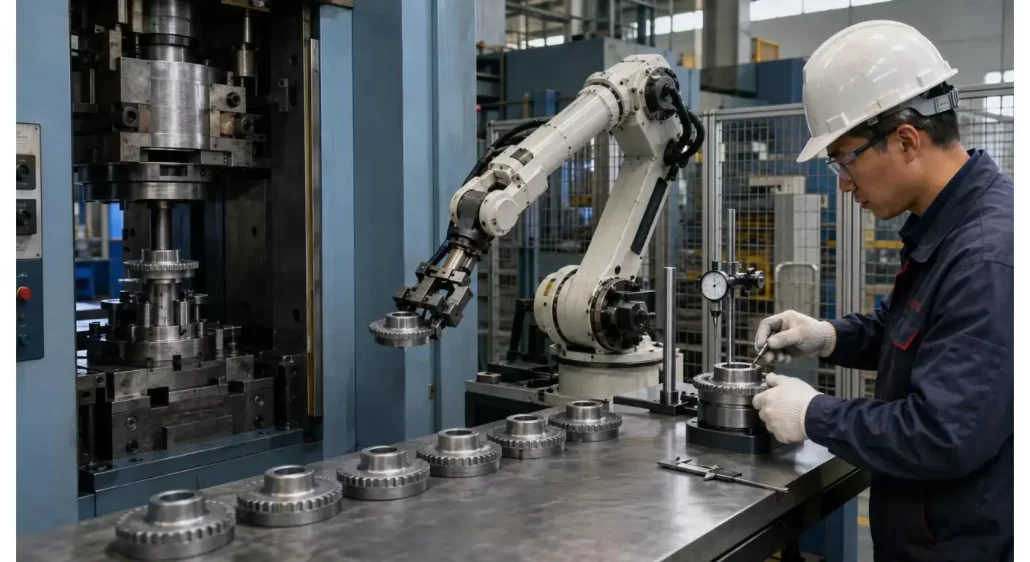
Consecutive parts should be measured with the acceptance test which will record:
- Forming load
- Ejection force
- Critical dimensions
- Concentricity
- Surface condition
- Tool temperature
- Cycle time
- Scrap causes
- Overload response
The testing to be done will be at the specified material condition with the specified lubricant and production tooling. If using substitute material, a false load and tool-life evaluation can result.
| Observed Change | Possible Cause | Verification |
| Rising forming load | Lubrication loss or material variation | Compare coating and batch records |
| Uneven wall thickness | Billet or tool misalignment | Check datum and guide alignment |
| Surface scratches | Material pickup on the tool | Inspect die and lubricant condition |
| Incomplete filling | Low billet volume or excessive friction | Verify billet weight and load curve |
| Difficult ejection | Excess contact or poor surface condition | Record ejector force |
| Early punch failure | Overload or lateral force | Review alignment and load position |
Final Engineering Check
A proper cold metal forging press is capable of exerting a load which increases as the metal materials are hardened, and maintains the good alignment of punches, dies and billets.
Based on measurable cold-forging requirements, GUANGDUAN can review billet, forming stages, tooling and production target to configure equipment around the measurable requirements rather than just the nominal capacity.
FAQ
Q1. What is cold metal forging press?
It can be used to form metal at room temperature or near room temperature by means of dies and high compressive force. It is applied in the extrusion, heading, coining and sizing process.
Q2. What are the materials that can be cold-forged?
Typically, low-carbon steel, some of the alloy steels, aluminum and copper alloys are used. They vary in their suitability according to their grade, hardness, ductility and former treatment.
Q3. What is the reason why high force is needed in cold forging?
There is no softening of the material by recrystallization heating and it work-hardens, making it stronger. As a result, forming load increases with the progress of deformation.
Q4. Why is lubrication important?
Lubrication is necessary to control the friction, surface quality, die filling and tool wear. An inconsistent coating can also adversely affect forming and ejection loads.
Q5. How to do a test of a cold forging press?
Apply the intended material, lubricant, use of tools and automation. Check the load, size and eject and surface finish from part to part.
CONTACT US


Guangdong Metal Forming Machine Works Co., Ltd.
We are always providing our customers with reliable products and considerate services.
If you would like to keep touch with us directly, please go to contact us
-

Home
-

Tel
-

Email
-

Contact