
Engine Component Forging Press: Bottom Dead Centre Dwell For Superior Grain Flow
When an engine component fails, the breakdown rarely starts at the surface. It begins inside the metal, along the invisible lines of its grain structure. That is why a growing number of precision manufacturers are turning to an Engine Component Forging Press that prioritizes not just tonnage, but the behavior of metal at the moment of formation.
GUANGDUAN‘s GK Series Knuckle Joint Press delivers exactly that, leveraging a refined crank-toggle mechanism that creates a purposeful dwell at bottom dead centre. This brief pause—approximately 1/18 of the cycle—transforms how grains realign, how stress distributes, and ultimately how each component performs under real-world loads.
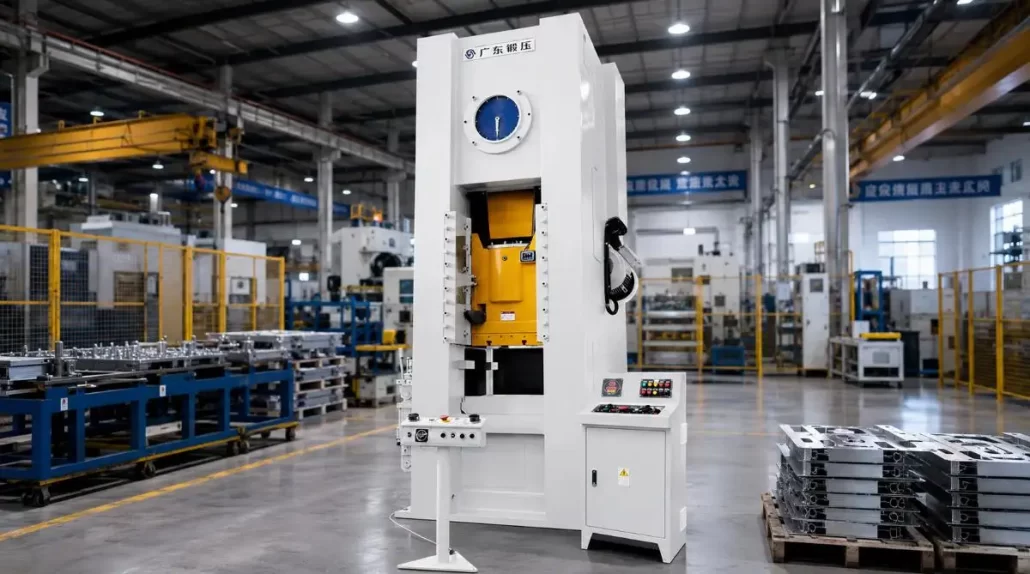
Why Grain Flow Defines Component Strength
Grain flow is the directional alignment of metal crystals shaped during forging. When optimized, grain flow aligns with the primary load‑bearing direction of the component. This alignment helps to strengthen the metal where the most stress occurs, enhancing mechanical strength.
In contrast, interrupted or poorly aligned grain flow can result in premature fatigue or weakness, especially in parts of an engine that rotate or move back and forth, and are subjected to repeated loads. For engine components, grain flow directly determines fatigue life, impact toughness, and long‑term structural integrity. A well‑designed Engine Component Forging Press therefore does more than compress metal—it guides internal architecture.
The Dwell Advantage: Precision Where It Matters Most
Conventional presses often rush through the critical moment of formation. The GK Series takes a different approach. As the slide approaches bottom dead centre, the knuckle‑joint geometry naturally slows the descent. Then it lingers. During that dwell, several important events occur simultaneously:
•Metal Flow Completes Its Path: Material has time to fully fill deep or asymmetric die cavities, achieving near‑net shape with exceptional fidelity.
•Grains Realigned Under Controlled Pressure: The bottom-stroke load directs grains along the path of least resistance in the intended direction.
•Elastic Spring-Back Is Supressed: The press holds the material under load, decreasing dimensional rebound and improving reliability of shape retention.
•Flash And Edges Stabilize: The dwell cycle stabilizes flash formation and improves edge quality, an advantage in most stamping and extrusion operations.
The crank-toggle mechanism provides a controlled deformation window which protects part geometry and stabilizes change over successive production runs.
From Grain Flow To Engine Reliability
Knowing the direction of grain flow is important, but the real value of an Engine Component Forging Press is measured by how that knowledge translates to a reliably performing engine. Take into account three of the most important engine components.
1) Connecting Rods
Connecting rods flex under tension and compression with every revolution of the engine. The GK Series dwell allows uninterrupted flow of the grain from the large end to the small end, allowing a continuous load path that resists buckling and cracking.
2) Crankshafts
Across several planes, a crankshaft experiences twisting and bending stresses. Controlled dwell helps maintain uninterrupted grain flow around each journal and crank throw, directly enhancing fatigue life in high‑horsepower applications.
3) Transmission Gears
Gear teeth rely on surface hardness paired with a tough, ductile core. The dwell’s controlled pressure zone enables superior die fill in tooth profiles while maintaining grain flow that follows the gear contour—strength where it is needed, resilience where it counts.
For component manufacturers, the bottom dead centre dwell means fewer in‑process rejects, reduced secondary machining, and greater confidence that parts leaving the line will perform as designed when installed in a customer’s engine.
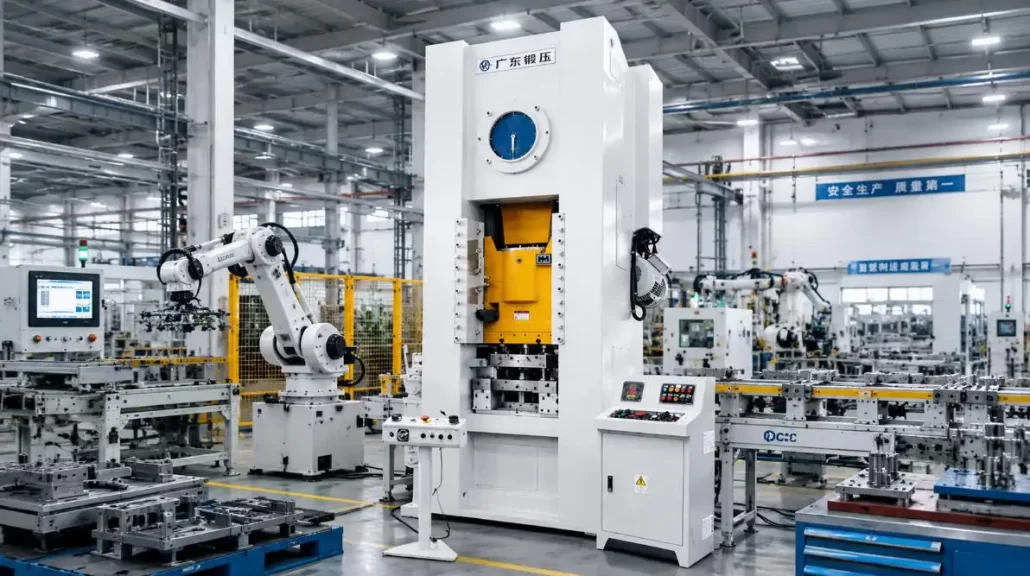
Precision Engineered for Consistent, Repeatable Output
The GK Series pairs its kinematic advantage with features that ensure every stroke matches the last:
•Die Height Indicator With 0.01mm Accuracy: Operators can set and verify die position with micron‑level precision, eliminating guesswork and accelerating changeovers.
•PLC-Controlled Architecture: The programmable logic controller governs speed, timing, and interlocks, delivering consistent behavior shift after shift and simplifying recipe management.
•As Standard – Mechanical Lower Ejector; White Paper: Ejector system lowers itself to prevent distortion during the removal from finished component faces.
•Customizable Clutch-Brake Systems: The GK-630 uses a pneumatic wet integrated friction clutch-brake, resistant to moisture and heat, for smooth engagement; the GK-800 to GK-2500 employs a pneumatic dry split integrated friction clutch-brake for rapid responsiveness and simplified servicing.
These integrated systems support the advantage of the dwell, ensuring that the optimization of grain flow is persistent and a norm throughout manufacturing.
A Press for the Challenges of Contemporary Engine Manufacturing
For overseas buyers, distributors, and engine component manufacturers, the precision of forming controls matters more than raw tonnage. With that in mind, the GK Series was designed to meet that demand. With a capacity range of 6300kN to 25000kN, and bolster sizes from 700x700mm to 1200x1200mm, the range provides a fit for a wide range of production. The knuckle joint presses from 4000kN to 16000kN adopt an integral design for maximum rigidity, while the 12000kN employs a split design for easy installation in facilities with space constraints.
Moving Forward With Confidence
Choosing an Engine Component Forging Press is a strategic choice with operational cost, product quality, and production effectiveness implications. The GK Series provides the time controlled dwell, precision feedback and robust engineering to the engine component producers of today. When grain flow and load direction are aligned, and you can rely on the same stroke to pause at dwell bottom dead centre, you can feel confident you’re forging reliability. For assistance with production goals, please reach out to GUANGDUAN to learn more about the GK Series.
Frequently Asked Questions
Q: How does bottom dead centre dwell improve grain flow in an Engine Component Forging press?
A: At Bottom Dead Center, dwell pressure is held for about 1/18 of a forging cycle. This pressure, during dwell time, controls the movement of metal crystals. These crystals move toward the load, improving the grain structure, and the fatigue life of the forged piece.
Q: Are GK Series machines suitable for the production of highly precise engine components at volume?
A: For components such as connecting rods, crankshafts and gears, GK Series machines further enhance productivity when producing such components. This is attributable to their high clutch-brake system and PLC Control which allow for adjustments of die height at increments of 0.01mm, guaranteeing consistency throughout even the longest production runs.
Q: What bolster sizes and tonnage options are available for the GK Series Knuckle Joint Press?
A: GK Series offers presses with bolster sizes ranging from 6300KN to 25000KN. Thus, you can choose the flexibility to manufacture small engine parts to large engine blocks.
Q: Can presses integrate with a smart manufacturing system?A: The GK Series is designed with PLC control and encourages real time data transfer and diagnostics. In addition, from a design perspective, the GK Series is compatible with the tools and technologies associated with Industry 4.0 and Predictive Maintenance.
CONTACT US


Guangdong Metal Forming Machine Works Co., Ltd.
We are always providing our customers with reliable products and considerate services.
If you would like to keep touch with us directly, please go to contact us
-

Home
-

Tel
-

Email
-

Contact