
How Does a Hydraulic Forging Press Machine Shape Metal? A Scientific Walkthrough
Turbine disks are one example of a part that can be made with a Hydraulic Forging Press Machine. Connecting rods, used in automotive applications, can also be formed using the same hydraulic press. The technology itself is complex. Let’s take a look to better understand the process.
1. Sculpting Metal: The Mechanics of a Forging Machine
While a hammer may strike with a precision impact within a smaller area, the Hydraulic Forging Press Machine uses a hydraulic fluid to exert a force as a static uniform pressure over an entire surface. This is known as the Pascal’s principle of the pressure of a confined fluid which moves uniformly in all directions.
•Pressure = Force / Area. The press uses a small-diameter pump cylinder with a large diameter main ram cylinder. This combination results in a massive increase in force. A modest 5,000 ton press has the capability of delivering the force of 1,000 African elephants.
•A key part of this system is that there is always full force at every point in the stroke of the ram, not just at the bottom dead center. This allows the metal to be shaped more readily.
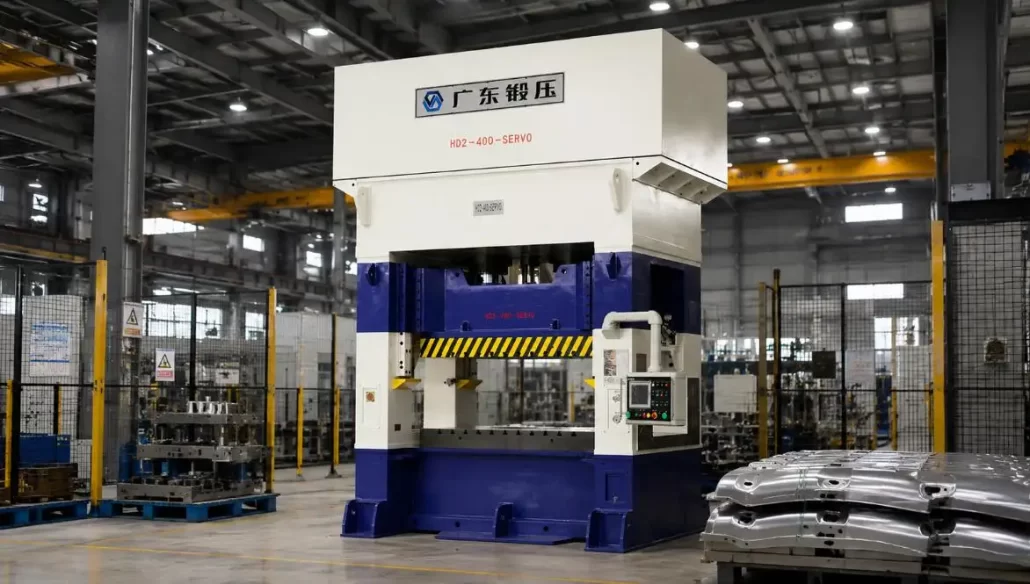
2. The Main Components that Make “Shaping“ Possible
To fully appreciate the gradual and precise reshaping of metal the Hydraulic Forging Press has many systems and components that work together seamlessly.
| Component | Function in Metal Shaping |
| Main hydraulic cylinder | Creates compressive force |
| Pump & valve system | Oversight of direction and rate of flow |
| Moving slide (ram) | Supports upper die and drives force |
| Bed (table) | Supports lower die and the workpiece |
| Guiding system | Fosters vertical alignment when forging |
| Control unit (PLC + sensors) | Oversees the limit of stroke, pressure, and speed |
In the forging cycle, the slide descends and ascends. This is known as an idle stroke. The slide contacts the hot metal, and then speed is controlled for the slide to apply pressure and dwell for a return. A true Hydraulic Forging Press Machine is defined by and relies on its capacity to control the speed and stroke of the machine.
3. Metal Flow under the Influence of a Hydraulic Fluid
After a hot steel billet begins its journey through a hydraulic press, it is placed between the two dies. The metal acts like a constantly available pliable substance that melts and travels to occupy all gap in the die along the route of least resistance.
•There are three stages of deformation:
– Primary Compaction: Internal gaps and flaws are closed.
– Bulk Flow: Horizontal elongation and/or expansion of the metal occurs.
– Die Filling: Sufficient metal enters to fill all corners and achieve net shape or near net shape packing.
•The application of a compressive load is highly beneficial to the plastic workings of metals. The breakage of coarse casting dendrites creates fine and even grain structures, improving both toughness and fatigue strength when compared to coarse structures.
4. Power and Precision: Where Hydraulic Presses Beat Mechanical Presses
A fixed stroke makes mechanical presses particularly dangerous. Hydraulic forging Press Machines allow the programming of speed, force, and position that makes possible behaviors like:
•Isothermal forging occurs at constant speed and load for titanium and superalloys. Dwell at bottom dead center during coining and sizing operations. Release valves open in the case of overloading. Controlled strain rates are essential for some aerospace alloys as the alloy begins to fracture if too much strain is applied too quickly.
The newest machines incorporate closed-loop, servo control systems. These systems utilize pressure cells, displacement transducers (grating rulers), and PLCs. The outcome is ± 0.1 mm in positioning accuracy and ± 1% in pressure repeatability.
5. GUANGDUAN‘s GY2S Series – The New Gold Standard in Hydraulic Forging Technology
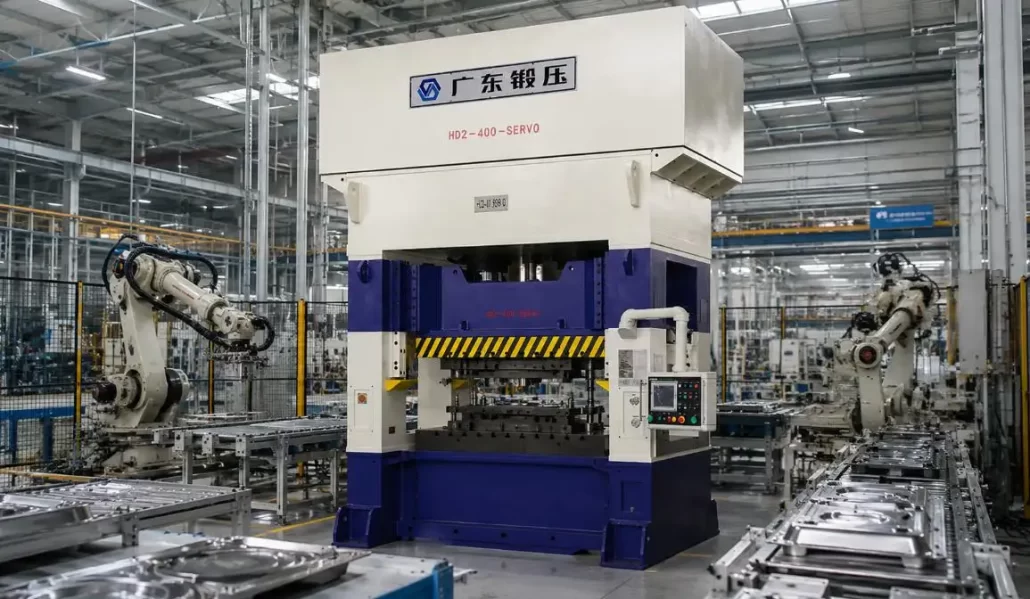
Among the top-tier manufacturers, GUANGDUAN has designed a range of solutions for Hydraulic Forging Press Machines that utilize the principles described above with remarkable quality of construction. Their Hydraulic Press GY2S Series stands out through several design breakthroughs:
Robust & Rigid Construction
•Fuselage structure – Made of high-quality steel welded box construction. This provides outstanding rigidity, a beautiful appearance, and easy transportation. Rigidity ensures that under full tonnage, deflection is minimized – so the dies close parallel and the forged part has uniform wall thickness.
•Slider (ram) – Steel plate welded box structure with an eight-sided full guide rail system. This gives excellent guiding precision and precision retention, even after millions of cycles. The eight contact surfaces eliminate any yaw or tilting, which is vital for long, slender forgings.
Advanced Lubrication & Thermal Control
•Thin oil continuous circulation lubrication system – All sliding surfaces receive a constant film of clean oil. This reduces friction, removes heat, and extends guide life. No grease nipples, no manual pump – fully automatic.
Servo–Driven Energy Efficiency & Quiet Operation
•Servo closed loop control – Comprising a servo motor driver, pressure sensor, displacement sensor, and PLC. This system delivers high precision, low noise, low vibration, and energy saving & environmental protection. Compared to traditional valve-controlled presses, a servo-driven Hydraulic Forging Press Machine can cut electricity consumption by 35–50%, because the motor only runs when flow is needed.
Intelligent Operator Interface
•PLC + touch screen + grating ruler control – Real-time digital adjustment is possible via the touch screen, depending on different molds and production processes. The system can store up to 20 sets of mold parameter settings. Changeover from one forging job to another takes minutes, not hours.
•High operability – Operators can view actual force-displacement curves, set ram speed profiles, and monitor maintenance alerts directly on the HMI.
Multi–Level Safety Features
•Slider locking device – Locks the slide at any position to prevent accidental downward creeping (critical during die setup or when the press is idle).
•Lower limit switch protection – Prevents over-travel.
•Two-hand anti-repeat control – Requires simultaneous button pressing, eliminating single-handed accidental actuation.
•Touch screen parameter setting anti-error protection – Invalid entries are rejected, and critical parameters require confirmation. Multi-level protection ensures both operator safety and machine integrity.
6. Why the GY2S Series Excels in Real–World Forging
Take the example of forging a 300-mm diameter bevel gear blank. A conventional press might require multiple heating cycles and shimming of dies. With the GUANGDUAN GY2S:
•The eight-sided guide keeps the upper and lower dies perfectly aligned, reducing mismatch to <0.2 mm.
•Servo pumps deliver the required flow precisely—without wasting energy or causing the oil to overheat.
•The touch screen stores the forging recipe; next batch, just recall program #12.
•The slider locking device holds the ram in top position for safe part ejection.
The result: higher dimensional accuracy, longer die life, 40% less energy use, and quieter shop floor.
Conclusion
A Hydraulic Forging Press Machine shapes metal not by brute impact, but by controlled, uniform, and programmable squeezing. From the rigid welded box frame to the eight-sided guiding and the servo-closed loop intelligence, every component is designed to transform raw steel into high-performance parts.
GUANGDUAN’s GY2S Series embodies this philosophy, offering reliability, precision, and energy savings for modern forging operations. Whether you are forging a turbine blade or a truck axle, understanding the science behind the hydraulic press empowers you to choose – and use – the right machine for the job.
Frequently Asked Questions (FAQ)
Q1: What differentiates a hydraulic forging press from a mechanical forging press?
A: A hydraulic forging press has the capacity to exert full force during any part of a stroke while a mechanical forgings press has a fixed stroke and only exerts maximum force at the bottom dead center of a stroke. In addition to this, mechanical forging presses do not have overload protection and can be easily damaged. Unlike mechanical forging presses, hydraulic forging presses do not exert more force than a die can withstand.
A2: Can you use a hydraulic forging press to forge cold metal?
A: Yes. Forging can be done on cold metal, but for most applications forging metal is performed at elevated temperatures (above the recrystallization temperature). This softens the metal, reduces flow stress, improves ductility, and eases the forging process. Some hydraulic presses are used for cold coining and sizing of softer metals like aluminum and copper.
Q3: How much energy a servo driven hydraulic press saves compared to a conventional one?
A: A servo closed loop system like the one in GUANGDUAN’s GY2S Series saves up to 35–50% in electricity consumption, as the motor only runs when flow is needed and has almost zero idle loss.
Q4: How much maintenance is needed for the eight sided full guide rail system?
A: The eight sided guide rails are automatically lubricated by the thin oil continuous circulation system. Regular checks of oil cleanliness and filter condition are recommended, but the system is designed for a long interval between manual interventions.
Q5: Is the GY2S Series suitable for small batch production?
A: Definitely. With the touch screen which stores up to 20 mold parameter sets, and real-time digital adjustment, quick and repeatable changeovers can be achieved, making it a suitable system for job shops, as well as high-volume forging lines.
CONTACT US


Guangdong Metal Forming Machine Works Co., Ltd.
We are always providing our customers with reliable products and considerate services.
If you would like to keep touch with us directly, please go to contact us
-

Home
-

Tel
-

Email
-

Contact