
EU-Compliant Cold forging for Data Centers: Turning Hardware into a Strategic Asset
EU-Compliant Cold forging for Data Centers is steadily moving from a niche process to a board-level decision. Across Europe, operators, rack manufacturers, and system integrators are realizing that their long-term reliability does not only depend on servers, cooling, and power. It also depends on the quiet, steel components that nobody notices until something goes wrong.

Behind every server rack, cable tray, and power distribution unit, there is a dense network of brackets, frames, rails, and supports. These parts carry heavy static loads, absorb vibration, and must pass strict European safety and environmental rules. When they deform, crack, or fail inspection, the outcome is costly: unplanned downtime, safety concerns on site, and rework that eats into margin.
At GUANGDUAN, we see a clear trend. Customers no longer ask only for “strong enough” hardware. They want components that can be traced back to stable processes, that help them meet EU compliance, and that fit into their wider sustainability strategy. EU-Compliant Cold forging for Data Centers is where these needs intersect with high-rigidity, closed-type single-point forge presses designed for stable, repeatable forming.
Why EU-Compliant Cold forging for Data Centers Is Gaining Momentum
n When Regulations Meet Real-World Loads
Data centers in the EU operate under pressure from two sides. Regulators are tightening requirements on materials, safety, and environmental impact. At the same time, technical demands are rising: racks are higher, power density is increasing, and layouts are more compact, leaving less room for over-engineering.
for structural hardware, that translates into very practical requirements:
•Components must hold their geometry under static and dynamic loads
•Parts must stay stable under years of vibration and thermal cycling
•Materials and processes must support EU compliance and documentation needs
Traditional forming or machining routes often struggle under this combination. Machined parts may suffer from sharp edges, burrs, and inconsistent grain flow, which can lower fatigue strength. Stamped parts produced on light-duty presses may warp or twist just enough to cause assembly issues. In both cases, certification and audit discussions become harder.
EU-Compliant Cold forging for Data Centers addresses these headaches directly. By forming steel at or near room temperature, the process improves grain flow and mechanical strength while delivering tight and repeatable tolerances. Fewer parts are scrapped, rework and secondary machining are reduced, and it becomes much easier to document a repeatable, robust process for even the most demanding audits.
n Hidden Reliability Risks in Data Center Hardware
Across conversations with data center hardware suppliers, a familiar list of concerns keeps returning:
•Brackets that slowly lose shape under the full weight of populated and cabled racks
•Rails, fasteners, or frame members that shift during transport and ruin alignment at the site
•Pressure from customers and regulators to prove process consistency with real data
•High material usage and cost when components are removed from bar or plate by machining
EU-Compliant cold forging on a stable, precise press offers a one-step route to reducing these risks and improving overall hardware reliability. The material is not simply cut to shape; it is flowed into the required geometry. This improves strength in critical zones such as bends, transitions, and mounting points. At the same time, a well-designed die set, combined with a high-rigidity press, keeps dimensions within a narrow band from the first piece of a batch to the last.
How GUANGDUAN Supports Reliable EU-Compliant Cold forging for Data Centers
n Stable forming for Critical Steel Components
The foundation of EU-Compliant Cold forging for Data Centers is a press that behaves predictably under high load. GUANGDUAN’s closed-type single-point forge presses are built with a rigid box-type frame that resists deformation. Instead of flexing every time force is applied, the frame keeps its shape, which helps maintain die parting-line alignment and supports full cavity filling for complex shapes such as rack corners, reinforcement brackets, and anchoring elements.
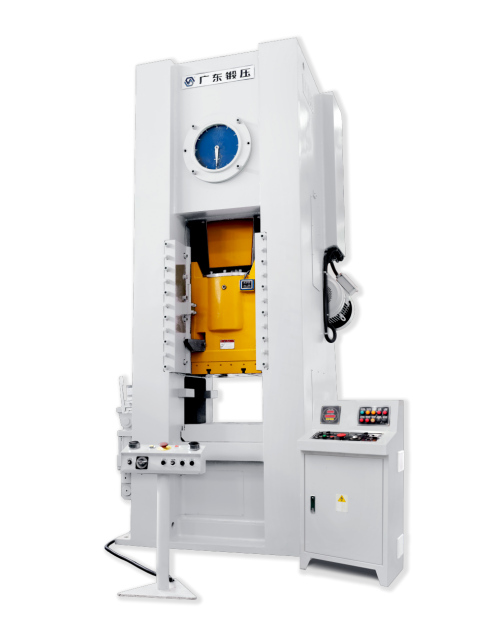
Inside the press, an eccentric-shaft crank system provides strong bearing capacity, transferring force efficiently into the workpiece. A wet-type clutch helps deliver smooth engagement and a long service life, which is important for plants running long series of repeated parts. The slide is guided on four sides, giving it precise, stable movement through every stroke.
for data center hardware manufacturers, this combination translates into tangible shop-floor benefits:
•More consistent thickness in brackets, rails, and mounting plates
•Reliable hole and slot positions for fast assembly and fewer adjustments on site
•Reduced die wear, helping maintain capability over long production campaigns
Die set height is adjusted mechanically and shown digitally, making setup clear and repeatable. Operators do not have to guess or rely on “feel” when changing over between different hardware families, such as varying rack heights or accessory kits. This shortens commissioning time and supports more flexible production planning.
n Safety, Automation, and Traceability Built into the Line
EU-Compliant Cold forging for Data Centers is about the part, but it is also about the way the part is produced. GUANGDUAN presses combine PLC-based control with pneumatic systems to manage three stroke modes: continuous, single, and micro-motion. This gives process engineers enough flexibility to tune the forming window, slow down where necessary, and record stable production data over time.
Where a project requires higher safety, throughput, or automation, additional systems can be integrated:
•Photo-electric protection to create safer working zones around the press
•Hydraulic overload protection on higher-tonnage presses to protect machine and dies
•Automatic feeding, uncoiling, and leveling equipment to build a more automated cell
With these features, data center hardware suppliers can move progressively from manual to semi-automatic and eventually to fully automated cold forging lines. This step-by-step path helps balance investment with current order volumes.
Just as important is traceability. A stable, automated line for EU-Compliant Cold forging for Data Centers makes it easier to capture production parameters, link batches to specific settings, and answer tough questions from customers about process capability, repeatability, and quality control.
From Today‘s Challenges to Future-Ready EU-Compliant Cold forging for Data Centers
As European data centers scale up in capacity and complexity, the steel parts behind the scenes become part of the strategic discussion. A single bent bracket or misaligned rail may not sound critical, but repeated across thousands of racks it translates into installation delays, rework, and questions about long-term reliability.
EU-Compliant Cold forging for Data Centers offers a way to address these issues in a structured way. By integrating high-strength, near-net-shape forgings with less waste and clear process documentation, hardware suppliers can:
•Deliver more reliable support structures for racks, cable routes, and power distribution assemblies
•Reduce raw material consumption relative to machining, supporting carbon and sustainability initiatives
•Achieve better traceability and process visibility, making audit preparation faster and simpler
At GUANGDUAN, we work alongside customers as engineering partners rather than just press vendors. Share your 3D models or detailed drawings of brackets, rails, and structural elements, and we will help review them. We then suggest how those designs could be optimized for EU-Compliant Cold forging for Data Centers, including material choices, draft angles, and fillet transitions that support good metal flow.
From there, we help you define a press and automation layout that fits your volume, your product mix, and your staffing model. Some customers start with a single cold forging cell focused on one family of parts; others plan a multi-line layout that covers several product ranges with shared tooling concepts. In each case, the goal is the same: a stable, predictable process that keeps quality high and cost per part under control.
ü Talk to GUANGDUAN about Your Next Data Center Hardware Program
If you are designing new hardware for high-density racks, upgrading existing support systems, or simply exploring what EU-Compliant Cold forging for Data Centers could do for your portfolio, this is a good time to start the conversation. Share your target components, expected annual volumes, and current pain points with our engineering team.
We will work with you to assess whether cold forging on a high-rigidity closed-type single-point press is the right route, and which level of automation and protection makes sense for your business and regulatory environment.
Call to Action:
Ready to make your data center hardware stronger, more sustainable, and fully aligned with EU expectations? Contact GUANGDUAN today to discuss a tailored EU-Compliant Cold forging for Data Centers solution for your next generation of racks, frames, and structural components.
CONTACT US


Guangdong Metal Forming Machine Works Co., Ltd.
We are always providing our customers with reliable products and considerate services.
If you would like to keep touch with us directly, please go to contact us
-

Home
-

Tel
-

Email
-

Contact