
Hydraulic Press For Energy-Efficient Cooling Explained for Industry
Hydraulic Press for Energy-Efficient Cooling is not just a new machine, but a new way to run a press line. It means the press, the hydraulic unit, and the cooling system work together instead of fighting each other. The press adjusts energy use and cooling in real time, based on load, temperature, and cycle needs. Oil temperature stays stable. Components last longer. Power use becomes visible and easier to control. But what is inside this kind of press, and how is it different from a traditional hydraulic press you see in most plants today?
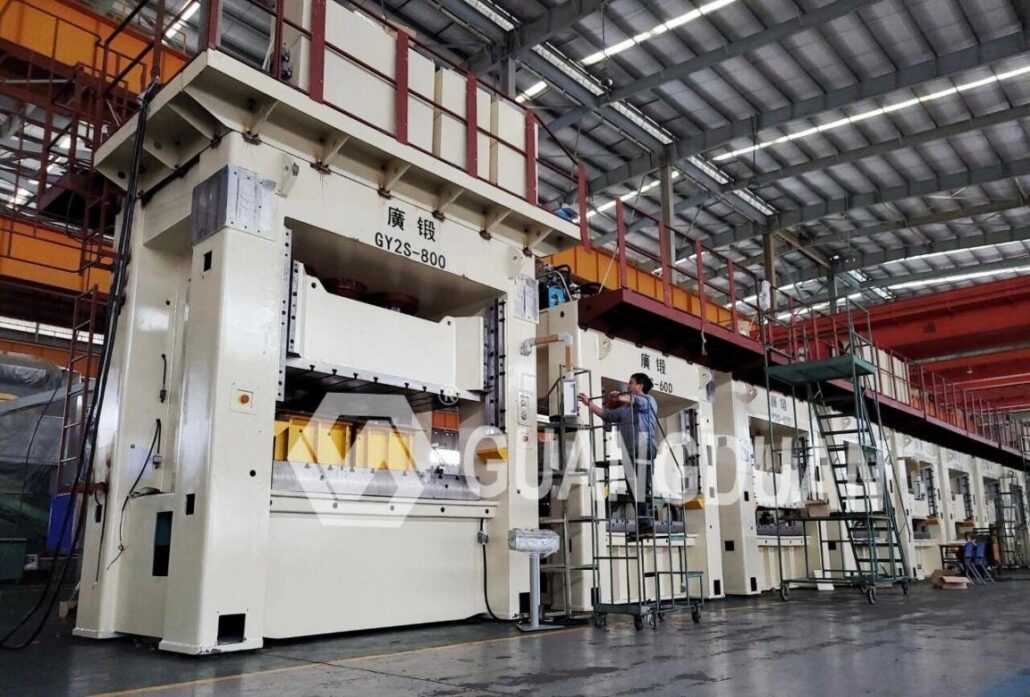
1) Cooling Challenges in Modern Hydraulic Press Lines
- Where Energy And Heat Really Come From
On most forming or molding lines, the hydraulic press sits among the top energy consumers. Pumps often run at high load for long periods, hydraulic oil temperature climbs through each shift, and the cooling unit works almost non-stop just to keep the system inside a safe thermal window.
At the root are repeatable, expensive pain points:
•Pumps and fans that keep running at almost the same speed, whether the press is busy, light-loaded, or idle
•Oil temperatures that stay elevated, accelerating seal damage and reducing the service life of valves and hoses
•Regular interventions on the cooling system to remove contaminants, sludge, and thermally fatigued parts
•A weak foundation of energy and temperature data when customers, auditors, or ESG stakeholders ask for proof
Operators experience this as inconsistent cycle times and sudden shutdowns when thermal limits are reached. Production and plant managers see it in higher power bills, inflated maintenance line items, and slow improvement against efficiency and sustainability metrics.
A well-engineered Hydraulic Press for Energy-Efficient Cooling tackles these issues at the root: it reduces how much heat is generated in the first place, and treats cooling capacity as a controlled process variable instead of an always-on background load.
- Why Conventional Cooling Approaches Waste Energy?
Traditional hydraulic presses usually rely on simple open-loop cooling logic. Oil is cooled at a fixed rate based on conservative assumptions, rather than on real-time feedback from load, temperature, and duty cycle. This is safe, but rarely efficient.
When cooling output is not matched to actual thermal demand, predictable problems appear:
•Pumps and coolers log many more running hours than necessary
•Temperature still drifts up and down because regulation is crude
•The “safe” answer is to oversize coolers and oil tanks, locking in higher capital and running cost
A Hydraulic Press for Energy-Efficient Cooling replaces the “cool everything, all the time” mindset with “cool only what is necessary, when it is necessary.” That shift calls for rigid mechanics, smart lubrication, distributed sensing, and servo-driven actuation – but in return, thermal management becomes a lever for quality and cost, not just a constraint.
2) GY2S Series: Core Design of a Hydraulic Press for Energy-Efficient Cooling
- Structural Integrity That Reduces Thermal Load
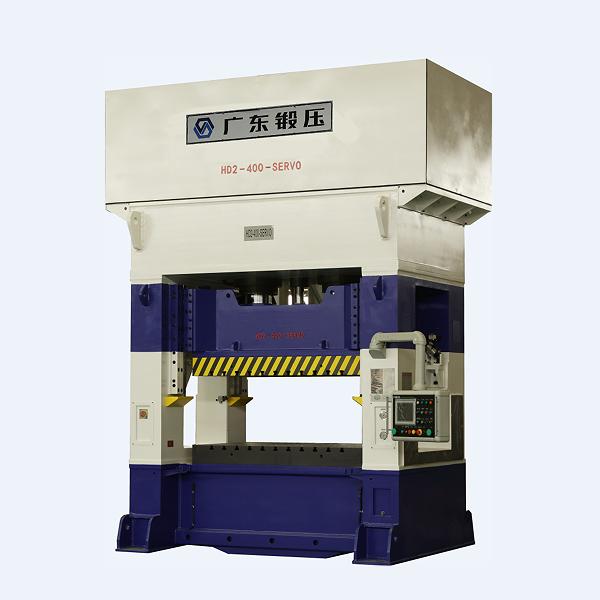
The GY2S Series hydraulic press uses a high-quality steel welded box frame. This fuselage-style structure delivers high rigidity, efficient load transfer, and minimal deformation even under heavy or asymmetric loading. From a thermal perspective, this stiffness is not just a mechanical benefit. Less deflection and smoother motion mean reduced friction and therefore less internal heat to remove.
The slider is built as a steel plate welded box and guided by an eight-sided full guide rail system. This configuration provides:
•Stable geometry and accuracy over long production runs
•Reliable precision under cyclic and high-tonnage conditions
•Lower lateral forces, which would otherwise turn into heat and wear on the guides
By minimizing mechanical loss and friction at the source, the GY2S design cuts the thermal load that must be carried away by hydraulic oil and external cooling equipment. In a true Hydraulic Press for Energy-Efficient Cooling, energy savings start with the frame and slide, not with a bigger chiller.
- Lubrication And Motion: Controlling Heat Before It Spreads
To further control friction and temperature, the GY2S Series uses a thin-oil continuous circulation lubrication system. Instead of relying on sporadic manual greasing, lubrication oil is supplied in a controlled, repeatable way to key contact points. This delivers:
•Lower friction on sliding and guiding surfaces
•More uniform heat removal from regions with high mechanical contact
•A stable lubrication film that supports precision and long service life
The result is a Hydraulic Press for Energy-Efficient Cooling that doesn’t depend solely on external coolers. It systematically cuts heat generation through structural design and lubrication engineering, before asking the cooling unit to do the rest.
3) Servo Closed Loop: Turning the Press Into a Demand-Driven System
The GY2S Series relies on a servo closed-loop control system that links a servo motor with pressure and displacement sensors, all coordinated by a PLC. This structure gives the press accurate control of stroke and force and helps reduce machine noise, vibration, and power draw.
In the context of a Hydraulic Press for Energy-Efficient Cooling, servo control is the key to turning hydraulic power into a demand-driven resource. Motor speed and hydraulic output follow the actual requirement of the forming stroke rather than sitting at a permanent high level. This brings:
•Pressure and motion curves that respond directly to load changes
•More stable forming behavior, with less energy lost to overshoot
•Lower maximum oil temperatures because inefficient high-load phases are shorter and less frequent
The operator works through a PLC + servo interface with a touch screen and grating ruler feedback. Different molds, materials, and part designs can be supported with tailored parameter sets. Up to 20 recipes can be stored, so the best energy and cooling strategies are retained and reused.
In everyday use, this means your Hydraulic Press for Energy-Efficient Cooling can be configured like a library of product-specific programs, not a single generic setting. Forming speeds, dwell times, and pressure ramps can be aligned with both quality requirements and thermal limits, instead of relying on a single generic setup.
- Safety Architecture that Underpins Thermal Stability
Safe operation and thermal stability go hand in hand. The GY2S Series therefore integrates multiple safety layers. A slider locking device can secure the slide at any position during setup or maintenance. Additional protection functions include a lower limit switch, a two-hand anti-repetition mode, and multi-level error monitoring within the touch screen interface.
As a result, accidental motion sequences, unexpected e-stops, and harsh mechanical impacts are far less likely, reducing both temperature spikes and structural stress. For a Hydraulic Press for Energy-Efficient Cooling, this controlled, safe mode of operation is what supports consistent heat management and reliable uptime.
4) Where a Hydraulic Press for Energy-Efficient Cooling Delivers Value
A GY2S-type Hydraulic Press for Energy-Efficient Cooling fits a wide spectrum of applications: automotive structural parts, stamped and formed metal hardware, brackets for electrical cabinets, enclosures, and many other components that demand repeatable forming and tight dimensional control.
In multi-shift operations, even modest improvements in thermal stability and cooling efficiency can translate into significant yearly savings. Typical measurable gains include:
•Lower electricity use for both the hydraulic drive and the cooling system
•Longer life for hydraulic oil, seals, hoses, and valves due to controlled operating temperature
•Improved dimensional stability and surface finish as a result of consistent thermal conditions
•Reduced overall noise and vibration, contributing to a better working environment
Because process parameters and recipes can be stored and recalled, energy and cooling strategies become part of the formal production documentation, not tribal knowledge that depends on individual operators.
- How To Select A Hydraulic Press for Energy-Efficient Cooling?
When evaluating new equipment, manufacturers should look beyond tonnage and footprint. Critical selection criteria include:
•Frame and Slide Concept – A rigid welded box frame and robust guide system to minimize friction and heat generation.
•Lubrication Architecture – Thin-oil circulation with defined channels for lubrication, heat removal, and long-term accuracy.
•Servo Closed-Loop System – A servo drive with pressure and displacement feedback plus PLC control for genuine load-based energy management.
•Process Data And Recipe Management – Touch screen operation and multi-recipe storage to fine-tune cooling-related parameters for each part.
•Comprehensive Safety Design – Slider locking, interlocks, and anti-repetition logic to protect people and equipment and maintain stable conditions.
Taken together, these elements are what distinguish a real Hydraulic Press for Energy-Efficient Cooling from a conventional press that simply has a larger oil cooler attached.
- From Concept To Commissioning: A Practical Roadmap
For plants planning to introduce or upgrade to a Hydraulic Press for Energy-Efficient Cooling, a structured rollout helps reduce risk and accelerate payback:
•Audit Existing Presses And Cooling Systems
Record energy consumption, oil temperature curves, and downtime related to overheating or cooling failures.
•Define Quantifiable Targets
Set clear goals for energy reduction, acceptable temperature bands, and quality metrics such as dimensional stability or scrap rate.
•Evaluate Candidate Press Solutions
Compare mechanical design, lubrication concept, servo control capabilities, data handling, and safety architecture – not just tonnage.
•Integrate With Plant Energy Management
Connect the press to plant-level monitoring so that energy and temperature data are visible in broader improvement programs.
•Train Operators And Maintenance Teams
Make sure staff understand how to use the press’s energy-efficient features, interpret key data, and keep the system within its optimal thermal window.
Turning Cooling Into an Engineering Advantage
A carefully specified Hydraulic Press for Energy-Efficient Cooling transforms cooling from a constant overhead into a controllable engineering parameter. With rigid mechanical design, optimized lubrication, servo closed-loop control, and robust safety built into platforms such as the GY2S Series, manufacturers gain a solid foundation for both productivity and efficiency.
If your plant is under pressure from rising utility costs, unstable oil temperatures, or customer requests for documented energy performance, this is an ideal moment to re-examine your press technology. Bring together your engineering and maintenance teams, review your current thermal challenges, and map out how a Hydraulic Press for Energy-Efficient Cooling can support the next stage of competitiveness and sustainability in your operations.
CONTACT US


Guangdong Metal Forming Machine Works Co., Ltd.
We are always providing our customers with reliable products and considerate services.
If you would like to keep touch with us directly, please go to contact us
-

Home
-

Tel
-

Email
-

Contact