
Heavy-Duty Metal Press for Aerospace Cost-Effective Quality Control
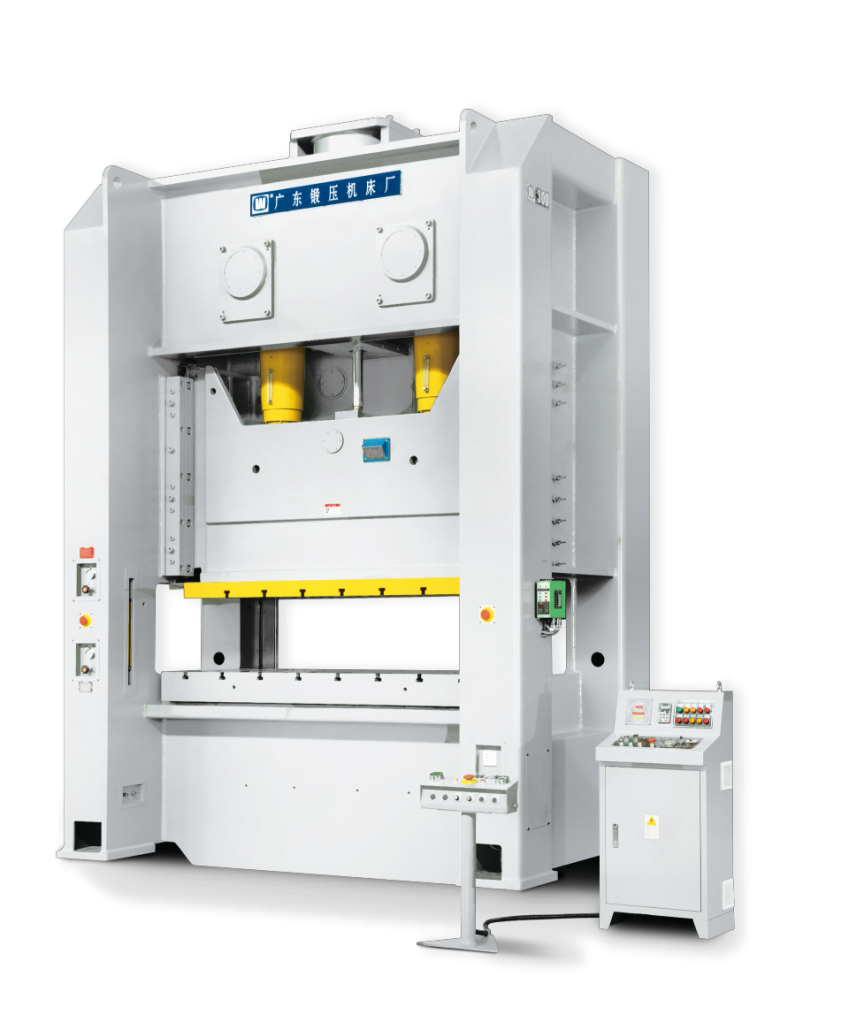
In modern aerospace plants, a forming press is no longer just “big tonnage on the shop floor.” It is a critical production platform that shapes safety-critical structures, complex skin panels, brackets, and profiles that must perform reliably in flight. A Heavy-Duty Metal Press for Aerospace therefore has to behave like a precision system: stable under demanding loads, predictable over long campaigns, and ready to provide data that backs up every part shipped. GUANGDUAN develops its heavy-duty presses with this reality in mind, combining robust mechanical design with intelligent control and automation tailored to aerospace work.
1) Aerospace Forming: High Stakes, Tight Margins
Aerospace production relies heavily on high-strength aluminum, titanium, and nickel-based alloys. These materials resist deformation, are sensitive to process variation, and are frequently used in components that sit directly in the load path of the airframe. Tolerances are tight, surface quality is closely inspected, and fatigue performance is a long-term concern rather than a short-term metric.
At the same time, manufacturers must demonstrate process stability and full traceability under standards such as AS9100 and customer gateway reviews. In that environment, a general-purpose industrial press quickly reaches its limits. A Heavy-Duty Metal Press for Aerospace must hold dimensions over long runs, control deflection under eccentric loads, protect high-value dies, and deliver documentation that stands up to audits. This is the performance envelope GUANGDUAN targets when engineering its heavy-duty solutions.
2) High-Rigidity Frame for Aerospace-Level Loads
The frame is the backbone of any aerospace-capable press. GUANGDUAN uses welded steel plate structures with carefully arranged ribs and comprehensive stress-relief treatments to achieve high stiffness and stable vibration characteristics. The objective is simple: when the press is driven close to its rated capacity, the frame must deform in a controlled, predictable way.
A balanced double-crankshaft layout helps distribute forces through the structure. By arranging the crankshafts in a reverse configuration, the drive system balances motion across the slide, counteracting side forces that would otherwise introduce distortion. For aerospace users, this frame philosophy supports consistent forming curves, reduces the chance of long-term frame distortion, and builds confidence in dimensional stability for demanding parts such as fuselage frames, wing ribs, or large structural brackets.
3) Slide Guidance and Control of Eccentric Loads
Many aerospace dies are inherently unbalanced. Large skins, progressive tools, multi-cavity layouts, and asymmetric profiles all create eccentric loads that try to tilt the slide. If the guidance system cannot resist these forces, slide parallelism drifts, die wear accelerates, and parts gradually move out of tolerance.
To counter this, GUANGDUAN adopts multi-surface slide guidance, such as eight-sided, full-length guideways that wrap around the slide. The enlarged bearing area improves resistance to tipping and lateral movement. In practice, this delivers strong anti-unbalance capacity, lower lateral stress on the guides, and better retention of slide geometry over time. For a Heavy-Duty Metal Press for Aerospace, that translates into more stable forming of long stringers, seat tracks, and intricate bracket tooling, while extending the life of costly aerospace dies.
4) Overload Protection and Tooling Safety
Aerospace tooling is expensive and heavily validated before it ever runs production parts. An unexpected overload can damage not only the die but also the overall press geometry, leading to long, unplanned downtime.
GUANGDUAN addresses this with hydraulic overload protection built directly into the slide. The system reacts rapidly to excess load, venting pressure and stopping motion before permanent damage occurs. Once the root cause is identified – such as a misfeed, misaligned blank, or tooling issue – the system can be reset and brought back online with minimal disruption. For aerospace plants that frequently change jobs and handle high-mix, lower-volume programs, this kind of integrated protection helps preserve tooling investments and maintain long-term alignment of the press.
5) High-Torque Wet Clutch for Consistent Drive Behavior
The way a press delivers force over the stroke has a direct impact on part quality and tool life. GUANGDUAN equips its mechanical drives with high-torque wet clutch-brake units designed for frequent, high-load cycling.
Compared with dry clutch arrangements, wet-type, oil-bath clutches can transmit higher torque, engage more smoothly, and operate longer between rebuilds because the friction elements run under controlled lubrication. They also help suppress dust and vibration-related noise around the press, which contributes to safer, more comfortable operator conditions. For aerospace lines, this robust clutch-brake package is a foundation for precise stopping accuracy, consistent stroke phasing, and stable forming performance – the core expectations for a Heavy-Duty Metal Press for Aerospace that must maintain tight tolerances over time.
6) PLC-Based Control and Smart Forming
Because an aerospace press is part of a larger cell, it needs coordinated control. GUANGDUAN utilizes PLC-centric systems to supervise slide motion, clutch-brake timing, lubrication delivery, ejector coordination, and safety logic through a single integrated control platform.
Typical capabilities include a touch-screen HMI for configuring stroke modes, speeds, and shut heights; integration of encoders, load cells, and displacement sensors for monitoring forming curves; recipe management for different tools and materials; and alarm logging with diagnostic support. This control layer lets process engineers fine-tune press behavior for difficult alloys, capture changes in forming response over time, and connect forming parameters directly to quality records. As a result, the Heavy-Duty Metal Press for Aerospace becomes part of a connected manufacturing cell ready for advanced analytics and predictive maintenance.
7) Automation-Ready for Aerospace Production Lines
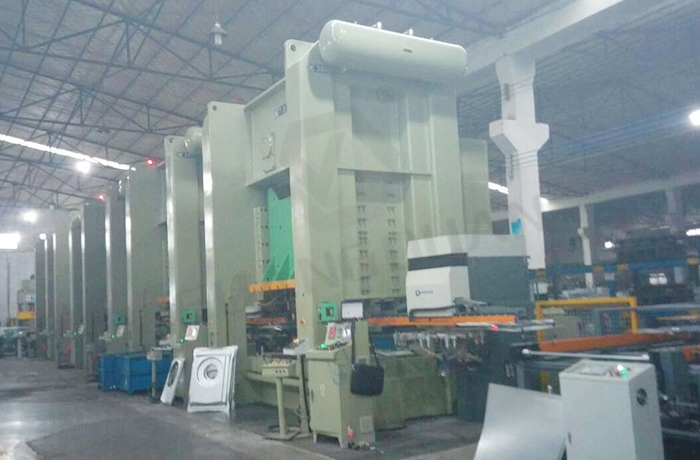
Pressure on labor, ergonomics, and repeatability is pushing aerospace manufacturers toward higher levels of automation. GUANGDUAN designs its presses with standardized interfaces for uncoilers, straighteners, servo feeders, transfer systems, robots, and in-line inspection or marking stations.
Whether the press is deployed as a stand-alone automated cell or integrated into a multi-press line, the mechanical layout and control system support progressive upgrades. Manufacturers can deploy presses in a simple, semi-manual configuration, then gradually bolt on coil feed systems, robotic handling, or automated inspection as new platforms launch or multiple tools are consolidated. This scalability ensures aerospace investments track program risk and volume ramp.
8) Data, Traceability, and Quality Assurance
In aerospace, producing a good part is only half the story; being able to prove how it was produced is just as important. GUANGDUAN’s heavy-duty press concept includes options for capturing forming force curves, stroke counts, overload events, and key parameter changes. The recorded signals can be tied back to lot numbers or unique serial identifiers and fed into existing MES or QMS environments.
Using these records to track shifts in forming loads, stroke timing, and alarm occurrence allows operators to spot process drift in advance, tune maintenance cycles to real wear, and demonstrate compliance and control in customer audits. In this way, the Heavy-Duty Metal Press for Aerospace becomes a source of quality intelligence, not merely a mechanical asset.
9) Representative Aerospace Applications
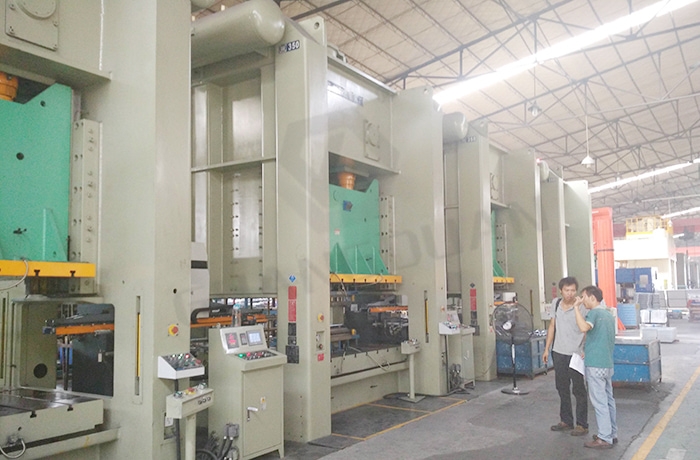
A GUANGDUAN heavy-duty press can support a wide variety of aerospace components, including primary and secondary structures. Typical applications range from ribs, frames, brackets, and floor beams to seat rails, support profiles, and engine or nacelle-related sheet metal parts where surface finish and dimensional control are critical.
In many facilities, replacing generic presses with purpose-designed heavy-duty units leads to tighter dimensional spread, fewer unscheduled stoppages, improved tool life, and a more stable cost picture over the lifecycle of an aircraft program.
u Choosing the Right Heavy-Duty Metal Press for Aerospace
When specifying a new press, aerospace decision-makers should look beyond headline tonnage. Critical evaluation points include frame rigidity and vibration behavior under real loads, slide guidance design and anti-unbalance capability, overload protection strategy and reset procedures, control architecture and connectivity, and the press’s overall automation roadmap.
Total cost of ownership also matters: energy consumption, maintenance intervals, spare parts availability, and the impact of press stability on tooling and secondary operations. Reviewing these factors as a complete package makes it easier to select a GUANGDUAN Heavy-Duty Metal Press for Aerospace that fits both the current program portfolio and future platform plans.
Final Words
A Heavy-Duty Metal Press for Aerospace is a strategic asset that influences quality, delivery reliability, and long-term competitiveness. GUANGDUAN combines rigid press structures, robust slide guiding, integrated overload protection, high-efficiency drive trains, and PLC-controlled automation to create presses tailored to the critical demands of aerospace forming.
Aerospace manufacturers that need to tighten process stability, manage risk, and prepare for next-generation airframe platforms can turn to GUANGDUAN to gain more consistent forming results, better data transparency, and a shop floor that is ready for upcoming programs.
CONTACT US


Guangdong Metal Forming Machine Works Co., Ltd.
We are always providing our customers with reliable products and considerate services.
If you would like to keep touch with us directly, please go to contact us
-

Home
-

Tel
-

Email
-

Contact