
How to Select a High Tonnage Press Machine For Metal Forming Based on Part Size, Material, and Precision
When selecting a High Tonnage Press Machine for Metal Forming, one needs to consider product quality, safety, cost, and production efficiency. These enormous machines that can be made to order with tonnage from 1000 tons to 50,000 tons leave much to be decided. Engineers must evaluate three core parameters: part dimensions, material behavior, and required dimensional accuracy. This guide walks you through the selection logic step by step.
Why Tonnage Alone Is Never Enough
Many buyers start with tonnage – but the correct High Tonnage Press Machine For Metal Forming balances force, energy, stiffness, and speed. A 5000-ton hydraulic press may fail to form a high-strength steel part if its stroke energy is insufficient, while a 3000-ton mechanical press might be overkill for thin aluminum sheets. Always consider the forming process (stamping, forging, extrusion, deep drawing) alongside the three pillars below.
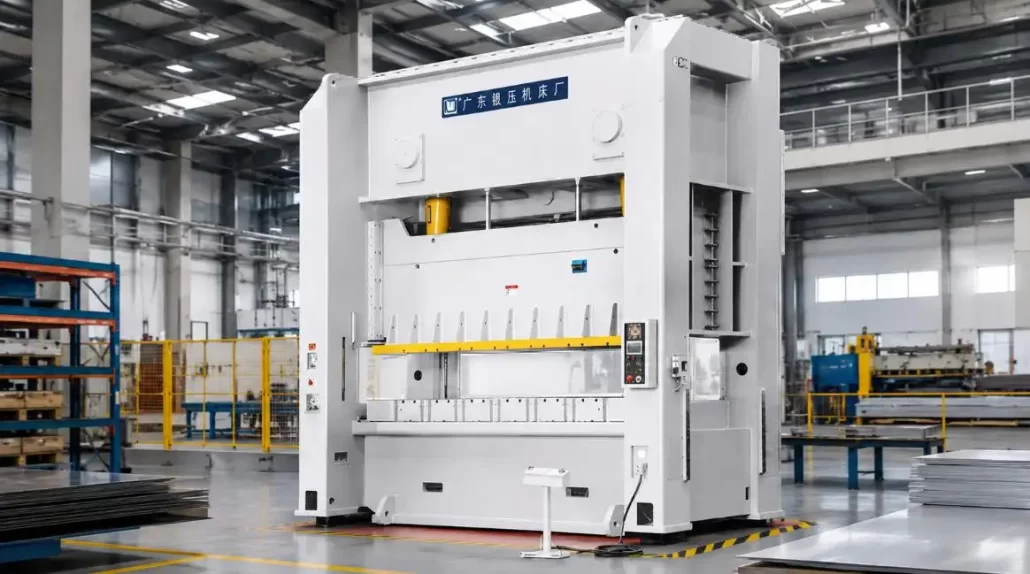
1. Part Size: Defining the Press‘s Dimensional Envelope
1.1 Project Area (Table Size & Die Space)
The largest horizontal dimension of your part determines the minimum bed and slide area. For example, forming an aircraft fuselage panel (2m x 6m) needs a press with a wide rectangular table, not just high tonnage.
• Rule of thumb: Table length & width should be at least 1.5 times the part’s maximum dimension to allow for die mounting and feeding.
• High Tonnage Press Machine For Metal Forming models above 10,000 tons often have custom-built tables for wind turbine flanges or nuclear vessel heads.
1.2 Stroke Length and Daylight Opening
Deep drawn parts (e.g., automotive oil pans, gas cylinders) require long stroke length. Calculate:
Stroke > Draw depth + part height + 150–200mm for handling.
• Low tonnage (1000–3000t): typical stroke 400–800mm.
• Ultra-high tonnage (20,000–50,000t): stroke can exceed 2 meters for heavy forging.
1.3 Part Width-to-Thickness Ratio
Thin, wide parts (like car body panels) create high bending moments on the press frame. The recommended description of a High Tonnage Press Machine for Metal Forming with a multi-point suspension system (four or eight tie rods) is designed to reduce early guide lead wear.
✅ For large but thin parts, bed uniformity is of greater importance than maximum tonnage.
2. Material: The True Determinant of Required Tonnage
When we look closely at the material, we find that the required forming force can vary substantially as a function of yield strength, strain hardening exponent, and forming temperature.
2.1 Cold Forming vs. Hot Forming
Room temperature forming results in the highest required tonnage. Example: forming DP1000 (1000 MPa yield) automotive structural part needs roughly 3× more force than mild steel.
• Warm/hot forming (500–950°C): Reduces flow stress by 50–70%. A High Tonnage Press Machine For Metal Forming for hot stamping of 22MnB5 boron steel can use 40% less tonnage than cold stamping the same geometry.
2.2 Material Flow Stress & Friction
Use this simplified forming force formula for first estimation:
F = k × A × UTS
Where:
• k = 0.7–1.2 (drawing/coining factor)
• A = projected area of the part under the punch
• UTS = ultimate tensile strength (MPa)
�� Example: For a 1000 cm² area, 800 MPa UTS steel, with k=0.9 → F ≈ 7200 tons. So you need a High Tonnage Press Machine For Metal Forming rated at ~8000 tons to have safety margin.
2.3 Material Hardness & Work Hardening
304 stainless steel and a number of nickel alloys harden quickly with work. From a practical standpoint, a press with a total energy capacity of more than 1.5× calculated force is necessary to ensure the press completes the stroke without stalling. Fully loaded strokes of a hydraulic press are accomplished at rated tonnage, while a mechanical press provides a peak force at the bottom of the stroke.
✅ The critical point is that for alloys that are difficult to form and for cases of variable lubrication, a 20–30% tonnage cushion should always be incorporated.
3. Precision: Matching Press Rigidity to Tolerances
Precision of press work can be as loose as ±1.0 mm for a rough forging or as tight as ±0.05 mm for components used in fine blanking or in aerospace work.
3.1 Static vs. Dynamic Accuracy
• Static accuracy: Frame deflection under full load. A quality High Tonnage Press Machine For Metal Forming should have deflection < 0.2 mm per 1000 mm of table width.
• Dynamic accuracy: Slide parallelism and vertical repeatability during high-speed operation (e.g., 30–50 strokes/min). For tight tolerances, choose a press with:
- Preloaded roller or hydrostatic guides
- Active levelling system (servo-hydraulic or electric cylinders)
- Minimum of eight guide gibs for >3000t presses
3.2 Die Closure Control
For coining, embossing, or calibration operations, precision is measured at bottom dead center. Hydraulic presses that have closed-loop servo valves can achieve a repeatability level of ±0.01 mm. Mechanical presses with eccentric drives achieve excellent stroke consistency but suffer from thermal growth after long runs.
Typical precision classes for a High Tonnage Press Machine For Metal Forming:
| Application | Required Tolerance | Recommended Press Type |
| Heavy forging | ±1.5 mm | Open-loop hydraulic |
| Deep drawing | ±0.3 mm | Standard mechanical |
| Fine blanking | ±0.05 mm | Servo-hydraulic with CNC |
| Aerospace superalloy | ±0.02 mm | Isothermal hydraulic press |
3.3 Anti-Tilt and Eccentric Load Capability
When forming asymmetrical parts (e.g., automotive side frames), the press must resist tilting. Check the maximum allowable eccentric load – typically 10–15% of rated tonnage for standard presses, but premium High Tonnage Press Machine For Metal Forming models allow up to 30% eccentricity using multi-cylinder cushion systems.
Finalizing a Selection Process
To find the right High Tonnage Press Machine for Metal Forming that fits your needs, use the following checklist:
- Determine part geometry → establish minimum table size, stroke, and daylight.
- Calculate force from material → using flow stress and projected area; add safety factor.
- Choose press type:
• Hydraulic → deep drawing, long stroke, high precision, variable speed.
• Mechanical → high speed stamping, short strokes, lower energy consumption per part.
• Servo-electric → ultra-high precision, flexible motion curves, higher initial cost.
- Verify rigidity → frame deflection < 0.2 mm/m under full load.
- Check energy requirement → E = F × h (h = forming depth in meters). Evaluate the capacity of each flywheel and pump to ascertain if the flywheel/pump incorporated in the press can endure that amount of energy on each cycle.
- Study the eccentric load. Where the geometry is asymmetrical, provide anti-tilt guides, or use larger tie rods.
Actual Example: Forming a Wind Turbine Main Shaft Flange
• Outer diameter 2.5 m, inner diameter 1.8 m, 250 mm thick
• Material: 42CrMo4 (UTS ~1100 MPa, hot work at 1150 °C)
• With a tolerance of ± 1 mm for the surface flatness and ± 0.5 mm on the concentricity,
• Tooling: 12,000-ton Hydraulic Press. Hot Tonnage press for Metal Forming. Worktable: 2.8 m wide, 1.5 m. Active leveling with integrated Hot Forging tool. Hydraulic type chosen because hot forging requires constant tonnage through the entire reduction height.
Final Thoughts
Selecting a High Tonnage Press Machine For Metal Forming is a multi-variable optimization. Start from your part’s size to determine envelope, use material properties to calculate real force needs, and let precision class guide mechanical vs. hydraulic decisions. Always run a trial simulation if possible, and consult press manufacturers for energy and deflection curves. A correctly sized press not only reduces scrap and tool wear but also extends machine life by decades – a crucial ROI for heavy industry.
Recall that volume alone cannot be judged quality. The ideal High Tonnage Press Machine For Metal Forming aligns size, force, and accuracy, to provide the best solution for your unique production set-up.
CTA
GUANGDUAN (est. 1958) is a trusted manufacturer for press machines. We provide R&D-based offerings including 125 ton cranes, and quick after sales service. Let us help you perfect your forming line. We have high quality machines and offers to ensure you get the most out of your press.
FAQ – High Tonnage Press Machine For Metal Forming
Q1: What’s a quick method for calculating the tonnage needed to form my part?
A: The initial tonnage can be calculated as follows:
Tonnage = Projected Shape Area (cm²) x Material’s UTS (MPa) x (0.7 to 1.2).
After the initial tonnage is calculated, a safety factor of 20-30 percent must be included.
Q2: What’s the difference between hydraulic and mechanical high tonnage presses?
A: Full hydraulic presses provide all their tonnage for the entire stroke of the ram and are suitable for deep cavity forming. The hydraulic press provides rapid effects and peak stamping forces at the bottom of the stroke. The hydraulic press is most suitable for high volume production.
Q3: What are the considerations for using the same press for hot and cold forming?
A: Hot forming and cold forming are very different and use the same press at the same time.
Q4: What is the recommended recalibration frequency for a high tonnage press?
A: A high tonnage press is typically recalibrated when it reaches one the following states:
a) once a year,
b) once it reaches 500,000 strokes,
c) when it loses bottom dead center and slide parallelism.
Q5: What is the expected lifespan of a heavy-duty press machine?A: If a press machine is properly maintained, it can last between 30 to 50 years. Many presses from the 1970’s are still in operation after frame refurbishment and hydraulic upgrades.
CONTACT US


Guangdong Metal Forming Machine Works Co., Ltd.
We are always providing our customers with reliable products and considerate services.
If you would like to keep touch with us directly, please go to contact us
-

Home
-

Tel
-

Email
-

Contact