
From Steel Coil to Car Body: The Hidden “Stamping DNA” Inside Every Automotive Stamping Press
How does a car manufacturer create a part that starts as a flat piece of flexible steel, and ends as a rigid part that has curves and contours, such as a car door or an engine hood? The answer: An industrial marvel called the Automotive Stamping Press, a high-power, precision piece of machinery without which modern vehicle manufacturing would collapse. Over 70% of a typical vehicle’s body-in-white (BIW), including everything from the roof panel to the side frame, is made from stamped metal parts. The “stamping DNA” of a vehicle is the invisible blueprint that gives every vehicle strength, shape, and safety.
Here, we will trace the path of a coil of steel to a car body while describing how the advancement of Automotive Stamping Press technology, including the Mechanical Punch Press STPP Series from GUANGDUAN, facilitates such metallurgical marvels.
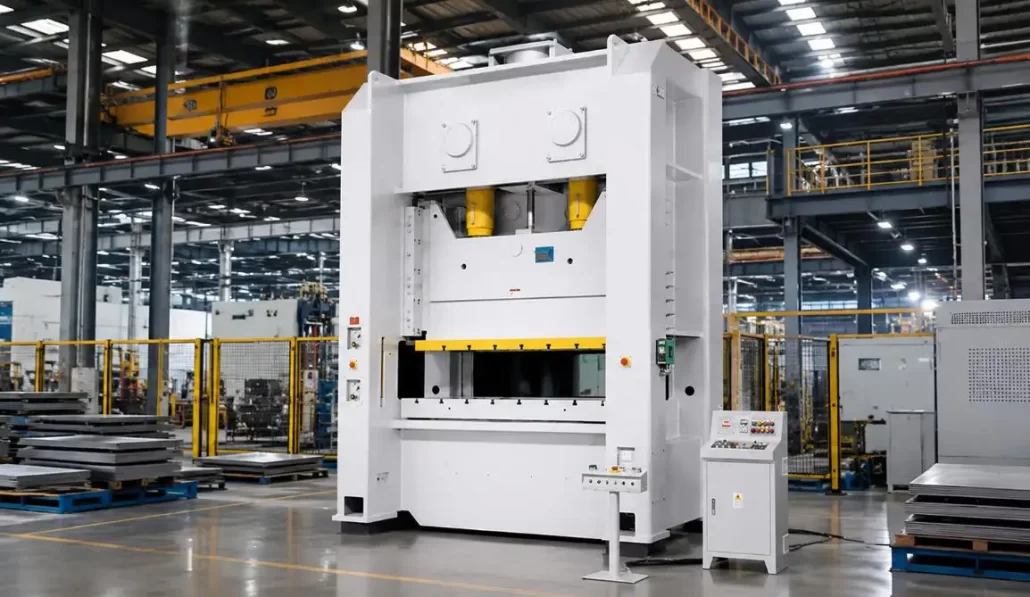
Automotive Stamping Press: The Heart of Sheet Metal Forming
An Automotive Stamping Press is a heavy-duty machine that employs a die to perform metal cutting, bending, and shaping to make automotive parts. General presses cannot perform the unique functions of an Automotive Stamping Press, including speed and tonnage, which can exceed 2,500 tons, as well as accuracy to the level of microns.
When considering the types of stamping presses that include hydraulic, mechanical, and servo, the industry workhorse is the mechanical punch press. It is ideal for high-volume automotive lines as it integrates a flywheel and clutch to deliver fast, repetitive strokes.
Did you know a single automotive stamping press line can produce 15,000 parts each shift? That means they complete a door panel in a matter of seconds!
Transforming Flat Steel to Curved Body Car Panels (A Development in Stamping)
Let’s define some terms using the first step of the stamping process in a stamping shop, focusing on the journey of the steel coil. The “stamping press” accomplishes four main functions.
1. Blanking – Getting an Approximate Shape
In this initial step, the massive steel coil is uncoiled, flattened, and cut into a manageable figure or left to be stamped in a rectangular shape. This is the first function an automotive stamping press performs once the coil enters the shop.
2. Drawing – Volume & Depth Formation
Here, the part is stamped in order to define its volume and depth which can take on the shape of a fender or an oil pan. This requires a stamping press with very high capacity.
3. Trimming & Piercing – Flash Removal and Cleansing
The part has some residue after drawing and needs some holes such as for door lights and outside door handle. The residue is trimmed and holes are added using a stamping press.
4. Flanging & Hemming – Edge Folding and Stiffening
The edges take on a rounded shape after a series of folds that also smooth the edges to prepare them for welding. This step provides the part with a finishing.
All steps must be performed with absolute and unerring uniformity. Even the smallest deviation of 0.1 mm will cause a misfit during assembly and will result in wind noise, water leaks, and possible structural compromise. The efficiency of the Automotive Stamping Press will dictate the quality of the vehicle.
Why Precision & Rigidity Matter: The Engineering Challenge
Automotive stamping challenges the laws of physics. When a press comes down with hundreds of tons of force, the metal tends to wrinkle, crack, and spring back. Furthermore, The Automotive Stamping Press itself undergoes huge lateral loads that can displace the slide (ram) and shorten the lifespan of the tool.
Defects attributable to press systems that are less rigid are:
•Panels that are warped
•Corners that are cracked
•Dies that show premature failure
To produce car bodies of highest quality, an Automotive Stamping Press must possess:
•Great rigidity to prevent deflection
•Accurate slide alignment to prevent lateral movement
•Fast, sensitive overload protection
GUANGDUAN’s Mechanical Punch Press STPP Series excels here.
GUANGDUAN‘s Stamping DNA: How the STPP Series Builds Better Cars
GUANGDUAN has designed its Mechanical Punch Press STPP Series to meet the most demanding needs of automotive stamping. Let us analyze the main features and see how each will add value to your production.
1) Rigid Welded Steel Body – The Skeleton of Strength
•What it does: The rigid body of the machine is manufactured by welding thick plates of steel with excellent rigidity.
•Why it matters for an Automotive Stamping Press: A stiffer frame will resist flexing and absorb less stamping shock which allows each stroke to direct the intended stamping force to the dies rather than to the press structure, therefore improving the efficiency of the press.
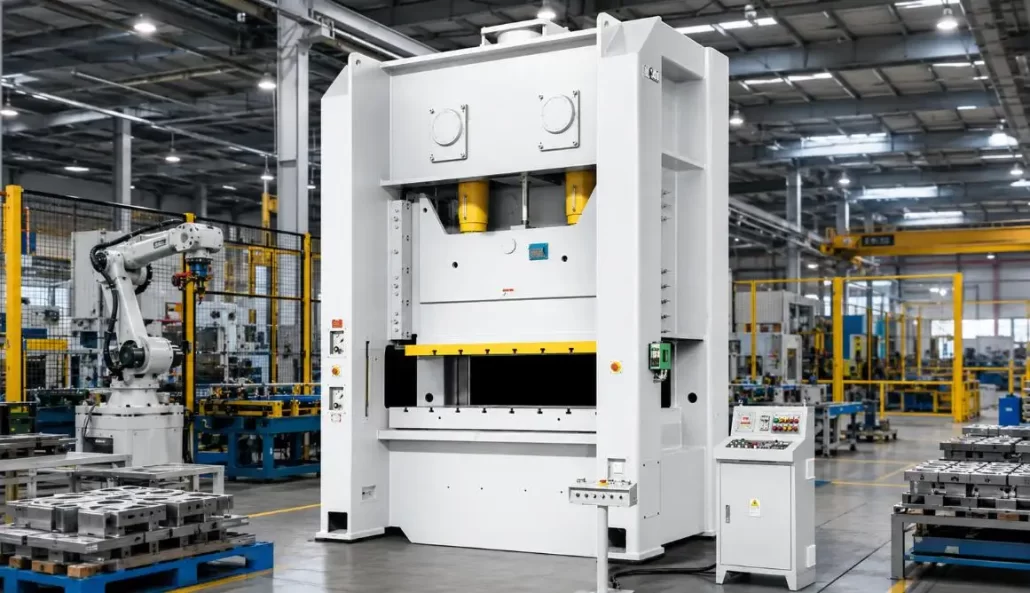
2)Reverse Double-Crankshaft Design – Cancelling Side Forces
•What it does: Two double crankshafts positioned to oppose each other are used. This balances the motion and cancels side forces from the linkage side block.
•Why this is revolutionary: Sideways forces can shift press alignment. The reverse design means that your Automotive Stamping Press remains aligned when stamping asymmetric parts. For example, left and right fenders on the same production line.
3) 8-Sided Full Guide Rails for the Slide – Unmatched Anti-Tilt Capacity
•What it does: The rails provide eight-sided full contact guidance for the slider.
•Easily Applied: Suitable for high bearing capacity, this deals with tilt and lateral wear, which controls wear. This allows the slide to withstand stamping of high-strength steel (HSS).
4) Built-in Hydraulic Overload Protection in the Slide Block
•How it works: In a high-speed hydraulic system, it takes pressure out the moment the force exceeds the limit.
•Why it is critical: In automotive stamping, crashing the tool can cost $100,000 and several days of loss of production. This system protects your dies and the Automotive Stamping Press, and it works fast, sensitively, and reliably.
5)High-Torque Wet Clutch – Silent, Durable, and Responsive
•Features: The clutch is a wet-type (oil-cooled) design with large torque capacity, long service life, and no wear-related degradation and provides low noise, with sensitive start and brake controls.
•Operational advantage: Conventional dry clutches are highly troublesome. They require constant adjustments and produce dust, contaminating the surrounding environment, and extending the intervals between the needed major maintenance overhauls of the Automotive Stamping Press. Keeping the stamping shop cleaner means less disruption to operations, while the wet clutch greatly extends the intervals between the needed major maintenance overhauls.
6) PLC Control with Automation-Ready Architecture
•Capability: The stamping press uses PLC and can be linked to coiling leveling devices and automated transfer devices.
•Production flexibility: The STPP series provides a complete answer for your requirements whether you need a single Automotive Stamping Press for your prototypes or a fully automated tandem system for mass production with 4-6 presses in series.
Building the Complete Stamping Line: One or Many Machines
One of the greatest features of the GUANGDUAN Mechanical Punch Press STPP Series is its flexibility. It can be configured as:
| Configuration | Best For |
| Single press with manual loading | Low-volume parts, service centers, or die trials |
| Single press with coil line (uncoiler and leveler) | Mid-volume production of smaller panels |
| Multi-press tandem line with robots | High-volume automotive body parts (doors, roofs, side panels) |
The PLC control is the brain that transmits signals to the Automotive Stamping Press and subsequent downstream machinery. This allows you to achieve automated stamping production with consistent cycle times and minimal human intervention.
The Future: How Stamping DNA Evolves with New Materials
Today’s cars use advanced high-strength steel (AHSS) and aluminum alloys to reduce weight for electric vehicle (EV) range. These materials are less forgiving – they want to crack or spring back. A traditional Automotive Stamping Press struggles to hold tolerances.
But a press like GUANGDUAN’s STPP series, with its eight-sided guide and overload protection, provides the controlled rigidity needed for AHSS. Moreover, the servo-ready design of newer models allows programmable slide motion (dwell, slow-down, fast-return) to optimize material flow.
�� EV revolution reminder: Every electric vehicle still relies on stamped steel or aluminum structural parts – from the battery tray enclosure to the motor mount brackets. The Automotive Stamping Press is here to stay.
Conclusion: Your Car‘s Strength Begins with the Stamping Press
Next time you close a car door and hear that solid, reassuring thud, remember that the sound comes not just from the door itself, but from the Automotive Stamping Press that formed it with micron-level precision. From the initial steel coil to the final painted body, stamping is the invisible DNA that defines modern automotive engineering.
Build better cars – start with better stamping. Contact GUANGDUAN to learn how the STPP series can upgrade your shop’s stamping DNA.
FAQs
Q1: What is the Tonnage Range of a Typical Automotive Stamping Press for Car Body Construction?
A: For stamping most of the car body parts which include doors, hoods, and fenders, a stamping press in the 400 tons to 1200 tons range would suffice. A stamping press in the 1500 to 2500 tons is suitable for A pillars and floor pans which are a part of car body frame construction. GUANGDUAN’s STPP series can be designed to meet specific tonnage requirements.
Q2: Why does a reverse Double-crankshaft Stamping Press produce better quality than a regular stamping press?
A: The side force generated by the off-center load is eliminated therefore maintaining a perfectly vertical alignment of the slide without wear to the die. This allows for production of parts with well-defined edges therefore allowing for easy fitting of panels in a car body.
Q3: Will the Mechanical Punch Press STPP Series be able to easily work with the AL of Electric Cars?
A: The STPP series can indeed handle AL panels. However, AL panels are problematic as they can cause scratches and bounce back. The use of eight sided full guide rails and dry lubrication can significantly improves the functionality with AL while avoiding the pick up of AL.
Q4: Will Your Press Fit in the Existing Stamping Lines of Other Companies?
A: Yes, the STPP series can replace older stamping presses and integrates well with PLC control and standard automation interface. This system can take the place of an older stamping press in a tandem stamping line or be a new stamping press in a line along with uncoiling and leveling tools.
Q5: How Regular is The Maintenance of The Wet Clutch?
A: Unlike dry clutches that need weekly inspection, a wet (oil-cooled) clutch typically requires oil changes every 4,000–6,000 operating hours and requires a clutch plate inspection after 10,000 hours. This significantly reduces downtime in high-volume automotive stamping.
CONTACT US


Guangdong Metal Forming Machine Works Co., Ltd.
We are always providing our customers with reliable products and considerate services.
If you would like to keep touch with us directly, please go to contact us
-

Home
-

Tel
-

Email
-

Contact