
Hydraulic Forging Press Machine for Automotive Parts: Frame Rigidity and Deflection Control
Frame rigidity is a critical factor in choosing a Hydraulic Forging Press Machine for Automotive Parts. Elastic deformation can negatively affect the slide parallelism, die clearance, material flow, and the resultant dimensions of the part. Even if a press can generate the necessary nominal force, press rigidity of the frame, columns, worktable, and guidance system may still render the press operationally ineffective.
As a result of the design and function of many automotive parts, most automotive production will involve asymmetric parts, large dies, off-center loading, and the need for high precision. For this reason, comparisons need to go beyond tonnage.
What Is Frame Rigidity?
Frame rigidity is a measure of how much elastic deformation a press will exhibit. A press with high rigidity will experience low displacement when a load is applied compared to a press with low rigidity.
Typical deformation includes beam bending, worktable deflection, column elongation, slide tilt, and loss of die-surface parallelism.
Rigidity is not the same as nominal tonnage. Tonnage indicates maximum hydraulic force, while rigidity shows how much the structure moves under that force. Two presses with the same capacity may therefore have different deflection and off-center-load performance.
Impact of Deflection on Automotive Components
| Deflection Issue | Tooling Effect | Part Effect |
| Slide tilt | Die contact becomes uneven | Dimensions become unequal |
| Worktable bending | Die clearance becomes uneven | Underfill or uneven flash |
| Lateral movement | Increased guide load | Misalignment |
| Off-center deformation | Localized pressure concentration | Cracks or folds |
| Repeated variation | Unstable shut height | Variation within the batch |
For a Hydraulic Forging Press Machine used for Automotive Components, high levels of deflection may have an impact on thickness, flatness, reference holes, flash, and machining allowance. Deflection can create uneven pressure which may result in incomplete filling, irregular flash, deviation of the flow line, or local overload.
Poor slide parallelism also increases wear on dies and guides.
What Contributes to Press Deflection?
Frame Design
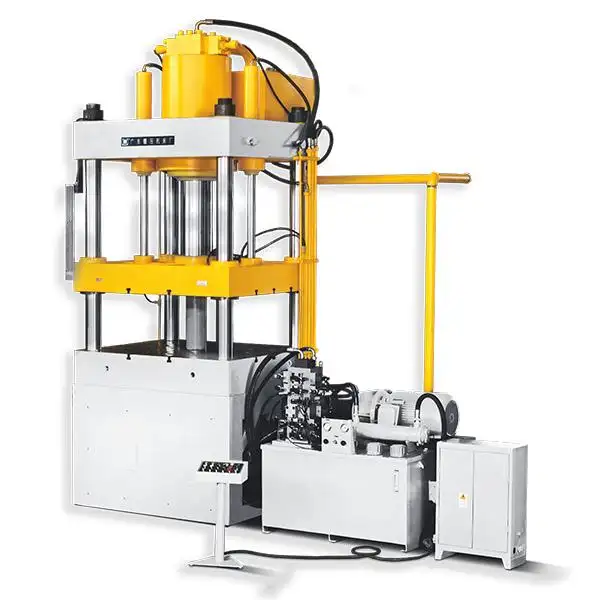
Four-column designs have open access but require some verification of Column extension, beam bending, and allowance for off-center loads. Straight-side designs are preferred when rigidity is a greater requirement and the need for more complicated loadings is anticipated. When dealing with flexibility, frame designs such as the H-frame, welded-joint stiffness, table stiffness, and among the various designs of load frames, prestressing, are the most relevant.
No frame type is best for every application. Selection should depend on force distribution, die size, cycle rate, and allowable deformation.
Off-Center Loading
Off-center load may result from asymmetric parts, uneven cavity filling, inaccurate placement, different station loads, or die wear. Buyers should ask:
What off-center load can the press tolerate at a specified distance from the centerline?
This can be more useful than nominal tonnage alone.
Work Tables, Dies, & Columns
With the expansion of the work table, the stiffness of the beams and the table becomes more critical. Purchasers must consider the size of the die, the size of the load center, the mounting of the die, and its supports.
The characteristics of a column (the diameter, length, material, and the preload and heat treatment) will also affect elongation.
How is Frame Rigidity Measured?
Finite Element Method (FEM) allows the prediction of stress, deflections of beams, and the bending of tables as well as the loading of columns and the tilting of slides under actual die loads.
When testing rigidity, the following must be done:
• Pressure and Leakage Tests
• Measurement of Slide Parallelism
• Measurement of Work Table Deflection
• Verification of Off-Center Loading
• Testing for Repeatability
Slide parallelism must be tested at unloaded, at or near rated pressure, centered and permitted off-center loading, and during pressure leakage.
Engineering Methods of Deflection Control
The best deflection control of a press combines:
• Optimal beam cross-sections and stress distribution
• Enhanced load transfer
• Better supports for work tables
• Stress relief of welded components
• Precise slide alignment and lubrication
• Stable and synchronized control of the pressure within the cylinders
• Control of the press cycle, as well as the hold, return, and relief.
In a four-column hydraulic press, the finishes of the columns, as well as the fit and lubrication of guide bushes, are important for long-term accuracy.
Within automotive production, the integration of control of pressure, position, speed, and time may be required, along with the operation of the press in fixed-position mode, which defines the end of a stroke, or fixed-pressure mode, which defines the end of a stroke.
Application Requirements
| Part | Main Challenge | Press Requirement |
| Connecting rod | Uneven longitudinal load | Stable die parallelism |
| Steering knuckle | Asymmetric geometry | Off-center resistance |
| Control arm | Large projected area | Rigid table support |
| Wheel component | Broad forming area | Uniform pressure |
| Gear blank | Tight concentricity | Repeatable positioning |
| Thin panel | Large-area drawing | Double-action control |
Heavy hot forging, cold extrusion, drawing of sheets and calibration are distinct processes. A Hydraulic Forging Press machine for automotive components should be aligned to the actual forming process, not just the tonnage.
Four-Column vs. Straight-Side Presses
Four-column presses provide unrestricted access, easy die changes and guidance of the die by the columns. Straight-side presses are often selected for higher rigidity or complex off-center loading. Actual performance still depends on beam design, guidance, frame dimensions, preload, and verified deflection data.
Press structure should be selected according to force distribution, die size, part geometry, production cycle, and allowable deflection—not by frame type alone.
Final Considerations
Frame rigidity directly affects part consistency, die life, and production stability. Nominal tonnage alone cannot define the capability of a Hydraulic Forging Press Machine For Automotive Parts. Buyers should evaluate worktable size, load position, off-center conditions, guidance design, hydraulic control, and measured deformation under load.
Discuss Your Automotive Forming Project With GUANGDUAN
For automotive thin-plate drawing, forming, aligning, bending, and related double-action operations, GUANGDUAN’s YA28 Series provides a four-column, three-beam structure, adjustable pressure and stroke, fixed-pressure or fixed-position operation, pressure holding, rapid idle travel, and two-hand safety control. Share your part drawing, die size, forming force, production rate, and off-center-load conditions for an engineering-based configuration assessment.
FAQs
Q1. Which automotive applications integrate with GUANGDUAN hydraulic presses?
GUANGDUAN hydraulic presses are used throughout the automotive industry for sheet drawing, forming, aligning, bending and folding as well as calibration and other processing operations. The optimal model is determined by the material, geometry of the part, die size, and the force requirements.
Q2. Can the GUANGDUAN YA28 Series be used for heavy automotive forging?
The YA28 series is intended for thin-plate deep drawing and forming, aligning, bending, and folding. Heavy hot forging or high-load closed-die forging will likely require a different frame and press design.
Q3. What is the design of the YA28 hydraulic press?
The YA28 Series is built using a four-column and three-beam design. This design enables an open work area with easy die accessibility, stable slide guidance, and versatility for double-action forming.
Q4. Are the pressure and stroke of the YA28 Series adjustable?
Yes. The working pressure and stroke of the slide are adjustable to meet the requirements of the material, die, forming depth, and processing within the limits of the machine.
Q5. Are fixed-pressure and fixed-position controls available for the YA28 Series?
Yes. The operator is able to set the machine to either fixed-pressure or fixed-position operation. In addition, the machine is capable of performing pressure hold and time delay functions within the forming cycle as dictated by the requirements.
CONTACT US


Guangdong Metal Forming Machine Works Co., Ltd.
We are always providing our customers with reliable products and considerate services.
If you would like to keep touch with us directly, please go to contact us
-

Home
-

Tel
-

Email
-

Contact