
Hydraulic Forging Press: How Forging Plants Cut Energy Waste And Keep Precision
Hydraulic Forging Press performance is now judged by more than tonnage alone. For overseas buyers, plant managers, and industrial distributors, the real question is whether a press can keep precision stable, reduce energy waste, improve operator safety, and fit the shift toward smarter manufacturing. That pressure is rising as the global metal forging market, estimated at USD 94.38 billion in 2024, is projected to reach USD 145.46 billion by 2030, driven by demand for stronger, lighter components across automotive, aerospace, and heavy industry.
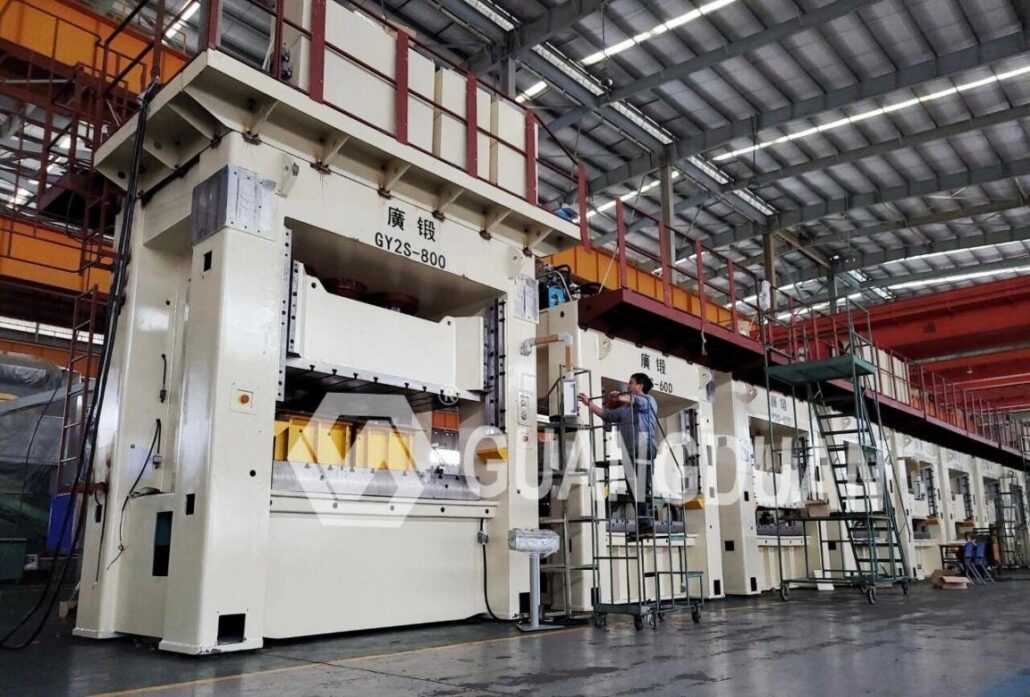
The Real Pain Point Is Not Force, But Process Stability
In many forging and forming shops, production problems do not begin with maximum pressure. They begin with instability during daily operation. Buyers often see the same set of challenges:
• Inconsistent slide guidance over long operating cycles
• Greater power consumption during idle periods and repeated strokes
• Excess vibration and noise that reduce both accuracy and shop comfort
• More complex setup adjustments across molds and part programs
• Safety risks caused by uncontrolled slide motion or operator error
These challenges matter because the industry is moving toward closer tolerances, shorter lead times, and more advanced digital quality control. At the same time, manufacturers are being pushed to increase productivity, work around labor shortages, and modernize production with automation and digitalization.
That is where equipment design starts to separate basic capacity from real production value.
Why Modern Buyers Expect More From a Hydraulic Forging Press
Today’s press investment is no longer just a machine purchase. It is a long-term decision about operating cost, precision retention, training complexity, and line integration.
This change is also visible in the broader hydraulics market. The global hydraulics market is projected to grow from USD 39.40 billion in 2025 to USD 44.26 billion by 2030, showing continued demand for hydraulic technology that improves productivity and efficiency.
For forging plants, that means a competitive Hydraulic Forging Press should now deliver four things at the same time:
• Structural rigidity for long-cycle precision
• Smarter control for faster adjustment and repeatability
• Energy-saving drive architecture
• Safety systems that support real shop-floor compliance
How GUANGDUAN Addresses These Shop-Floor Challenges
GUANGDUAN positions its hydraulic press technology around exactly these production needs.
The machine frame uses a high-quality steel welded box structure, which supports rigidity and helps the equipment maintain stable performance under heavy-duty operation. For buyers, this matters because frame strength affects more than appearance. It directly influences deflection control, repeatability, and service life.
The slider also uses a steel plate welded box structure and adopts an eight-sided full guide rail system. This is especially important in forging and forming applications where guide accuracy and long-term precision retention determine whether part quality remains stable over extended runs. Practically speaking, stronger guidance contributes to lower drift, better repeat accuracy, and more reliable die performance.
GUANGDUAN also uses a thin-oil continuous circulation lubrication system, which helps keep friction, wear, and maintenance pressure under better control. In production environments where uptime matters, lubrication design is not a small detail. It is part of how a press protects precision over time.
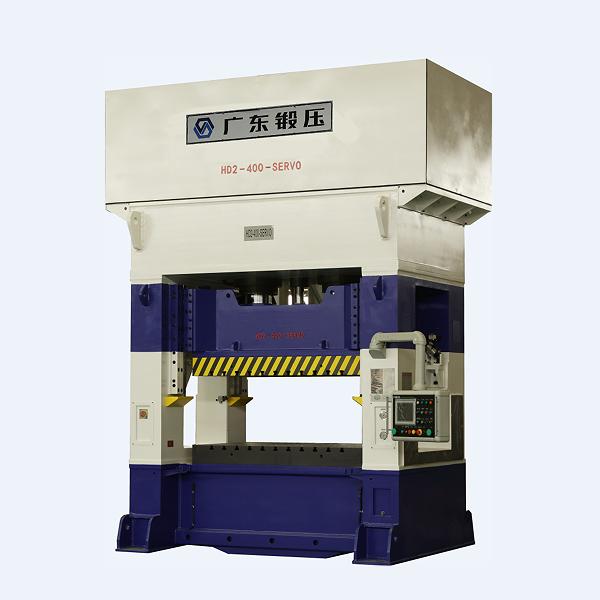
Servo Closed-Loop Control Fits the New Manufacturing Standard
One of the clearest industry shifts is the move toward presses that are not only powerful, but also measurable and adjustable in real time.
GUANGDUAN’s servo closed-loop control system, built around a servo motor driver, pressure sensor, displacement sensor, and PLC, responds directly to that trend. This matters because closed-loop control gives operators better control over stroke, pressure, and movement consistency. It also helps reduce excess noise and vibration while supporting more energy-conscious production.
That direction is strongly aligned with wider equipment development. Bosch Rexroth reported that servo-hydraulic press solutions can deliver up to 30% energy savings through recuperation, while also improving flexibility, productivity, and digitalization potential.
For forging plants facing electricity cost pressure and sustainability targets, that is no longer optional. It is becoming part of the purchasing checklist.
With GUANGDUAN, the practical value is clear:
• High precision through sensor-based closed-loop control
• Lower noise and vibration for better operating conditions
• Energy-saving performance that fits modern factory targets
• Better repeatability across different production cycles
Faster Setup, Better Usability, and More Consistent Output
A common bottleneck in forming shops is not only the press stroke itself, but the time lost during setup, adjustment, and mold changeovers.
GUANGDUAN addresses this with an intelligent control architecture that combines PLC, servo system, touch screen, and grating ruler control. Operators can make real-time digital adjustments according to different molds and process requirements, and the system can store 20 sets of mold parameter settings.
For overseas buyers and distributors, this is an attractive benefit because it enhances usability without making the system harder to operate. It also supports:
• Faster recipe switching between jobs
• Lower dependence on manual trial-and-error
• Better consistency between operators
• Easier training for new staff
This kind of digital control also fits the broader shift toward data-based production management. Siemens highlights that modern manufacturing systems increasingly focus on machine utilization, batch traceability, quality KPI trends, and energy data evaluation.
In other words, presses are expected to become part of a smarter production system, not remain isolated pieces of equipment.
Safety Is Still a Core Buying Decision
No serious buyer ignores safety. In heavy forming environments, safeguarding is directly tied to risk control, compliance, and production continuity.
GUANGDUAN equips the machine with a slider locking device that can lock the slider at any position, reducing the risk of accidental sliding. It also includes lower limit switch protection, two-hand anti-repeat protection, and multi-level anti-error safeguards in the touch-screen parameter setting system.
These functions match real industry expectations. OSHA notes that two-hand trip systems must incorporate an anti-repeat feature, and its machine guarding guidance emphasizes that proper safeguarding is essential to prevent serious press-related injuries.
For buyers serving regulated markets, these design details strengthen both equipment value and customer confidence.
Why GUANGDUAN Matches Where the Market Is Going
The market is expanding, but so are buyer expectations. A modern Hydraulic Forging Press must support more than force output. It must help manufacturers manage cost, precision, safety, and digital readiness at the same time.
GUANGDUAN’s combination of:
• Rigid welded box construction
• Eight-sided full guide rail guidance
• Thin-oil continuous lubrication
• Servo closed-loop control
• Intelligent touch-screen parameter management
• Multi-level safety protection
makes it well aligned with current forging industry needs.
For distributors, OEM buyers, and plant decision-makers, that means a press platform designed not only for today’s workload, but also for the next stage of manufacturing: higher precision, smarter control, better energy performance, and safer operation.
In a market that keeps pushing toward automation, traceability, and efficiency, GUANGDUAN is not simply offering hydraulic force. It is offering a more production-ready answer to what forging plants now need most.
CONTACT US


Guangdong Metal Forming Machine Works Co., Ltd.
We are always providing our customers with reliable products and considerate services.
If you would like to keep touch with us directly, please go to contact us
-

Home
-

Tel
-

Email
-

Contact