
Hot Forging Press: Modern Forging Plants Need More Than Tonnage
Hot Forging Press selection is no longer only about force output. For overseas buyers, distributors, and metalforming manufacturers, the real question is whether a press can hold precision, support automation, reduce unplanned downtime, and stay aligned with the wider shift toward energy-efficient, data-aware manufacturing. That pressure is rising as industrial energy demand remains high globally and manufacturers are pushed to modernize for competitiveness, efficiency, and supply-chain resilience.

The Real Pain Point in Forging Is Process Stability, Not Just Capacity
Many buyers still compare forging equipment by nominal tonnage first. In practice, that is rarely enough. A forging line can have enough force on paper and still lose money through unstable slide motion, weak guidance accuracy, inconsistent die protection, or slow changeover. Those issues matter even more in sectors such as automotive, motorcycles, hardware, instrumentation, and gas appliances, where repeatability and throughput directly affect delivery performance and scrap control.
The market is moving in a direction that makes those weaknesses harder to hide. Lightweight component demand, stronger material requirements, and the broader adoption of advanced manufacturing all push suppliers toward better forming consistency and smarter production systems. The U.S. Department of Energy notes that reducing vehicle weight by 10% can improve fuel economy by about 6% to 8%, which helps explain why manufacturers keep investing in strong, high-performance formed parts and more advanced production routes.
Why Traditional Press Buying Logic Is Falling Behind
Older buying logic often focused on three things: price, tonnage, and basic durability. Today, international buyers tend to look further. They want equipment that can work well inside a modern factory environment, where uptime, safety, automation compatibility, and documentation all matter.
Common problems in conventional forge press operations include:
• Insufficient frame rigidity under repeated heavy-load production
• Slide guidance wear that gradually affects forming precision
• Longer setup time when dies need adjustment or recalibration
• Overload risk that raises maintenance cost and die damage probability
• Limited readiness for feeding, leveling, and automated line integration
• Weak safety coverage for operators in higher-speed production
These concerns are no longer secondary. NIST continues to emphasize smart manufacturing as a foundation for trustworthy technology adoption in production, while its recent work on traceability also reflects how structured production data and clearer operational records are becoming more relevant across modern manufacturing ecosystems.
How GUANGDUAN Answers These Production Challenges
This is where GUANGDUAN positions its Hot Forging Press solution more strategically. The JH31 series is not presented as a simple high-force machine. Its design addresses several pain points that buyers increasingly care about when they evaluate long-term line performance.
The narrow-table closed-type single-point structure uses a monolithic box-type body, with some models adopting a four-pull level pre-light structure. In practical terms, that matters because higher rigidity supports better resistance to deformation under repeated load cycles. For buyers producing demanding metal parts, stronger rigidity supports more stable forming conditions and better long-cycle precision retention.
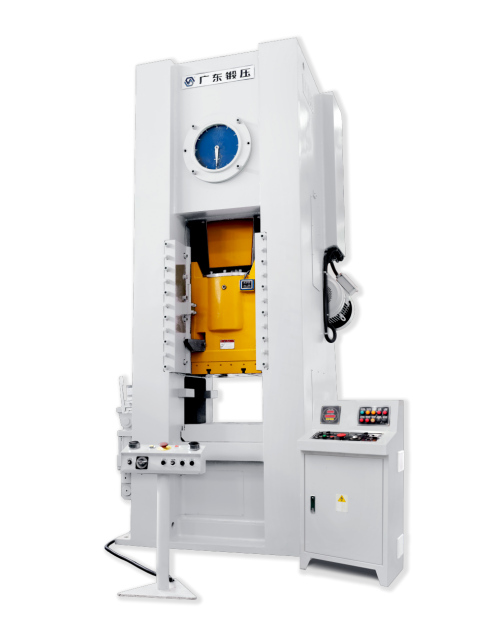
The crankshaft adopts an eccentric shaft structure with strong bearing capacity, while the wet-type clutch is designed for longer service life. That combination is relevant to plants trying to reduce maintenance interruptions and keep production more predictable across extended operating periods.
Another important point is the four-surface full-guideway slide block design. In forging, guiding precision affects more than motion smoothness. It influences die alignment, holding accuracy, part consistency, and the long-term health of the tooling system. For distributors or end users selling into automotive or industrial component manufacturing, that is a meaningful value point rather than a minor technical detail.
Built for Faster Adjustment, Better Protection, and Safer Operation
A major frustration in forging plants is lost time between jobs. GUANGDUAN addresses this with mechanical die height adjustment and digital display, making die calibration easier and faster. That helps operators reduce setup complexity while improving repeatability during job changes.
Protection features are also matched to different tonnage ranges. The JH31-400/630/800 models adopt hydraulic overload protection, while the JH31-200-300 models use a wedge-shaped iron die unlocking device. For buyers, this is important because overload protection is not only about emergency response. It is also about protecting tooling investment, lowering repair frequency, and maintaining more stable production economics.
The control architecture combines PLC and pneumatic control, with three stroke modes: continuous stroke, single stroke, and micro-motion. This gives plants more flexibility for different process needs, especially when they need to balance output speed with forming control.
From a safety standpoint, the machine can be equipped with photo-electric protection. That matters in a market where production efficiency can no longer come at the expense of operator security. Safer operation is increasingly tied to purchasing decisions, especially for exporters and manufacturers supplying regulated customers or larger industrial buyers.
Why Automation Readiness Now Matters More Than Ever
One of the clearest industry shifts is the move from standalone machines to connected production cells. NIST points to automation, digital adoption, and resilient manufacturing systems as core trends shaping the future of industrial performance. In such a landscape, a Hot Forging Press that cannot fit into automated production lines is increasingly viewed as a disadvantage rather than a strength.
GUANGDUAN responds to that shift by offering optional automatic feeding and uncoiling leveling devices. This is valuable for plants planning to reduce manual intervention, standardize throughput, and support more scalable production. For overseas buyers, that automation readiness also improves the machine’s long-term market appeal, because customers are not only buying current output capability. They are buying future production flexibility.
Energy and efficiency pressure also continue to shape industrial purchasing. The IEA notes that industry remains the largest share of global final energy consumption, and current policy thinking increasingly focuses on efficient motors, pumps, systems, audits, and energy management. In that context, buyers are more likely to favor equipment that supports smoother operation, lower waste, and better production discipline rather than purely mechanical output claims.
A More Practical Hot Forging Press Choice For Today‘s Buyers
For many buyers, the best equipment decision is not the machine with the most aggressive headline specification. It is the one that helps the plant run with fewer interruptions, safer operation, better die protection, stronger guidance precision, and clearer automation potential.
That is why GUANGDUAN’s Hot Forging Press offering fits current market demand well. Its rigid closed-type structure, precise four-surface guideway system, digital adjustment support, overload protection design, PLC-plus-pneumatic control, and optional automation configuration all respond to the real direction of the forging industry: higher precision, higher reliability, better safety, and smarter production integration. Those priorities align closely with wider advanced manufacturing and efficiency trends now shaping industrial investment worldwide.
For a distributor, importer, or end user evaluating forging equipment in 2026, that makes the conversation much clearer. A modern Hot Forging Press must do more than press metal. It must help the factory stay precise, competitive, and ready for the next stage of manufacturing.
CONTACT US


Guangdong Metal Forming Machine Works Co., Ltd.
We are always providing our customers with reliable products and considerate services.
If you would like to keep touch with us directly, please go to contact us
-

Home
-

Tel
-

Email
-

Contact