
Industrial Crankshaft Press Design and Performance Explained
In many modern forging plants, the Industrial Crankshaft Press has moved from a supporting role to a core strategic asset. It is no longer seen as a simple source of tonnage but as a precision forming platform that shapes part quality, tooling cost, energy use, and production risk. For manufacturers such as GUANGDUAN, the main question is not just “How many tons can it deliver?” but “How consistently can that force be applied, shift after shift, over many years?”
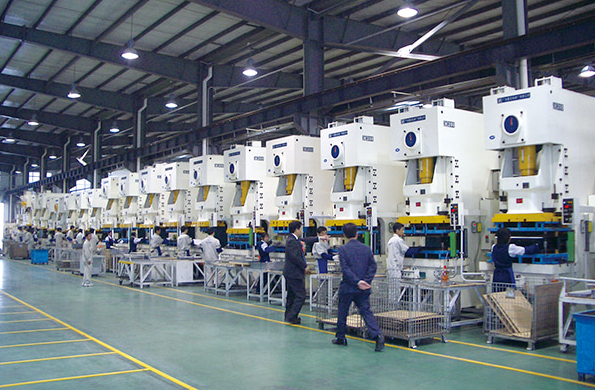
1) What Exactly Is an Industrial Crankshaft Press?
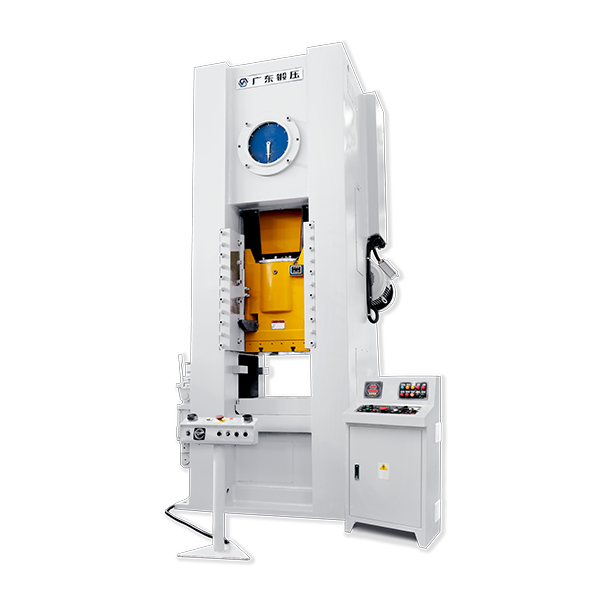
At its core, an Industrial Crankshaft Press is a mechanical press in which a crankshaft converts the motor’s rotary motion into the linear stroke of the slide. When that motion is combined with a toggle or knuckle joint, the press can generate very high forming forces right at the bottom of the stroke, where final geometry and surface finish are determined.
Compared with a hydraulic press, a high-quality Industrial Crankshaft Press typically offers:
- High force output from a relatively compact frame
- A well-defined stroke with a fixed bottom dead center (BDC)
- Excellent repeatability from part to part and batch to batch
Because of these characteristics, this type of press is widely used for demanding cold and warm forging, precision extrusion, and fine stamping of high-strength materials, where narrow tolerances and stable processes are critical.
2) Frame Design, Load Flow, and Rigidity
The frame of an Industrial Crankshaft Press is not just a shell; it is a load-bearing precision structure. Under forming loads that can easily range from about 6,300 kN to 25,000 kN or more, any uncontrolled deflection will show up directly in die misalignment, dimensional drift, and shortened tool life.
Modern press builders like GUANGDUAN approach the frame as an engineered system:
- Integral vs. Split Frame Structures
Smaller and medium-capacity presses are usually built around a single-piece frame that resists bending and reduces any relative motion at joints. As press size and weight increase, modular split-frame designs are adopted to simplify logistics and on-site assembly. These larger presses still maintain tight deflection limits by using engineered bolted joints, accurately machined contact faces, and validated stress models.
- Controlled Load Paths
The press frame is configured so that all major force-carrying elements – columns, crossbeams, and tie rods – work together to channel forming loads directly into the floor, ensuring stable and repeatable operation. By limiting bending and twisting within the frame, the press can maintain small clearances between the slide and guides under load. The practical result is a press that can repeatedly hit tight tolerances without operators constantly adjusting shut height as the machine warms up or as parts become more demanding.
3) Crank–Toggle Kinematics and Bottom Dwell
A key reason engineers specify an Industrial Crankshaft Press is the crank-toggle or knuckle mechanism used between the crankshaft and the slide.
This kinematic layout offers two standout benefits:
- Intensified Force Near BDC
Approaching bottom dead center, the crank-link assembly reaches near alignment, which boosts mechanical advantage. This enables the press to concentrate maximum forming pressure just as the material is hardest to shape and the final size is being defined.
- Short Dwell at the Bottom
Around bottom dead center, slide speed decreases and a brief dwell often occurs, typically around 1/18 of the overall cycle. As the press holds at dwell, the component stays under intense pressure, allowing metal to fully occupy corners and subtle details, while limiting springback and improving feature sharpness. For demanding tasks – such as cold extrusion, fine blanking of intricate shapes, or forming advanced high-strength alloys – this short dwell segment provides a decisive quality advantage.
4) Slide Guidance and Die Height: Turning Design into Reality
Even the best mechanism will not deliver good parts if the slide is unstable or die height is difficult to control.
- Precision Slide Guidance
High-accuracy guide systems keep the slide on its proper path even under eccentric or asymmetric loads – a common reality in multi-cavity tools or complex geometries. Proper guidance reduces lateral loads on the dies, lowers wear on guide surfaces, and helps avoid sudden misalignment that can damage tools or scrap parts.
- Fine Die Height Adjustment
A modern Industrial Crankshaft Press usually integrates a die height indicator with fine resolution, often down to 0.01 mm. This enables toolmakers and maintenance personnel to:
- Set up die heights quickly and accurately
- Record exact settings for each part number or tool set
- Return to proven recipes without lengthy trial-and-error
Over the life of the press, this combination of rigid guidance and precise die height control helps cut scrap, reduce tool breakage, and shorten changeover time – direct benefits for throughput and cost per piece.
5) Clutch–Brake Systems and Energy Control
The reliability of an Industrial Crankshaft Press also depends heavily on how its energy is transmitted and controlled. GUANGDUAN and other advanced builders match clutch-brake systems to the required tonnage, stroke energy, and operating mode.
Common solutions include:
- Pneumatic Wet Integrated Friction Clutch-Brake
Used frequently in small and medium-tonnage presses, this system provides smooth engagement and benefits from efficient heat removal via the oil medium. It supports steady braking performance and reliable operation in continuous production.
- Pneumatic Dry Split Friction Clutch-Brake
For higher-tonnage presses with greater energy per stroke, a dry split unit is often preferred. It simplifies maintenance because components can be accessed and replaced with less disassembly. At the same time, it maintains strong torque capacity and safe stopping characteristics.
In both cases, the goal is the same: ensure that the slide accelerates, forms, and stops in a controlled, repeatable way, protecting the drive train, the dies, and the workpieces during thousands of cycles per day.
6) Ejection, Part Handling, and Die Protection
Part removal may look like a detail on paper, but on the shop floor it heavily affects stability and cycle time. Industrial Crankshaft Presses designed for serious forging duty therefore often include a mechanical lower ejector as standard equipment.
A properly designed ejector:
- Provides a controlled upward motion to release the part from the die
- Reduces the risk of parts sticking and being hit again unintentionally
- Protects delicate features and functional surfaces on the forging
- Limits impact loads on the tooling that could shorten die life
In cold forging, where parts frequently grip the die surface tightly, consistent and predictable ejection is essential for maintaining cycle time and operator confidence.
- From Mechanical Press to Connected Forming Cell
For a modern Industrial Crankshaft Press, the control system is just as important as the frame and crankshaft. A PLC-centered architecture links motion control, safety logic, and peripheral equipment into one digital environment.
Standard functions include:
•PLC-based motion and safety coordination – Slide travel, clutch-brake engagement, ejector operation, lubrication timing, and safety interlocks are coordinated by the PLC and tuned via a touch-screen operator panel.
•Continuous process feedback – Encoders, load sensors, and additional transducers capture real-time data on position, load profiles, and cycle health, enabling early diagnosis of process or mechanical issues.
•Support for quality and traceability – by logging key process values, the press can supply evidence of process stability and repeatability to customers and auditors in automotive, energy, and other regulated industries.
For GUANGDUAN, this digital layer is not an add-on; it is an integrated part of how an Industrial Crankshaft Press is designed, built, and supported.
- Where Industrial Crankshaft Presses Are Used
Thanks to their combination of high force, controlled dwell, and accurate slide motion, these presses are widely used in:
•Cold and warm forging of structural and safety-related parts
•Precision extrusion of shafts, gears, fasteners, and profiles
•Fine stamping of high-strength sheet metal with narrow tolerances
•Forming operations where surface finish and dimensional stability are critical
Across these applications, the objectives are similar: near-net-shape parts, reduced secondary machining, long tool life, and consistent, predictable output.
7) Why Work with GUANGDUAN for Industrial Crankshaft Press Projects?
When selecting an Industrial Crankshaft Press, buyers quickly realize the choice is about more than tonnage and price. Long-term success depends on engineering capability, manufacturing quality, and after-sales support.
GUANGDUAN emphasizes:
•High-rigidity frames with carefully engineered load paths
•Crank-toggle mechanisms tuned for efficient force delivery and useful dwell
•Fine die height indication, robust slide guidance, and integrated ejectors for day-to-day productivity
•PLC-based control platforms that support safe motion, process monitoring, and data logging
•Close cooperation with customers on part analysis, tooling concepts, and press configuration
This approach helps manufacturers build forging lines that are not only powerful but also stable, repeatable, and easier to document and validate.
Conclusion
The Industrial Crankshaft Press has evolved into a precision forming platform at the center of many advanced forging operations. Its true value lies not only in maximum tonnage, but in its ability to control slide motion, provide a useful dwell window, protect tooling, and integrate with modern control and data systems. For manufacturers aiming to improve quality, reduce scrap, and strengthen process reliability, partnering with an experienced supplier such as GUANGDUAN for a well-engineered Industrial Crankshaft Press can become a lasting competitive advantage on the production floor.
CONTACT US


Guangdong Metal Forming Machine Works Co., Ltd.
We are always providing our customers with reliable products and considerate services.
If you would like to keep touch with us directly, please go to contact us
-

Home
-

Tel
-

Email
-

Contact