
High-Strength Cold Forging Equipment for Consistent Quality Output
High-Strength Cold Forging Equipment is no longer just another piece of heavy machinery. It has become a precision forming platform that shapes metal at or near room temperature with tightly controlled force. Rather than removing material, it compresses and flows it into the final shape, boosting part strength, dimensional accuracy, and surface quality. This makes it ideal for parts like gears, fasteners, and structural components that must stay reliable under stress. But what really separates standard presses from true High-Strength Cold Forging Equipment – and why does it matter so much for consistent quality output? Keep reading.

1) Why High-Strength Cold Forging Equipment Matters for Quality
Cold forging is a natural choice for gears, fasteners, brackets, and many structural parts that must combine strength with tight dimensional control. Yet in many plants, the press is still treated as a “black iron box” that operators adjust by feel. As quality demands rise, this mindset creates several recurring problems.
- Hidden Pain Points in Conventional Forging Lines
When the press frame, slide motion, and shut height control are not optimized, issues may appear later in machining, assembly, or even in the field:
•Variations in forming depth that cause inconsistent thickness, hole sizes, or tooth heights
•Local overforming that creates stress concentrations and reduces fatigue life
•Uneven die wear and frequent regrinding due to misalignment or frame deflection
•Difficulty generating reliable capability data for PPAP, audits, or customer reviews
These problems hurt far more than the scrap rate. They make it harder to prove that the process is stable over time and that quality is truly built into the operation. High-Strength Cold Forging Equipment is designed to close these gaps by combining a rigid frame, controlled slide motion, and precise shut height adjustment into one coherent platform. The press itself becomes a measurable and repeatable element of the quality system.
- From Trial-and-Error to Controlled Forming
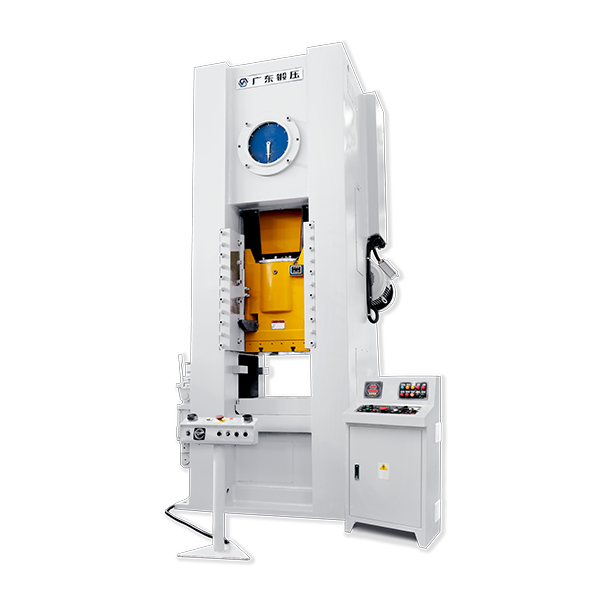
The GK Series knuckle joint press illustrates how High-Strength Cold Forging Equipment changes daily production behavior on the shop floor.
With nominal capacities from roughly 6,300 kN up to 25,000 kN and bolster sizes up to 1,200 x 1,200 mm, these presses can support a wide range of cold forging tools and part families. But the real difference lies in how the force is delivered.
The crank-toggle mechanism allows the slide to dwell near bottom dead center for about 1/18 of the cycle. During this short dwell, the slide speed drops significantly while forming pressure peaks. This controlled slow-down at the critical moment of deformation:
•Stabilizes metal flow at the end of stroke
•Helps reduce springback and dimensional scatter
•Improves filling of fine features, ribs, and corners
For process engineers, this means less dependence on purely empirical try-outs. Forming curves, die designs, and tolerance chains can be defined with greater confidence because the press motion itself is more predictable.
2) Inside the GK Series High-Strength Cold Forging Equipment
Rated capacity alone does not guarantee good parts. What matters is how the structure, drive train, and control system work together. The GK Series is engineered as a complete cold forging platform.
- Knuckle Joint Motion Curve for Accurate Forming at Bottom Dead Center
With a knuckle joint, rotational input from the crankshaft is transformed into a strongly slowed slide movement as it nears bottom dead center. When the joint almost straightens, slide speed diminishes while forming force builds, which delivers:
•Excellent controllability in the last part of the stroke, where minimal slide travel changes critical part features
•Reduced closing shock, lowering tooling stress and decreasing vibration loads on the frame and foundation
•More uniform metal flow into fine, deep, or intricate sections, boosting structural integrity and limiting internal flaws
High-rigidity, integral frames on presses up to 16,000 kN capacity further cut deflection and stabilize die alignment during forming. Larger presses can be supplied in split structures that are easier to transport and install, but still deliver the stiffness required during forming.
- Precision Features That Protect Your Tolerances
In High-Strength Cold Forging Equipment, even small positioning errors translate quickly into measurable quality drift. Maintaining consistent tolerances, even on demanding jobs, is supported by the GK Series’ precision-driven design.
The fine die height indicator, accurate to 0.01 mm, gives toolmakers and service personnel the ability to dial in die positions precisely and store shut height data for every production tool. This is critical for reproducible setups and faster changeovers.
Drive and clutch/brake systems matched to duty:
•Lower-tonnage presses use pneumatic wet integrated friction clutch-brake units that provide smooth engagement and good heat dissipation.
•In the upper tonnage range, the press line features pneumatic dry split friction clutch-brake units capable of managing higher energy per stroke while preserving braking stability and reducing maintenance frequency.
•Mechanical lower ejector devices deliver precise, stable ejection, reducing die-sticking events, preserving surface finish, and limiting unexpected impact stresses on the tooling.
•A PLC-centered control architecture links motion control, safety monitoring, and auxiliary device management into one coherent system. Operators see clear status information on the HMI and can call up stored recipes for different tools, materials, and part numbers.
Because control is PLC-based, High-Strength Cold Forging Equipment such as the GK Series can be integrated into plant-level data systems. Signals like stroke count, error codes, and operating status can feed directly into MES or quality software, supporting traceability, OEE tracking, and continuous improvement.
3) Turning Consistent Output into Business Value
Upgrading to advanced High-Strength Cold Forging Equipment is more than a technical decision. The impact can be measured in your budget, your risk profile, and your customer satisfaction scores.
On the process level:
•Controlled forming curves and accurate slide control boost repeatability between production runs.
•Scrap and rework are minimized as parts stay within their specified tolerances.
•Post-forging machining can often be reduced, thanks to near-net-shape results from the forging step.
•Tool life may improve thanks to reduced impact loads and better alignment, leading to fewer unplanned stoppages for die repair.
On the business side:
•Plants that can present documented process parameters, capability indices, and maintenance records build stronger trust with key customers.
•Audits become more predictable when the forging line can show traceable data and clear evidence of process control.
•Customers gain confidence that quality will remain stable across the entire program life, not just during initial sampling or short-term runs.
In many markets, this ability to demonstrate controlled, repeatable forging is a deciding factor in winning new business or maintaining preferred-supplier status.
4) When to Consider Upgrading Your Cold Forging Line
Many manufacturers postpone press investments until there is a serious breakdown or a visible lack of capacity. However, there are earlier warning signs that suggest it is time to evaluate modern High-Strength Cold Forging Equipment:
•Frequent dimensional corrections in downstream machining or sorting
•Increasing tool maintenance driven by misalignment, uneven load, or premature wear
•Difficulty meeting tighter tolerances on new product designs
•Customer pressure for better documentation, traceability, and capability data
If several of these symptoms are present, replacing or supplementing older presses with a knuckle joint platform such as the GK Series can change the performance level of the entire line. Instead of fighting individual defects, engineering and quality teams gain a stable, high-rigidity forming foundation.
ü Next Steps: Turning Press Capability into Competitive Advantage
If your plant is preparing for new programs, facing stricter audits, or simply seeing scrap and tool costs creep upward, it is a good moment to review your forging platform. Look at where dimensional drift appears, how often dies are reworked, and how easily your team can provide documented proof of process control.
From there, engage a specialist in High-Strength Cold Forging Equipment to evaluate whether a modern GK Series knuckle joint press fits your part mix and quality targets. A focused technical review today can lead to more stable production, stronger customer confidence, and a more profitable forging operation in the years ahead.
CONTACT US


Guangdong Metal Forming Machine Works Co., Ltd.
We are always providing our customers with reliable products and considerate services.
If you would like to keep touch with us directly, please go to contact us
-

Home
-

Tel
-

Email
-

Contact