
How Aerospace Forging Presses Forge the “Skeleton and Heart” of Aircraft
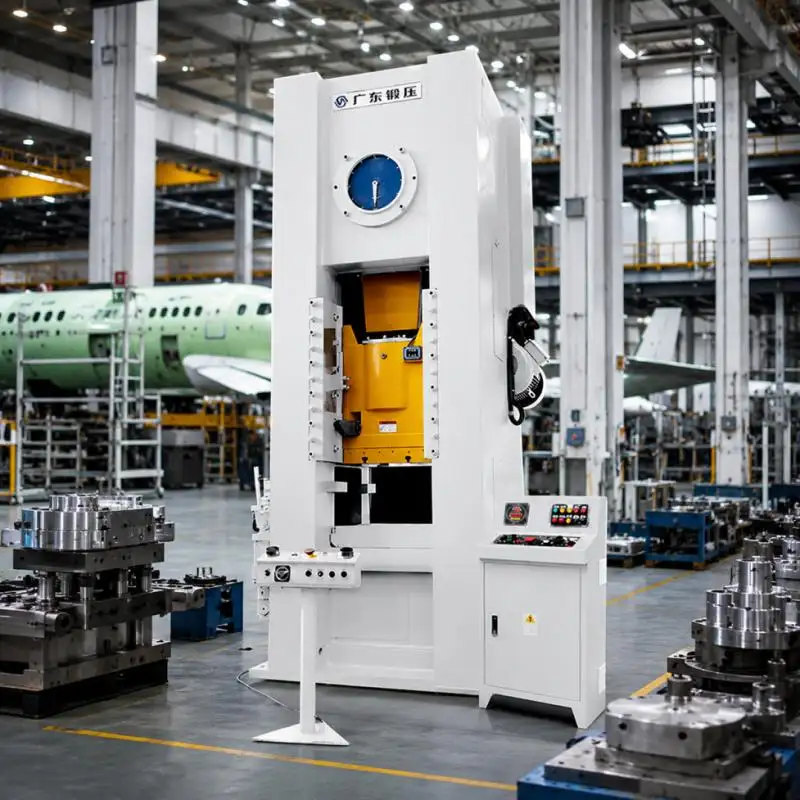
Aircraft depend on thousands of forged metal components—landing gear, engine discs, structural brackets—that withstand extreme forces, temperature shifts, and fatigue. Many are shaped by an Aerospace Forging Press. This article explores how GUANGDUAN’s GK Series knuckle joint press, with its crank-toggle mechanism and precision control, transforms raw metal into the “skeleton and heart” of modern aircraft.
What Makes Aerospace Components Different?
Aerospace hardware lives under high load and tight scrutiny. Aircraft components are unlike automotive parts or most consumer goods because there are no options where failure is permissible. Several factors are considered in the design of these components such as:
•Controlled grain flow: To mitigate the risk of creating weak points in the internal structure of the metal, it must be aligned with the direction in which the forces are expected to act.
•Stable deformation: The metal must flow in a stable manner to fill the geometry of the die.
•Verifiable dimensions: All components must be made to a tight tolerance that may be inspected and are traceable.
•Lightweight strength: In order to have the strength at the least weight, aerospace alloys of nickel superalloys, titanium, and aluminum of high strength must be used.
These criteria present a challenge to the limitations of conventional stamping. That is why the industry increasingly turns to the knuckle joint press—a machine type engineered for precision where it counts most.
The Knuckle Joint Advantage: Precision at the Point of Truth
What Is a Knuckle Joint Press?
A knuckle joint press uses a special linkage system—a crank-toggle mechanism—to drive the press slide. Unlike a conventional press that applies peak force in the middle of the stroke, the knuckle joint design concentrates force at the bottom of the stroke, where the actual forming happens.
The Dwell That Changes Everything
The defining feature of the knuckle joint mechanism is the dwell at bottom dead center. The GUANGDUAN GK Series, for instance, allows the slide to dwell at the bottom dead centre for around 1/18 of the cycle.
What does this dwell achieve?
•Material settling: Dwell time allows the metal to pack tightly into the cavity.
•Less rebound: Less spring-back improves size consistency of the component.
•Greater die longevity: Less impact minimizes die wear and tear, which is the largest cost associated with the production line.
•Surface quality: Motion control results in a finished component with less surface defects.
Aerospace applications particularly need this dwell time since surface defects affects the performance negatively.
GUANGDUAN GK Series: Aerospace Specific
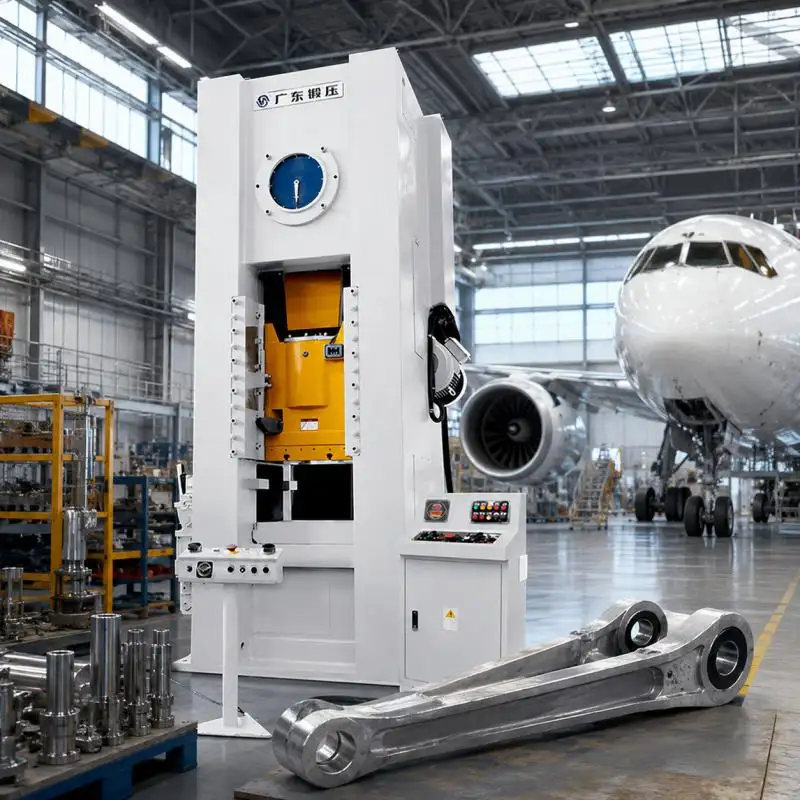
With 60 years of experience and multiple manufacturing capabilities, GUANGDUAN has launched the GK Series knuckle joint press which has the capability to cater the aerospace industry for the demanding applications of increased precision.
1. Capacity and Versatility
The GK Series line can come with different bolster sizes, between 700×700 mm to 1200×1200 mm with a range of 6300KN to 25000KN. This allows the line to produce fine stamping components to large engine parts:
•6300KN to 8000KN models: Small precision and fine stamping parts.
•10000KN to 16000KN models: Ideal range to produce components of moderate size, including brackets.
•25000KN model: Suitable range to produce large, high forging requirement landing gear components and large engine discs.
2. Integral vs. Split Structural Design
GUANGDUAN offers two design options within the GK Series:
•Integral structure: For presses from 4000KN to 16000KN, this design offers the highest rigidity and stability of alignment.
•Split design: the 12000KN model features a split structure, which aids installation and servicing in space-limited environments.
This combined method gives manufacturers the ability and freedom to customize the structure of the press to the specifications of the floor plan, as well as considering the requirements of maintenance. This is something that is often overlooked when selecting equipment.
3. Precision You Can Trust: The 0.01mm Standard
Aerospace forging often demands absolute accuracy in die height. An error as small as 0.1mm could cause failure in a forging’s shape or the strength of the material.
To help solve this, the GK series incorporates a die height gauge which is accurate to within +/- 0.01mm. The advantages of this feature are:
•Uniform dimensions of components: All components produced by forging are of identical size.
•Less time to set up: The time to change over dies is considerably less as the desired height is achieved much more easily.
•Audit-ready traceability: The process data will show compliance during regulatory/customer assessment.
•Less material waste: Process stability will reduce the need to rework scrap material.
For an Aerospace Forging Press, this level of accuracy will determine whether the process can be reliably run or if costly rework will be needed.
4. Clutch and Brake: Application Specific
No two aerospace forging operations have the same duty cycle. GUANGDUAN accounts for this in the clutch-brake system:
•GK-630 series: A pneumatic wet integrated friction clutch-brake designed for high-cycle operations.
•GK-800 to GK-2500 models: A more traditional pneumatic dry split friction clutch-brake.
Both models maintain the stable stroke and precision stopping required when performing multi-step operations or in-die extrusion with advanced alloy materials.
5. Intelligent Control: PLC and Automation
Aerospace forging presses in the GK Series are controlled using a PLC (Programmable Logic Controller) and offer the following benefits:
•Quick Learning: New employees easily learn the system within shorter time limits.
•The automatic lower ejector device is standard in all product lines for safer and easier handling.
Applications: The Intersection of the GK Series and Aerospace
The GK Series is favored for processes like fine stamping and extrusion where edge quality and process control are paramount. The following are some of the aerospace applications:
•Turbine-disc preforms: The bottom dead center dwell features control of the flow of the disc’s material in these fully formed components.
•Structural brackets: The repeatability and precision guarantee the fit among the numerous assemblies of the airframe.
•Landing gear: High tonnage models are required for the large, critical components.
•Engine housings and casings: The forming process provides control of wall thickness in various features.
Market Context: Relevance of Aerospace Forging Capacity
The forging press market is expanding with the special rapid growth of forging presses in the aerospace market. The market for die forging presses was estimated to be USD 1,737 million in 2024 with a projected growth of 4.25% per year.
In addition, reshoring is increasing the demand for domestic aerospace forging capability. There is a growing requirement for systems that provide consistent quality and controlled scrap with digital traceability. These are the very features provided by modern Aerospace Forging Press systems such as the GK Series.
Conclusion: Forging the Future of Flight
Forged landing gear, turbine discs, and brackets are the skeleton and heart of every aircraft. GUANGDUAN’s GK Series knuckle joint press makes them possible through:
•Crank-toggle for precise force delivery.
•Bottom-dead-center dwell for material stabilization.
•Precision die height of 0.01mm for constant results.
•Reliability for sophisticated control tasks.
•Adaptable design and bandwidth.
The Aerospace Forging Press will be called upon to fill an even larger role as demanding designs push the envelope—machines of today will fly the aircraft of tomorrow.
FAQs
Q: Why are Knuckle Joint Presses used in aerospace?
A: Knuckle Joint Presses utilize a crank-toggle mechanism that allows a dwell time with the ram at bottom dead center. This benefits the flow of the material and stability of the dimensions.
Q: What is the capacity range of GUANGDUAN’s GK Series?
A: 6,300 kN – 25,000 kN. This range allows for the pressing of small precision pieces to large structural forges.
Q: What are the bolster sizes?
A: Bolster sizes are from 700×700 mm to 1,200×1,200 mm.
Q: What is the precision of the die height adjustment?
A: The precision of the adjustment is to 0.01 mm as indicated.
Q: What is the purpose of “dwell” at bottom dead center?
A: Dwell allows the material to fully occupy the die, reduces spring-back and improves the die life and surface finish.
CONTACT US


Guangdong Metal Forming Machine Works Co., Ltd.
We are always providing our customers with reliable products and considerate services.
If you would like to keep touch with us directly, please go to contact us
-

Home
-

Tel
-

Email
-

Contact