
Open-Frame vs. Closed-Frame: A Multi-Dimensional Analysis of Large Forging Press Machine Structures
When investing in a Large Forging Press Machine, one of the first engineering decisions is the frame configuration. The two dominant designs—open-frame (gap-frame or C-frame) and closed-frame (straight-side or box-frame) —each offer distinct benefits that cater to different production needs. Understanding their respective advantages helps manufacturers choose the right machine for their specific metal-forming challenges.
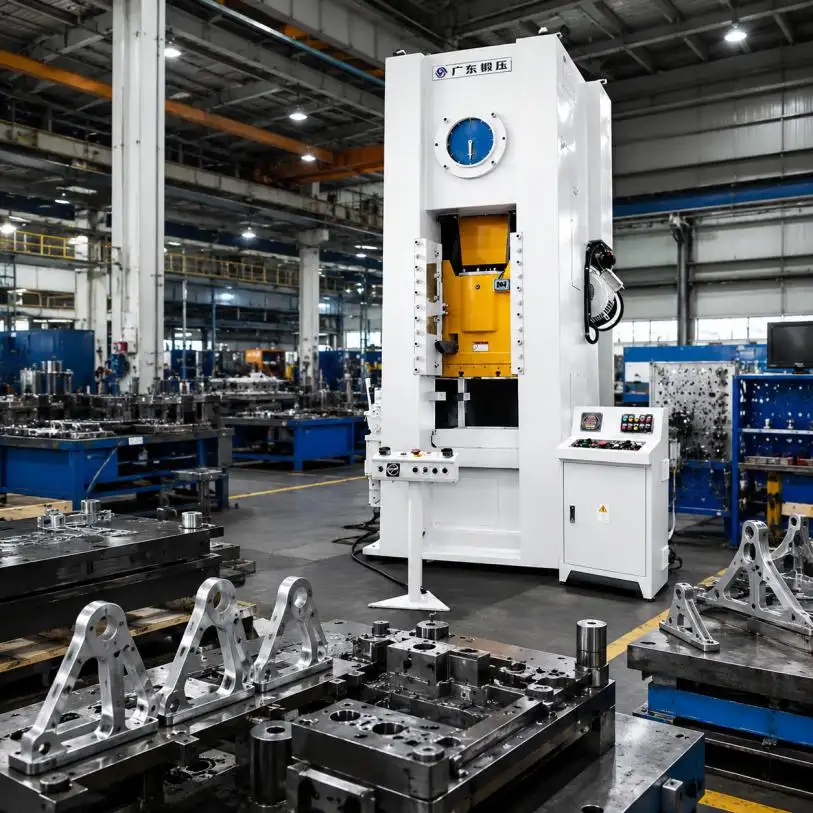
This article provides a balanced, multi-faceted comparison of these two structural approaches, with special reference to GUANGDUAN‘s JH31 Series Closed Type Single Point Forge Press Machine, which exemplifies the advanced capabilities of modern closed-frame engineering.
What Defines an Open–Frame Large Forging Press Machine?
An open-frame Large Forging Press Machine has a C-shaped structure with three open sides. This layout offers the most convenience and accessibility. Therefore, plenty of machines in workshops are purposely built this way.
•Operator friendly: The three sided openness means that operators can feed the blank parts and collect completed components while viewing the operation almost from every angle.
•Space efficient: With no side columns, the machine is more compact and can fit into tighter areas in the production environment.
•Affordable Accessibility: Open-frame Large Forging Press Machines tend to be a lower cost option for presses of this kind. The lower cost makes these types of machines a more accessible option for smaller tool rooms and manufacturers.
•Rapid Setup: With more openness, access to dies is much easier which decreases die change times.
•Simple Automation: C-frame design makes adapting a custom material handling solution with automation more straightforward.
•Versatility: Open-frame Large Forging Press Machine Models are flexible and can perform punching, blanking, bending, drawing, assembling, etc. Flexibility is their only limitation apposite to diverse applications.
What is a Closed-Frame Large Forging Press Machine?
A closed-frame Large Forging Press Machine such as GUANGDUAN’s JH31 Series relies on a box-type structure to achieve maximum rigidity, precision, and reliability.
•Excellent Rigidity: The closed frame structure can be made monolithic and reinforced with a tie-rod and will suffer no distortion at the maximum loads.
•Great Precision: A frame can be designed to guide the vertical motion of a press with the highest precision.
•Heavy duty crankshaft and clutch: The eccentric crankshaft combined with a wet-type clutch has a better bearing capacity and shorter downtime.
•Intelligent stroke control: PLC control and pneumatic actuation allow strokes to be controlled for continuous, single, and micro motion with great flexibility.
•Digital Die Height Adjustment: Calibrating is faster using mechanical adjustment with a digital display.
•Advanced overload protection: Tooling and frame protection from hydraulic overload (larger models) and wedge-shaped unlocking devices.
•Safety and Automation: systems integration is improved by the compact design; photo-electric guarding with automated feeding/uncoiling enables safe and unattended lines.
•Wide tonnage range: Models from 50 to over 2,500 tons are appropriate for automotive, aerospace and deep drawn applications.
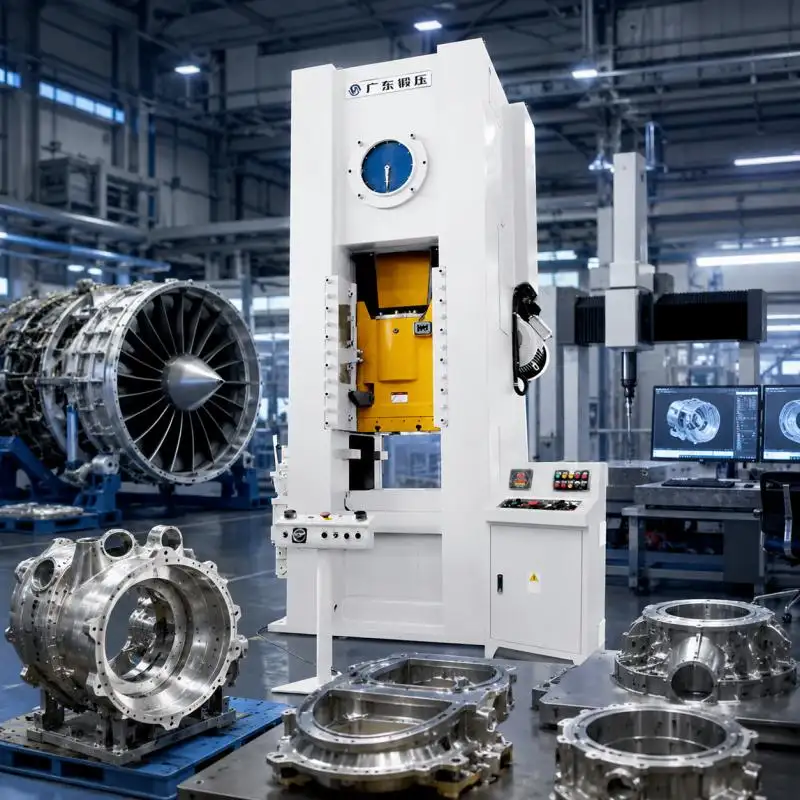
Multi–Dimensional Comparison: Strengths of Each Design
Rather than framing this as a competition, let’s examine the distinctive advantages of both architectures across key operational factors.
| Dimension | Open-Frame (C-Frame) Strengths | Closed-Frame (Straight-Side) Strengths |
| Accessibility | Three-sided openness simplifies manual feeding, inspection, and die maintenance. | Front-to-back workflow promotes systematic part flow; compatible with automated transfer systems. |
| Floor Space | Compact footprint fits tight layouts; ideal for job shops with limited area. | Modern compact models (e.g., JH31-200/300) minimise floor space while retaining high rigidity. |
| Tonnage Capability | Efficient for light-to-medium loads (10–500 tons), covering a broad range of common stamping tasks. | Available from 50 to over 2,500 tons, supporting heavy-duty forging and large-part forming. |
| Precision & Stability | Adequate for general-purpose work where tolerances are not ultra-tight. | High rigidity and four-side guiding deliver micron-level accuracy and repeatability – essential for progressive dies. |
| Cost Efficiency | Lower initial purchase cost; quicker return on investment for simple operations. | Higher upfront cost, but longer die life, fewer rejects, and reduced maintenance yield superior total cost of ownership. |
| Automation Readiness | Easy to integrate pick-and-place robots from multiple directions. | Built-in interfaces for auto-feeding, uncoiling, and levelling devices; supports fully automated manufacturing cells. |
| Safety Features | Open design allows visual monitoring; optional light curtains can be installed. | Photo-electric protection and enclosed structure provide robust operator safety; hydraulic overload systems protect the machine itself. |
| Typical Applications | Punching, blanking, bending, shallow drawing, small-batch assembly. | High-precision stamping, deep drawing, hot forging, automotive panels, aerospace components, and large appliance parts. |
Application Scenarios: Where Each Design Shines
The open-frame Large Forging Press Machine is a natural fit for:
•Small-to-medium job shops that process varied parts in low volumes.
•Maintenance and repair workshops requiring quick die changes and flexible operation.
•Prototype development where manual intervention and inspection are frequent.
•The closed-frame Large Forging Press Machine – and especially GUANGDUAN’s JH31 Series – is the preferred choice for:
•High-volume automotive production (body panels, chassis parts, motorcycle components).
•Aerospace and defence (structural forgings demanding absolute reliability).
•Consumer durables (precision parts for instruments, gas appliances, and daily hardware).
Any application where consistency, dimensional accuracy, and tool life directly impact profitability.
Why GUANGDUAN‘s JH31 Series Represents the Best of Closed–Frame Engineering
GUANGDUAN has refined closed-frame technology to address the most demanding production requirements. Key design highlights of the JH31 Series include:
•Monolithic box-type construction – Ensures the highest rigidity and vibration damping.
•Four-pull pre-loaded tie-rods (on selected models) – Add extra pre-stress to counteract dynamic loads.
•Eccentric-type crankshaft – Provides exceptional bearing strength and smooth torque transmission.
•Wet-type clutch and brake – Offers fade-free performance and reduced maintenance intervals.
•Four-surface full guideway – Guarantees precise slide movement and consistent part geometry.
•PLC + pneumatic control – Provides a total of three stroke modes which allows for flexibility in many different processes.
•Digital die height display – Easy setup and less operator error.
•Optional hydraulic overload protection – Safeguards the machine and tooling from unexpected jams.
•Photo-electric safety and automation interfaces – Enable safe, lights-out manufacturing.
•Compact, rational layout – Combines high performance with a small factory footprint.
These features make the JH31 Series a benchmark for reliability and productivity in the closed-frame Large Forging Press Machine market.
Conclusion: Choosing the Right Structural Design
Both open-frame and closed-frame designs offer proven value. Open-frame is best for lightweight tasks when flexibility and cost are concerns. For strength and high-precision mass production, closed-frame (e.g., GUANGDUAN JH31) is better. The best option is dependent on your parts, volume, and goals on quality. Closed-frame is best for consistency in quality and lower running costs, so it’s the best strategic investment in the long run.
FAQs
Q1: What is an open-frame Large Forging Press Machine?
The machine is shaped like the letter C, leaving three sides open. This provides great flexibility and excellent access for the operator, and is suited to light and medium forming requirements.
Q2: What is a closed-frame Large Forging Press Machine?
Like the JH31 Series from GUANGDUAN, a machine with a closed frame has a box-type structure that completely encloses the working area, providing the maximum structure stiffness for excellent and long-term stability and precision.
Q3: Which design provides higher precision?
Due to the rigid structure and more sophisticated guiding systems, we can state that closed-frame presses have a design that allows for more precise and repeatable operations.
Q4: Can a closed-frame press handle small-batch production?
Yes, closed-frame presses with flexible digital units for quick die height adjustments are equally efficient for large and small production volumes.
Q5: What applications are closed-frame presses best for?
Pressing structural panels for the automotive and aerospace industries, and producing components that are deep drawn and require tight tolerances and consistent results.
CONTACT US


Guangdong Metal Forming Machine Works Co., Ltd.
We are always providing our customers with reliable products and considerate services.
If you would like to keep touch with us directly, please go to contact us
-

Home
-

Tel
-

Email
-

Contact