
Building an Automated Forging Press System for Stable Production
The automated forging press system isn’t a press and an automated robot beside it. It is a synchronised production line where heating, descaling, lubrication, billet movement and forging and part discharge need to be synchronised.
When one station has to run slower than the desired cycle time, the entire line is out of production. Delayed transfer could cause billet temperature to be outside the approved range prior to forming. Hence, automation has to be programmed around movement of materials and timing of processes and not speed of the machine.
A successful system ensures that all billets are driven through the proper billet sequence, temperature, and orientation, while maintaining protection for the tooling, equipment and operators.
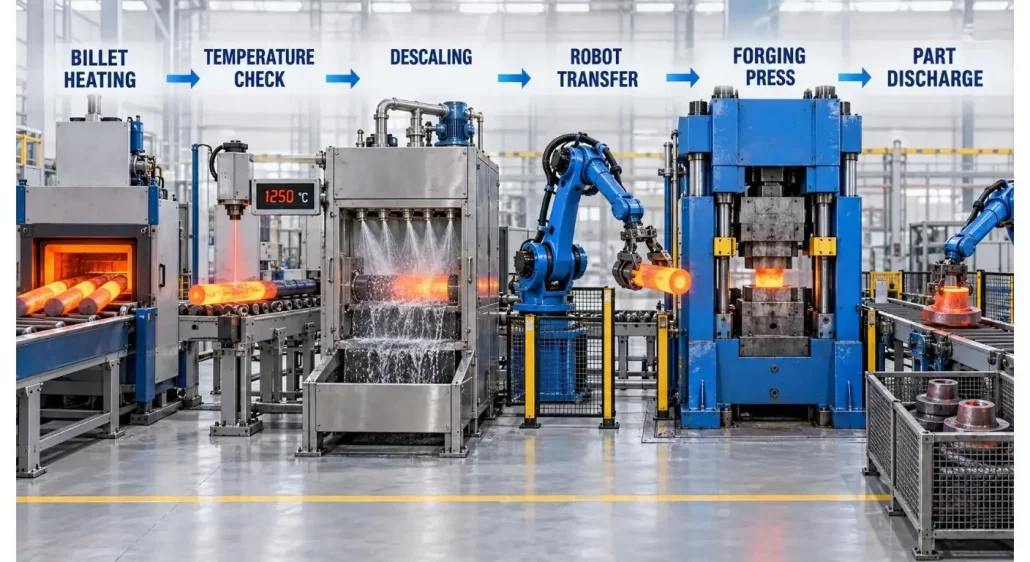
Plot the Entire Forging Sequence.
System planning should start as soon as the billet enters into the production system and stop when the forged component goes to the next production system. Record all operations such as cutting, heating and temperature control, descaling, lubrication, preforming, final forging, trimming, cooling and inspection.
Not all of these processes are necessary for all projects. But missing steps are costly add-ons once the line layout and controls are done.
Write down the necessary time, input condition and output condition for each operation. This shows the operator where buffers, part rotation or extra forming stations are needed.
Determine the Part Family and Production Target
Automation should focus on a set of components. Provide billet material, weight, dimensions, forging temperature, finished geometry, forming force and annual volume.
Dedicated tooling and handling is available for a line which is geared for one high volume component. For a system that is making multiple part families, the system must provide adjustable grippers, stored recipes and sufficient die change space.
Determine target parts per hour and the required system availability. If the line stops a lot to change the tool or make mistakes in handling the billet, it is a poor value and no matter how fast the theoretical cycle is.
Choose the Process Load, Press from the Process Load.
The main press should apply the required load and energy at the right place on the stroke. Mechanical, hydraulic and knuckle-joint press produces various forces and motion characteristics.
Mechanical forging presses offer repeatable strokes and are suitable for high volume production. Hydraulic presses offer adjustable force, speed and dwell, and knuckle-joint presses have controlled motion towards the bottom of the stroke.
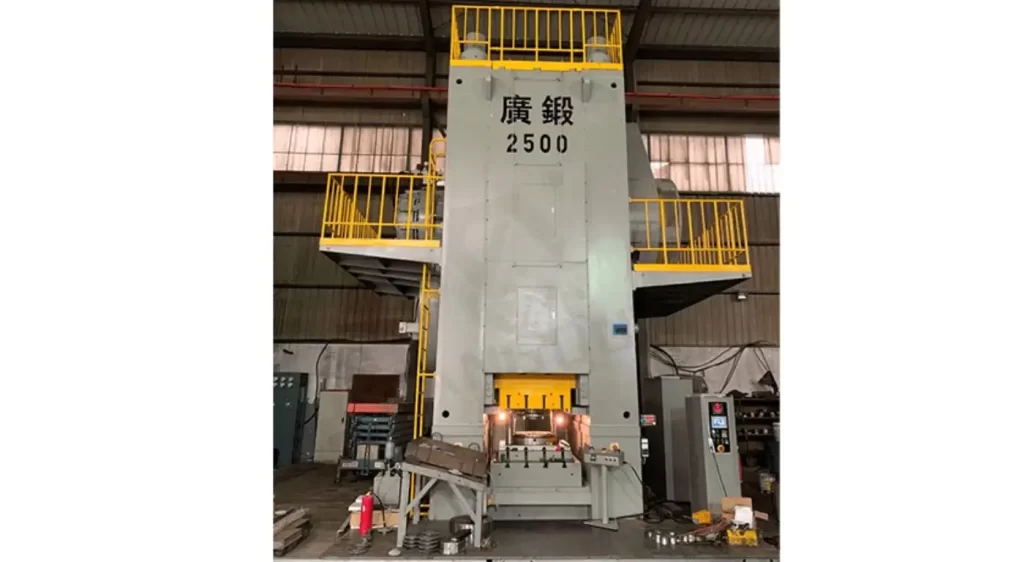
The forge press equipment manufactured by Guangduan includes hot and cold forge press. The functions of die cushion and hydraulic slide adjustment and automatic die changing are also illustrated in its 2500 ton knuckle-joint press project.
Set Realistic Line Cycle Time
The press stroke is but a part of the stroke. Billet heating, robot travel, die lubrication, part release, and inspection of part temperatures might require a longer process time than the forming.
Determine the time for each station and find the bottle neck. Specify acceleration, gripping, confirmation signals and safe waiting positions NOT only travel distance.
The system should also include for the occasional variation. It is important that the billet(s) do not collide and do not come out of the heater below the acceptable temperature.
| Process Stage | Time to Record | Critical Condition |
| Billet heating | Heating and discharge time | Target temperature |
| Temperature check | Measurement and decision time | Approved range |
| Transfer to press | Pick, travel and placement | Maximum transfer time |
| Die lubrication | Spray and clearance time | Complete coverage |
| Forging | Press stroke and dwell | Required force |
| Part removal | Release, grip and discharge | Stable orientation |
Adjust Billet temp during Transfer.
There is a restricted temperature range for hot forging. High transfer times can lead to load on the die, poor die filling and non-uniform material flow.
Take temperature reading prior to forging at a sensible location. The control system should not automatically pass billets out of range, but reject or re-direct them.
Grippers and conveyors should be able to withstand radiant heat, scale and frequent thermal cycling. They should maximize avoidance of critical surfaces of billet and provide stable billet orientation.
Create Robust Grips and Orientations
A robot can reach the desired position but if the billet is not controlled by the gripper the robot will fail. Temperature, part weight, surface scale and changing geometry and center-of-gravity movement are all considerations for gripper selection.
There should be confirmation each transfer that the component is picked and positioned correctly. Part-presence sensors and gripper-position monitoring and orientation checks prevent an empty forging stroke or a misaligned one.
There should be a definition of what occurs if a pick is failed. When a hot billet is placed in an unknown location, repeated automatic attempts may not be safe.
Do not touch the dies when they are hot.
Automation needs reliable contact with the tooling! The die needs to eject the part in a consistent manner and the part needs to be available for the next gripper to pick up.
Verify ejector stroke and knockout timing, oil lubrication pattern, and oil removal path. Excessive lubricant or scale can cause interference to sensors and decrease grip reliability.
If multi-stage forging is involved, a stable location for transfer must be provided by each intermediate geometry. These pick-and-place features should be considered jointly between the tooling and automation engineers before die manufacturing starts.
Create a 1 Line-Level Control Strategy
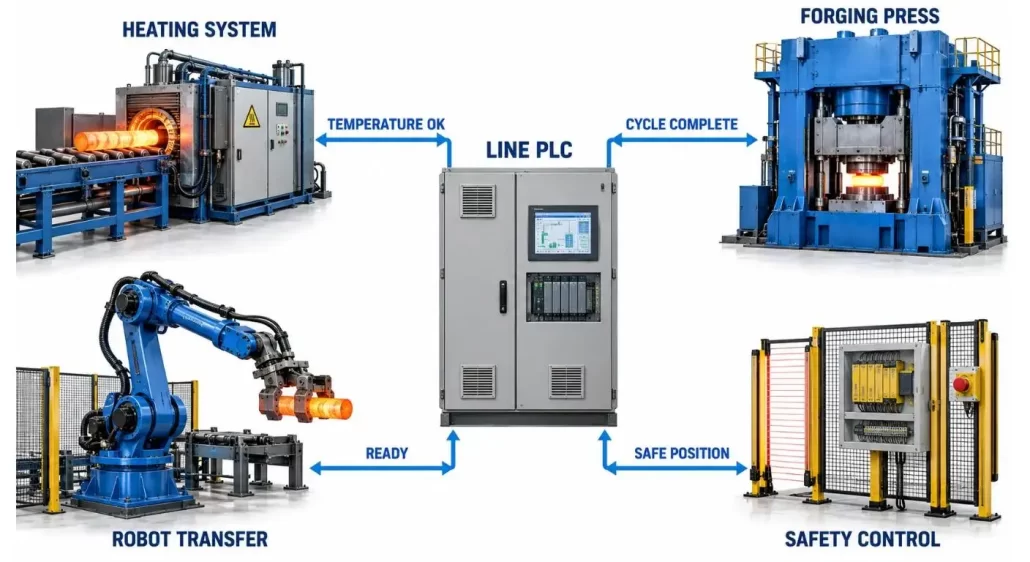
The furnace, transfer system and press and auxiliary equipment can be controlled separately, but should be combined with one operating sequence in the line. The master controller and responsibility for each interlock should be identified by the project team.
Signals need to be for ready, part present, temperature okay, safe robot position, press okay, and cycle complete. The equipment should be put in a predictable condition with each fault.
Guangduan’s metal-forming automation solutions demonstrate how press equipment and sensors, material handling and production monitoring can all be integrated into a coordinated system.
Not lose process control with Buffers.
Buffers allow one stop to not stop the whole line. But, in hot forging there is a limit on the waiting time of a billet.
With cold billet it may be practical to have a buffer between billet cutting and heating. A buffer after heating needs to be tightly controlled with respect to time and temperature.
Billet sequencing and billet residence time should be monitored by the system. Any billet that is over the approved waiting time needs to be rejected or returned following a specified procedure.
Protect People & Equipment
Automated Forging involves high forces, moving robots, hot material and ejected scale. Safety Planning to be considered for entire line treating the press and robot as separate machines is incorrect.
Implement physical guarding, interlocked doors, safe robot zones and controlled maintenance modes. Press, robot, and hot billet should not be left in an unpredictable state, but instead, with emergency stops, a coordinated line response is taken.
Operators must also have a safe way to remove a dropped billet, release a stuck part and restart production following a fault.
| Fault Condition | Automatic Response | Operator Action |
| Billet too cold | Block press entry | Remove or reheat billet |
| Failed robot pick | Stop transfer sequence | Inspect billet position |
| Incorrect orientation | Reject transfer permission | Reposition component |
| Part stuck in die | Stop press and robot | Use safe release procedure |
| Guard opened | Controlled line stop | Verify protected area |
| Sensor signal lost | Prevent next cycle | Inspect sensor and wiring |
Observe and control output and process stability
Other production information includes billet temperature, press load, cycle time, tool count and rejected parts list, alarm history. These values are all used to determine issues that may not be apparent from the finished product total.
Force or motor-load trends can show wear on the tool, changes in temperature or improper billets. If the same robot-position fault occurs repeatedly, it may be due to an unstable part release and not to a robot programming problem.
It is important to monitor only information that will be used to make quality, maintenance or production decisions and not data for data’s sake.
Verify the Complete Line prior to delivery
In the factory acceptance testing phase, it is necessary to perform testing between the press, the heating interface, the robots, the sensors, safety systems and other components as one line. Testing per machine is not equal to the production goal for the sequence.
Wherever possible, use representative tooling and billets. Check cycle time, temperature control, grip stability, transfer accuracy, part quality and fault simulation response.
Guangduan’s case library of press production-line can be used for reference projects to discuss the scope of automation and the requirements of factory acceptance.
Conclusion
An automated forging press system is successful when each machine, sensor and transfer action is involved with one steady material flow. However, no press can make up for inadequate heat-up speed, erratic grips or inaccurate controls.
Cycle-time analysis and temperature management and complete-line acceptance testing minimize the risks of automation. They also develop a more solid foundation of regular quality and the safety of the operators and future production increases.
FAQs
Q1. What kinds of equipment are there in an automated forging line?
The line can comprise billet preparation and heating, descaling, lubrification, a forge press, robots, trimming and discharge equipment. It depends on the component and process to be determined.
Q2. What is the formula for forging-line cycle time?
Determine the transfer and confirmation signals and the time needed for each station. The sustainable line rate is limited by the slowest needed operation.
Q3. Why Billet temperature monitoring is important?
Flow and forming load are dependent on temperature. If billets are not within the approved window they should be either rejected or rerouted out of the press.
Q4. Is it possible for one line to be automated to make various components?
Yes, provided that the press, dies, grippers and recipes accommodate the desired part range. Changeover time and adjustable handling should be considered during the design of the system.
Q5. Will the whole line be tested prior to delivery?
Yes. Integrated testing validates timing, interlocks, temperature decisions and robot transfer and fault recovery prior to installation at the production site.
CONTACT US


Guangdong Metal Forming Machine Works Co., Ltd.
We are always providing our customers with reliable products and considerate services.
If you would like to keep touch with us directly, please go to contact us
-

Home
-

Tel
-

Email
-

Contact