
Choosing an Automotive Sheet Metal Forming Machine
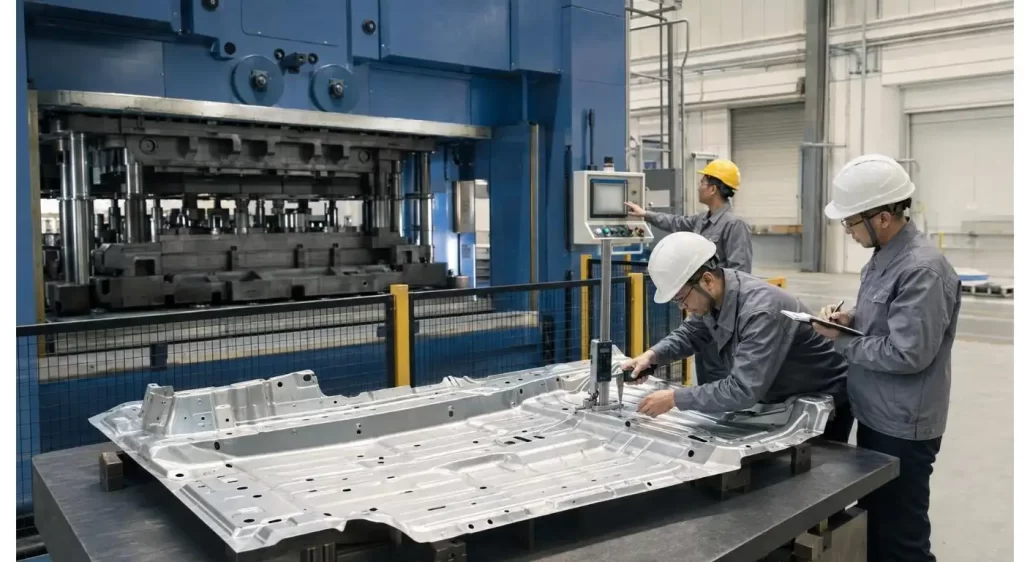
Very few people can see that a finished vehicle panel was a very difficult process to create. The sheet may be blanked, drawn, trimmed and pierced, flanged and restrikked prior to assembly. Different control of slide, die and material is required for each of the operations, which result in varying force curves.
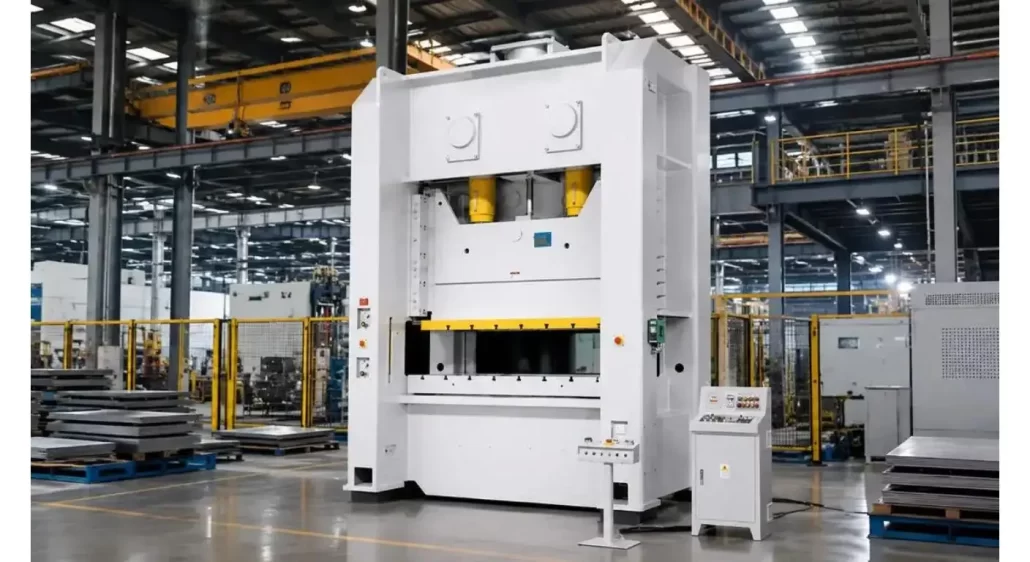
Therefore, it is not advisable to choose an automotive sheet metal forming machine by tonnage. Part geometry, material behavior, die envelope, production target and automation method must be considered for the machine.
GUANGDUAN is a manufacturer of hydraulic press machine and mechanical press machine of various kinds of automobile forming processes. A good equipment appraisal should still start with the production requirement and not the desired type of press.
Use the Part Family to Start
Sheet metal parts for the automotive industry can be split up into a number of process groups:
Other exterior surfaces, such as doors, hoods and fenders
Inner panels and wheel housings – minimising provisions for maintenance and cleaning.
Chassis reinforcement/crossmembers
Brackets, clips and mounting plates
Trays and parts for EV enclosure batteries
The outer panels need to have a controlled material flow and surface quality. Structural parts have more stringent requirements for rigidity and resistance to eccentric loads. Small brackets tend to focus on production speed and efficiency in coil-feeding.
Prior to making a quotation request for machine, specify the size, grade, thickness, forming depth, annual quantity, downstream assembly requirements, etc. of the part.
By dividing the operations from the machine selection.
Blanking, drawing and flanging are all processes that can be performed on sheet metal, but these processes do not load the machine in the same manner.
Blanking results in a short, sharp load near the bottom of the stroke. Controlled force over a longer distance is required and the blank holder controls the flow of material during deep drawing. Repeatable pressure or position at the end of the cycle in restriking and calibration.
The process plan should include identification of:
- Number of operations performed at each station
- Peak force and stroke position)
- Requirements for blank-holders/cushions
- Pressure-holding requirements
- Part-transfer method
- Scrap-removal direction
This will avoid the risk of choosing a machine with an adequate nominal tonnage but inadequate motion or load characteristics.
Match the Drive System with the Forming Window
Mechanical presses are most frequently found in repetitive blanking, piercing and progressive-die stamping. Their crank-driven movement provides them with fast and stable production, in case when process is already well defined.
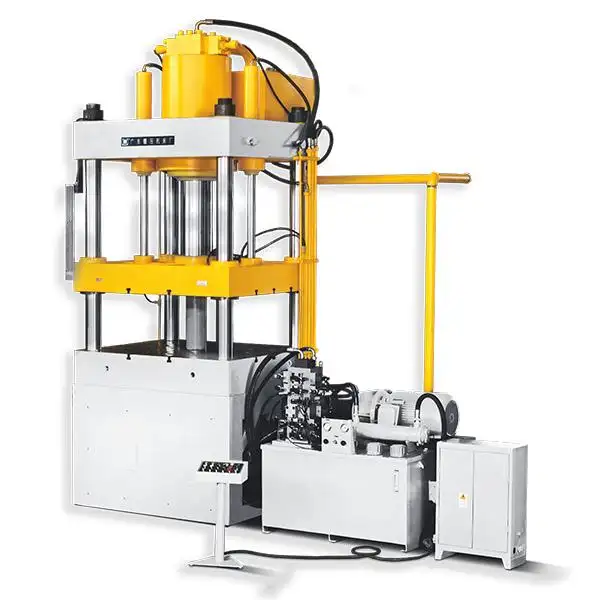
Adjustable pressure, stroke and forming speed is supplied by hydraulic presses. They can be used for deep drawing, die trials and low volume panels and processes which need pressure holding. GUANGDUAN’s double action hydraulic press is suitable for thin plate drawing, forming, aligning, bending & folding.
Servo Controlled Equipment: A programmable slide-motion profile is provided. The slide can slow down during material forming and speed up fast after the critical operation.
This should therefore be decided on the basis of process needs:
- Mechanical press for repetitive and high volume stamping
- Flexible force and long stroke control by hydraulic press.
- Servo press for programmable motion and production requirements that change
| Automotive Part or Process | Preferred Equipment Direction | Primary Selection Reason |
| Outer body panel deep drawing | Double-action hydraulic or controlled-motion press | Blank-holder and forming-speed control |
| Large structural panel | Straight-side multi-point press | Rigidity and eccentric-load resistance |
| Small brackets and clips | Coil-fed mechanical press | High output and repeatable short strokes |
| Progressive stamped components | Mechanical or servo press line | Feeding accuracy and continuous production |
| EV battery tray | Large-bed hydraulic or servo forming press | Working area and material-flow control |
| Die trial and low-volume panels | Programmable hydraulic press | Flexible stroke, speed and pressure settings |
Change machine requirements in the automotive sector.
Modern vehicle bodies are made of a mix of mild steel, advanced high strength steel and aluminum. Similar part geometry can be used with the materials but different forming conditions are necessary.
Using high-strength steel results in higher forming load and spring back. Aluminium is lighter and more susceptible to scratching and galling and uneven flow of material.
Material selection affects:
- Required forming capacity
- Blank-holder pressure
- Forming speed
- The hardness and stiffness of the press and the die.
- Different types of oils and coatings for tools
- Springback compensation
- Part-handling method
When the material grade is changed it is necessary to renew the die, load curve and machine settings review. A press designed to work with conventional steel can’t necessarily be expected to work the same with aluminum or advanced high strength steel.
Consideration of tonnage and load distribution must go hand-in-hand.
The nominal tonnage is merely the maximum rated capacity. Engineers also need to identify the location of the force and the force distribution on the die.
Asymmetric or large automotive tools may cause the pressure center to be offset from the machine center. This results in slide tilt, unequal die clearance and quickened guide wear.
Before selecting review the following:
- Peak forming force
- Force available at the working position.
- Pressure center die foot print
- Permitted eccentric load
- Blank holder/cushion pressure.
- Slide-guidance structure
- Engineering safety margin
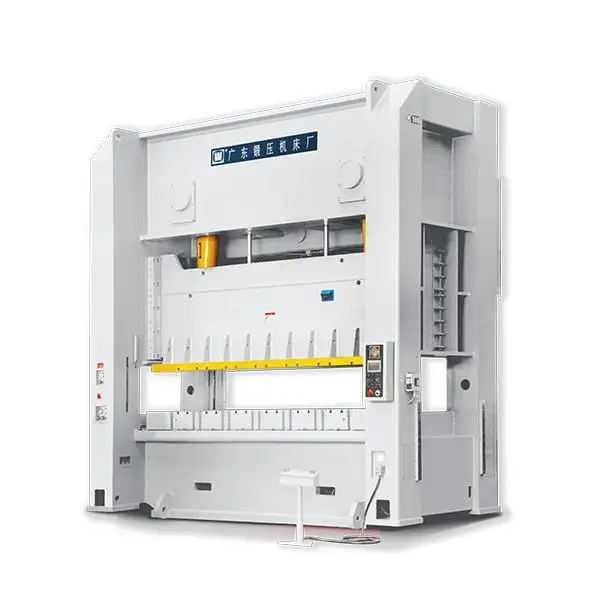
GUANGDUAN’s STPP mechanical punch press adopts the reverse double crankshafts and eight-sided slide guideways, which enhance the balancing performance and anti-unbalanced load ability of the mechanical punch press.
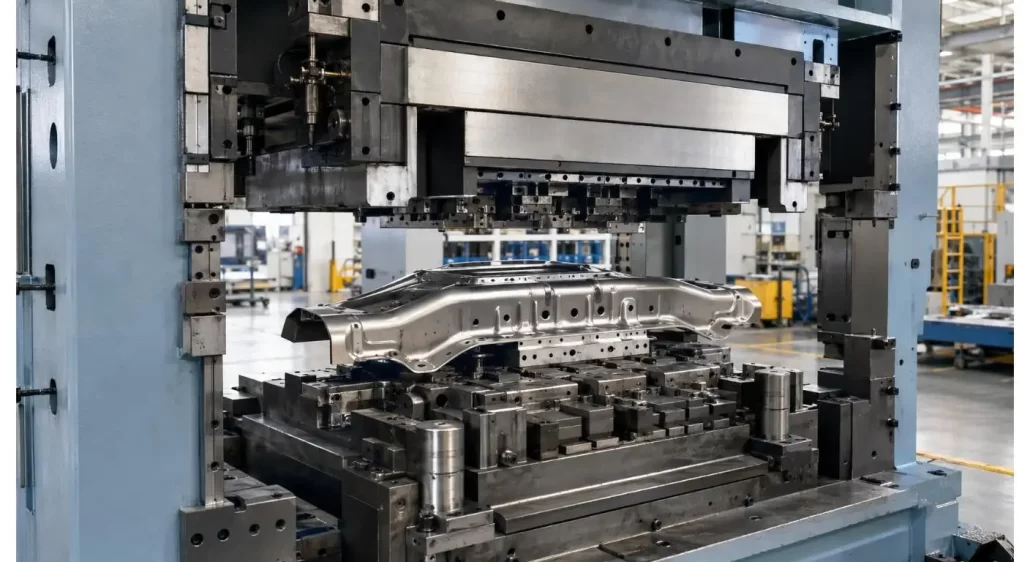
Confirm Complete Die Envelope: Highlights whether the complete die envelope is confirmed.
A machine may be strong enough but not big enough to install the tooling.
The specification of equipment should cover:
- The bolster and slide are about the size of a 12-inch meat loaf.
- The highest and lowest die elevation
- Working stroke and Daylight
- The weight and direction of load on the die.
- Moving-bolster requirements
- Space to accommodate transfer equipment
- Discharge of raw and finished parts.
Also future tooling should be taken into consideration. If the machine is sized for just one of the current dies, then the production of subsequent vehicle platforms can become limited.
GUANGDUAN’s straight-side multi-station press can be used for two-dimensional and three dimensional servo-line interfaces for large progressive and multi-station dies.
Allow Production Volume to determine Line.
For low-volume panels and replacement parts, a stand-alone press with manual or automatic (robotic) loading can be used. Normally, high volume production needs coil feeding and/or transfer automation or multiple synchronized forming stations.
Common configurations include:
- Manual loading of die trials and low quantity production.
- Small part progressive press with coils.
- Flexible production with robot loaded press.
- Multi-stage forming and transfer of press.
- Body panels, Tandem line for large body panels
- Combining operations at multi-stations under a single press.
When determining an automotive stamping press, be sure to use the entire cycle (loading, forming, transfer, unloading and fault recovery). The stated stroke rate is not line output or sustainable.
Test to ensure performance in production conditions.
No-load accuracy does not mean that the press will have alignment under a large, eccentric die.
As part of the Factory Acceptance Test, the following should be verified:
- Slide-to-bolster parallelism
- Repeatability of position/pressure.
- Evaluation under load representative to the specific application.
- Full automated cycle time with automatic start/stop.
- Communication from feeder or robot.
- Protects against overload and safety.
The dimensions of the parts made in the trial were:
All testing should be performed, to the extent possible, with the specified material, and a representative production die. The successful dry cycle is not an indication of forming capability, it is an indication of movement.
| Acceptance Item | Recommended Verification | Production Risk Controlled |
| Working capacity | Form representative parts under load | Insufficient forming force |
| Slide alignment | Measure parallelism and guide behavior | Uneven die clearance |
| Position repeatability | Repeat programmed bottom position | Dimensional variation |
| Load balance | Test representative eccentric conditions | Slide tilt and guide wear |
| Cycle performance | Run the complete automated sequence | Unrealistic output estimate |
| Safety response | Test guards, interlocks and overload protection | Operator and tooling risk |
Final Engineering Check
Not all high tonnage and fast sheet metal forming machines are the best choice for automotive applications. It is the machine that allows the desired forming window for the part, while taking into account material, die and production volume.
Comparisons should be made based on load distribution, die compatibility, cycle calculations and trial production evidence. This way, you can minimise the risk of finding out that your process has a limitation after the equipment is installed.
FAQ
Q1. An automotive sheet metal forming machine can produce which parts?
Can be used in the manufacture of body panels, chassis reinforcements, brackets, battery trays and enclosure parts. The type of required machine depends on the material properties, geometry and sequence of forming.
Q2. Which is better: hydraulic or mechanical press in auto forming?
Mechanical Presses are good for high volume, repetitive stamping. Hydraulic presses offer greater flexibility in drawing and in holding the force and speed for lower volume processes.
Q3. How do you determine automotive forming press tonnage?
It is dependent on the material properties, thickness, part shape and forming process. Also, blank-holder force, eccentric loading and engineering safety margin should be taken into account.
Q4. Why is it that press rigidity is important?
Slide alignment and die clearance under load is affected by frame deflection. This can lead to dimensional variations, uneven forming and to the premature wear of the die.
Q5. Is the press able to be combined with a robot and feeder?
Yes. Control interfaces and safety logic can be designed to make possible connections to coil feeders, transfer systems, robots and inspection equipment in modern presses.
CONTACT US


Guangdong Metal Forming Machine Works Co., Ltd.
We are always providing our customers with reliable products and considerate services.
If you would like to keep touch with us directly, please go to contact us
-

Home
-

Tel
-

Email
-

Contact