
Closed Die Forging Press Selection Guide
A forging that is “true” can have an unstable process yet still meet final dimensions. Some of the above problems can develop before the press reaches full load capacity and can be caused by incomplete die filling, folded material, too much flash or irregular grain flow.
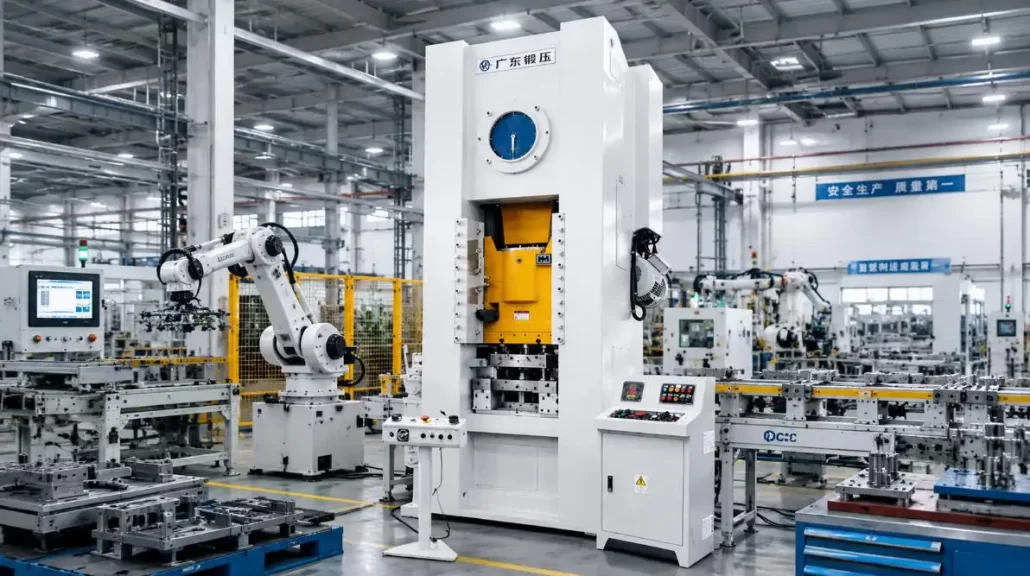
The high force is not the only thing that a closed die forging press should be capable of. It needs to be identical to the billet, material temp, preform, cavity of the die, forming process and production speed.
GUANGDUAN provides various forge press products to meet the requirement of cold, warm and hot forging processes. Nominal press capacity should not be a factor in equipment selection; it should start with the forging process.
Controlled Material Flow is the key to Closed Die Forging.
Closed die forging is a process in which a billet is pressed between upper and lower dies of suitable shape. This material is fed into the closed container until it takes the desired shape. Excess material can enter a flash gutter (depending on the tooling design).
Some of the common closed-die forged products are:
- Car gears and transmission pieces
- A crankshaft and connecting rods.Crankshaft and connecting rods.
- Bearing races
- Flanges and couplings
- The use of hand tools and hardware.
- Valves and Industrial Fittings.
The process can optimize the utilization of materials and also generate a favorable grain flow, but only if the billet size, the preform shape and the die filling are optimized together.
The larger the press, the less it can do to correct the wrong preform. If too much material is left, it could only cause a higher peak load, flash formation and die stress.
The Forging Route must be determined first, prior to selection of the Press.
Generally, complex components are not easy to manufacture from a simple billet. A stable route will have:
- Billet cutting
- Heating or lubrication
- Upsetting
- Edging or bending
- Preforming
- Final forging
- Trimming and piercing
- Calibration
The material is redistributed for each stage for the next die cavity. If too much material is left in one area the last operation might result in folds or undue pressure. When the quantity of material that reaches the deep feature is insufficient, the cavity might not be completed.
The forging route, in its entirety, should therefore be included in the RFQ, not just the final drawing of a forging, but the entire route.
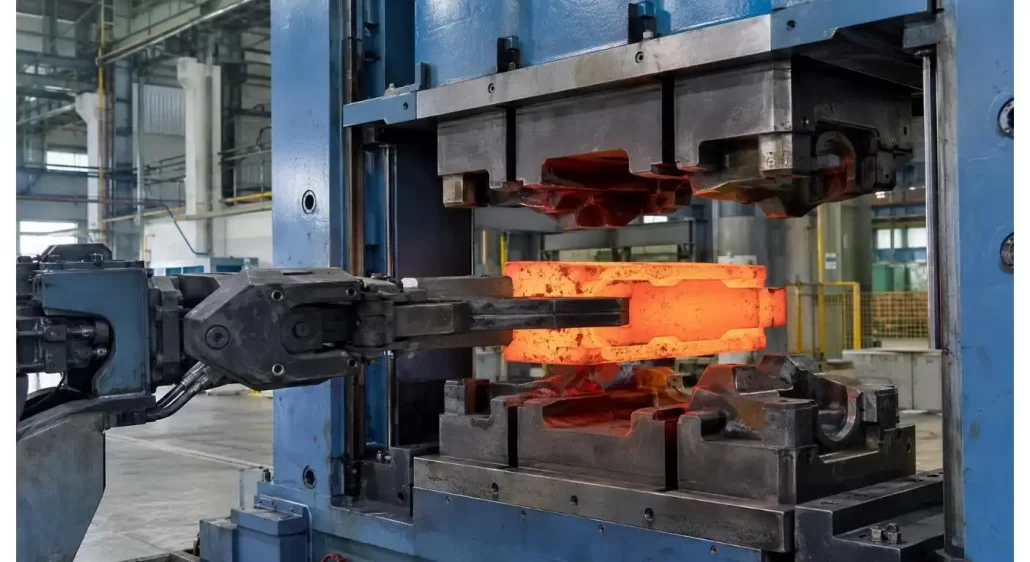
Match Press Type with the Load and Motion Requirement.
Mechanical forging presses are presses that make repeated strokes by storing flywheel energy and utilizing a crank mechanism. They are good for high volume of billet and die process, and are suitable for large-scale production.
The force and speed are controllable and the stroke longer with hydraulic presses. They are beneficial in the process when the deformation should be slower, pressure should be maintained or flexibility between parts is needed.
Knuckle-joint presses slow down near BDC (bottom dead center) and deliver high force in the last forming zone. GUANGDUAN’s GK Series knuckle-joint press offers a range of capacities from 6300kN to 25,000kN and a dwell time of around 1/18-cycle at bottom dead center.
The appropriate machine will be determined by the:
- Peak load and forming energy.
- The location of the peak load in the stroke.
- Required contact time
- Part complexity
- Target production rate
- Cold, warm or hot (forging) conditions
| Production Condition | Equipment Direction | Main Engineering Reason |
| High-volume stable forging | Mechanical forging press | Repeatable strokes and high output |
| Flexible part mix | Hydraulic forging press | Adjustable force, speed and stroke |
| High final-forming load | Knuckle-joint press | High force near bottom dead center |
| Cold precision forging | High-rigidity precision press | Controls alignment under high load |
| Hot complex forging | Automated forging line | Controls temperature and transfer time |
| Multi-stage forging | Press with transfer integration | Coordinates preform and final operations |
Determine MORE THAN NOMINAL tonnage.
The factors which affect the forging force are the strength of the material, temperature, projected area, friction, geometry and flash design. As the cavity gets filled up resistance can build up very quickly.
The engineering assessment should take into consideration:
- Load–stroke curve
- Required forming energy
- Maximum projected area
- Billet-temperature range
- Friction and lubrication
- The design of flash land and gutters.Design of flash land and gutters.
- Safety allowance
- Permitted off-center loading
Machines that are oversized will also have higher capital and energy costs. Undersizing can result in inadequate filling; overload trips or multiple strikes to shorten die life.
The above example of hydraulic forging for automotive parts is from automotive gears and shafts, which has shown GUANGDUAN how pressure, stroke and part alignment must be taken into account.
Die Parting Line Protection with frame rigidity.
Closed-die tooling need to be aligned during the high speed of load rising. In frame deflection or slide tilt, the parting line will move and cause uneven flash, parting-line dimensional variations or localized die wear.
Structural factors that are important are:
- The stiffness of the frame with closed or straight frame sides.
- The length and area of contact of slide-guidance
- Enforce and reinforce parallelism
- Crankshaft bearing capacity
- Permitted eccentric load
- Machine-foundation requirements
GUANGDUAN’s JH31 single point closed type forge press adopts monolithic box body, eccentric-shaft crank and the four surface slide guiding to ensure guiding and holding accuracy.
The rigidity of the machine should be determined not just with no load, but under representative forging load.
Make sure to confirm Die Space, Ejection and Handling
Even a press having good load capacity may not be adequate for the tooling and material-handling system.
Confirm:
- Strengthen and push out area
- Maximum die height
- Die-height adjustment
- Stroke length
- Side and front openings are easily accessible.
- Therefore, it is necessary to do a change of weight and method of die.
- The lower and upper ejector requirements are specified.
- Take out the scale and lubricant discharge.
- Please access with a robot or transfer.
Hot dies also need space for cooling, lubricating and measuring their temperature. Difficult access adds to change over times and puts unnecessary heat on the operator.
The temperature of the billets is a process variable.
Hot forgings decrease stress of material being forged but increase scale, oxidation and die-heating problems. Cold forgings can be made with surfaces that are cleaner than those produced by hot forging, but to create the forging, more force and attention to lubrication are needed. Warm forging provides a compromise between forming loads and surface condition; and material flow.
The press chosen should be able to produce a consistent product over the temperature range. The amount of change that can vary by temperature is:
- Peak forging load
- Cavity filling
- Flash thickness
- Die temperature
- Ejection force
- Final dimensions
Therefore, heating time and transfer time for billets should be included in the process-control plan.
It is important to note that automation should not only take over labor, but also time.
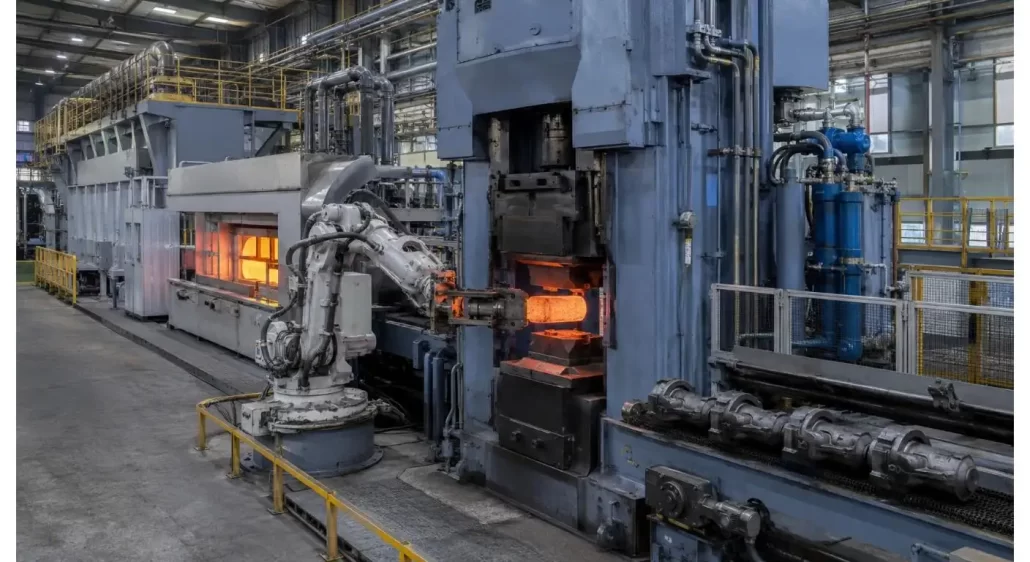
An automated forging line can have the processes of heating the billet to temperature, descaling, lubrication, billet transfer, forging, ejection and inspection. The operations have to be synchronized since the billet temperature will continuously drop after the heating.
The following are some of the helpful automation functions:
- Billet-presence detection
- Temperature verification
- Avoid loading and unloading by hand, utilize robot or transfer loading.
- Die lubrication
- Part ejection confirmation
- Overload monitoring
- Production counting
- A record of fault and maintenance activity.
GUANGDUAN’s closed single-point forging press overview introduces a PLC control, continuous, single and micro-motion mode and optional feeding and photoelectric protection.
Institute the use of Representative Billets to validate the process.
A dry-cycle test does not ensure the filling of the die or control the flash or tool alignment.
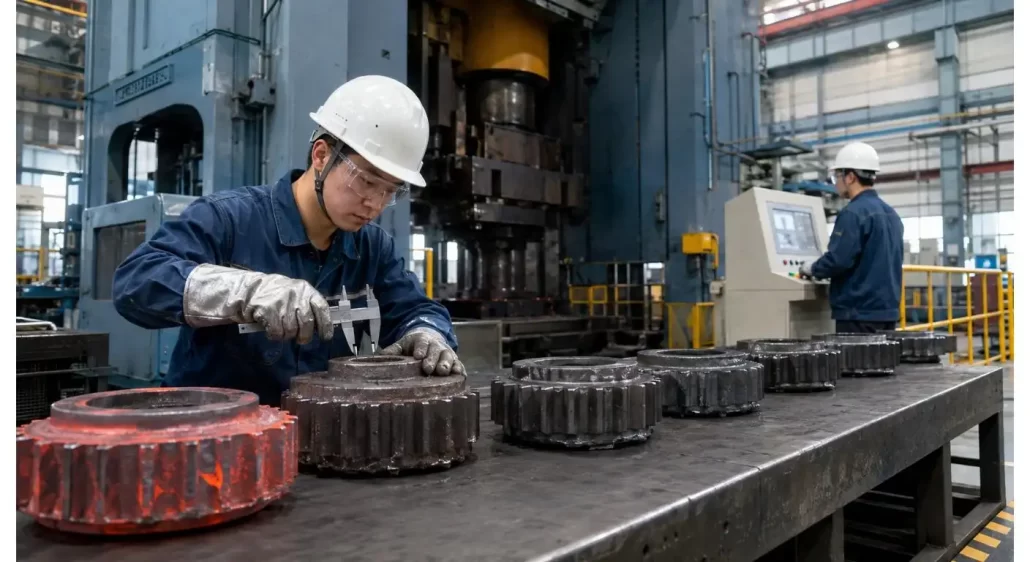
The factory or production acceptance should confirm:
- Peak load during the forming process
- Billet-temperature range
- The die filling and flash distribution is the name of the game.
- Parting-line alignment
- Ejection reliability
- Sustainable cycle time
- Forged-part dimensions
- Ensuring safety and responding to overloading.
After achieving a stable operating temperature of the dies, several consecutive parts should be evaluated. An acceptable forging is not repeatable production.
| Acceptance Item | Verification Method | Risk Controlled |
| Forming load | Record the production load curve | Overload or insufficient capacity |
| Die filling | Inspect deep and thin cavity features | Underfill and cold shuts |
| Flash | Compare thickness around the part | Uneven flow or misalignment |
| Ejection | Run repeated hot production cycles | Sticking and transfer delays |
| Dimensions | Measure stabilized production parts | Thermal dimensional drift |
| Cycle time | Time the complete automated process | Unrealistic output estimates |
Final Engineering Check
It is important that the cavity is filled in the closed die in a press continually with a minimum of the press load, and no flash and die stress. Tonnage is key but forming, energy, motion, rigidity of the frame and die space, temperature control and ejection dictate production stability.
GUANGDUAN is able to review billet, die and output information, so the manufacturer can choose a forging presses according to the measurable requirements of the forging process instead of capacity.
FAQ
Q1. What is a closed die forging press?
Makes a billet fit into dies of a desired shape which are substantially encasing the billet. The billet is fed into the cavity to create a close tolerance forged part.
Q2. What are the parts that are produced by closed die forging?
The typical ones consist of gears, connecting rods, bearing races, flanges, tools and valve components. The process is applicable to highly repetitive, well controlled grain flow parts.
Q3. Which one is better, a mechanical or a hydraulic forging press?
Mechanical presses are ideal for high volume, repeatable forging processes. The hydraulic presses offer more flexibility with regard to force, speed and stroke.
Q4. What is the capacity of closed die forging press?
Capacity is determined by the material, temperature, projected area, geometry, friction and flash design. Consider the load–stroke curve as well as peak tonnage; also consider the forming energy.
Q5. What are the reasons for the difference in life of die forging?
The alignment, billet temp, peak load, lubrication and thermal cycling affects the life of the die. The stability of the process can be more critical than the type of the die material.
CONTACT US


Guangdong Metal Forming Machine Works Co., Ltd.
We are always providing our customers with reliable products and considerate services.
If you would like to keep touch with us directly, please go to contact us
-

Home
-

Tel
-

Email
-

Contact