
Choosing a Hydraulic Press Machine for Automotive Manufacturing
The tonnage isn’t the only criterion used by automotive manufacturers to choose a hydraulic press. A large body panel might be successfully drawn on a press that is too large and too slow for bearing assembly; and a high-speed machine might not have the control to hold the pressure to meet the specifications for composite or precision calibration applications.
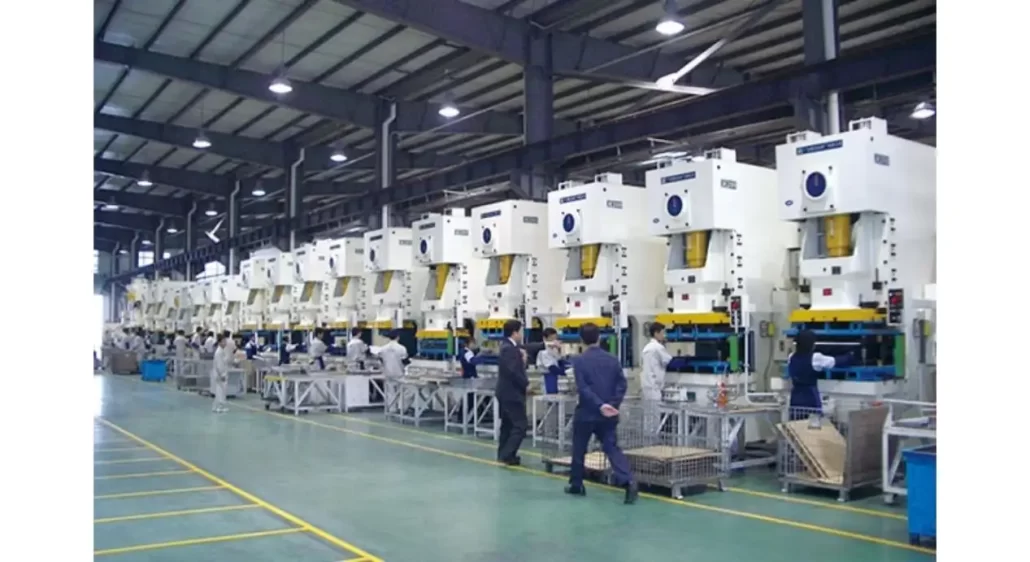
To select the appropriate hydraulic press machine for automobile manufacturing, the part geometry, material, die size, forming process, volume requirement, and dimensional tolerances need to be taken into account. This guide will give you an understanding of what you can do to convert those production requirements to a usable press specification for your auto manufacturer.
In the automotive sector, hydraulic presses come into play in the production of car seats, doors, hoods, and other parts.
Hydraulic presses are especially applicable in those applications where a process in the automotive industry demands control of the force applied during the stroke, a variable slide speed, pressure holding or a long working stroke. These are characteristics which set them apart from traditional mechanical presses designed for high speed repetitive stamping.
Common auto uses are:
- Drawing of deep pan, wheel house, structure covers of oil pan, etc.
- Body & chassis: forming & flanging
- Straightening and calibration of welded and/or heat-treated components.
- Press fitting bearings, bushings, shafts and suspension parts
- Molding under pressure of composite interior components or structural components
- Shaping Battery Trays and parts of EV Enclosure
- Die testing and low & medium volume part production
GUANGDUAN’s hydraulic press solutions include drawing, pressing, bending and other types of controlled force forming. Each project however should be designed around the specific part and not by the broad term of the industry.
Automotive Part and Forming Process Start With
First, the physical change that the press must make is determined. The hydraulic system and machine frame are subjected to different stresses during deep drawing and calibration and press fitting.
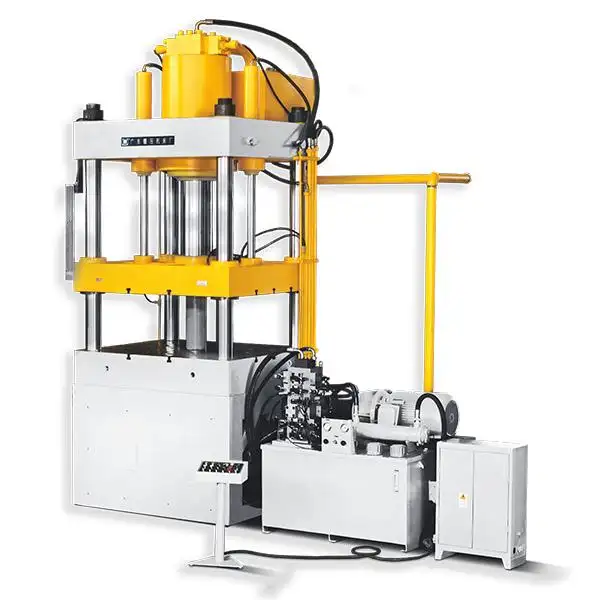
Engineers should consider the following in regard to sheet-metal drawing:
- The material and thickness of blank.
- Drawing depth (or “draw ratio”)
- Required blank-holder force
- Forming-force curve
- Lubrication and surface-quality requirements are in good supply.
- There is risk of wrinkling, tearing and spring back.
The information is changed to the following critical information for assembly/calibration:
- The depth of insertion and force required for insertion.
- Acceptable force–displacement window
- Component alignment
- Holding time
- Final dimensional tolerance
- Need for traceability of each press cycle
For deep drawing, it might be better to have a double-action hydraulic press, so that the blank-holder and main slide can be set independently. The company’s automotive-focused hydraulic press application guide also discusses why it’s important to consider pressure, stroke and load distribution in tandem.
| Automotive Process | Typical Components | Key Press Requirement | Main Quality Risk |
| Deep drawing | Oil pans, covers, housings | Controlled forming speed and blank-holder force | Wrinkling or tearing |
| Calibration | Chassis and welded parts | Repeatable end pressure or position | Dimensional variation |
| Press fitting | Bearings, bushings, shafts | Force–displacement monitoring | Misalignment or overloading |
| Compression molding | Interior and composite parts | Uniform pressure and holding time | Incomplete filling or uneven curing |
| EV component forming | Battery trays and enclosures | Large working area and controlled material flow | Springback or panel distortion |
Determine the tonnage of an engineering margin.
The nominal press capacity should be higher than the maximum forming load, but getting the largest machine available could lead to higher energy usage, tooling and space requirements.
The minimum sized capacity should be sized to include:
- Peak Forming/Assembly Force
- The force that holds the blanks in place, such as an auxiliary force.
- Material-strength variation
- The friction/ lubrication conditions
- Off-center loading
- Wear of tools & variation of process
- Appropriate engineering safety margin
A single peak tonnage figure is not as useful as the forming force-curve. Drawing operations may need to be controlled in the automotive industry when the pressure must be controlled over a long stroke, and calibration operations may need to be controlled near the end of the stroke to achieve a maximum force.
Therefore it is necessary for press suppliers to discuss the part drawing, material specification, forming simulation or trial data to determine the capacity.
Do the maths for Bed Size, Daylight and Stroke Together.
Even if a press has a high tonnage, it may not be appropriate if the work space of the press is not appropriate for the die.
The specification should comprise:
- Die dimensions – left to right and front to back.
- Bolster and slide surface dimensions (Bolster size and slide surface size)
- Maximum die height
- Required daylight opening
- Return stroke, Working and Return stroke
- Die-loading direction
- The moving requirements include bolster or Die-Cart.
- Sensors and ejectors/transfer equipment space
When multiple features are formed in a single tool, the loading conditions of the tool can be asymmetric, due to the influence of automotive dies. Therefore, worktable size and frame rigidity should be taken together as a purchasing parameter not separately.
The deflection and off-center loads of control frames.
Part repeatability, die alignment and die life are the factors that are affected by die stiffness. When a large amount of deflection occurs, it may alter the clearance between mating tools, resulting in a non-uniform wall thickness, dimensional drift or excessive guide wear.
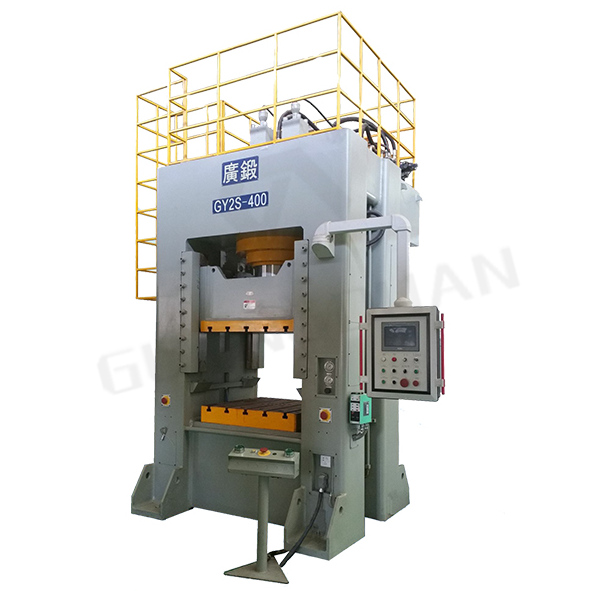
Four column presses provide easy die access and die versatility. When larger dies or greater rigidity are desired or there are significant off-center loads, straight-side or H-frame structures are generally considered. Either construction is not necessarily superior – it depends on the size of the die, the position of the load and the tolerable deformation.
Ask the supplier to provide the following information:
- Vertical or horizontal bending on a frame that is measured or calculated.
- Permitted eccentric-load conditions
- Slide-guidance design
- Increase the degree of flatness and parallelism
- Full-load testing method
- Checks for alignment after installation.
Understand the relationship between Pressure and Motion Control and Material Behavior
Advanced high-strength steel, aluminum and composite systems are increasingly becoming a part of the automotive materials. Sometimes, the springback, thinning, flow and curing behaviour properties cannot be controlled with the help of peak force only.
A modern hydraulic press machine that is used in the automotive industry may need programmable control of:
- Rapid approach speed
- Pre-forming slowdown
- Forming speed
- Pressure build-up rate
- Pressure/position holding
- Decompression
- Fast return
- Blank-holder force
Servo-hydraulic control can enhance the flexibility of motion and minimize unnecessary operation of the pump during low demand periods. GUANGDUAN’s servo hydraulic press capacities can be used for reference by manufacturers when considering the architecture.
Determine the Cycle Time and then Select the Hydraulic System
Hydraulic presses offer the advantage of flexibility in terms of pressure or motion control, but cycle time needs to be determined for the entire sequence of operations, and not just the forming stroke.
Include:
- Material loading
- Rapid approach
- Controlled forming
- Pressure holding
- Decompression
- Slide return
- Part unloading
- Inspection and/or data recording.
If the stamping is of short stroke, high volume, such as may be required in very large volume stamping, a mechanical or servo-mechanical press might be used for higher output. This comparison should be done based on process window and for annual production volume. Naturally linked here is GUANGDUAN’s explanation of difference between hydraulic and mechanical press.
Plan Automation & Production Data Integration
The press for an automotive production cell needs to communicate with upstream and downstream equipment.
Possible integrations include:
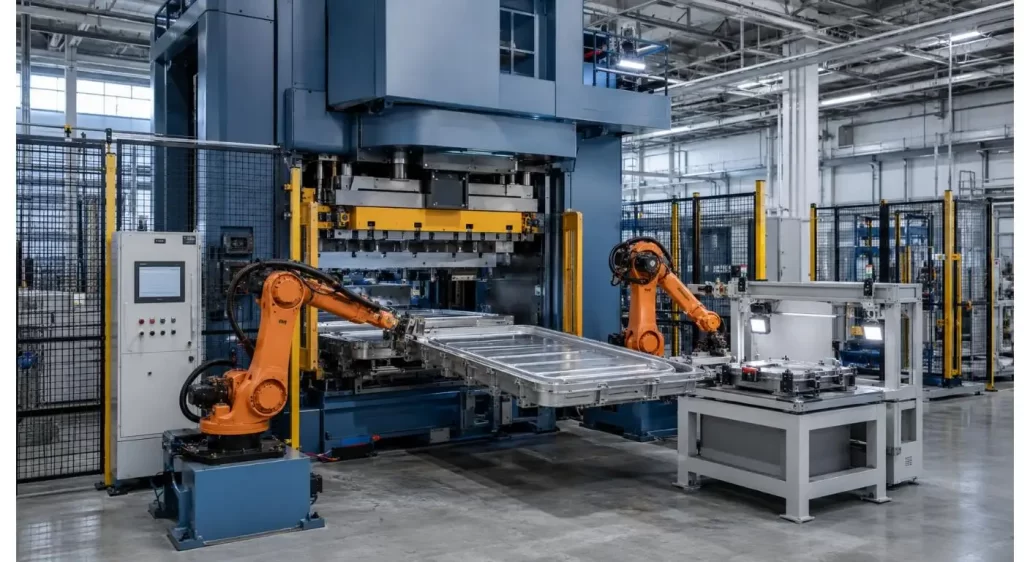
- Robot / transfer loading
- Feeding and handling of coils and blanks
- Die identification
- Automatic lubrication
- Part-presence detection
- Vision inspection
- Force–displacement monitoring
- Recipe management
- MES production-data exchange
- Fault alarm and maintenance record.
Signal protocols, safety zones and fault-recovery logic should be specified in the control specification prior to equipment manufacture. Adding these functions after commissioning generally causes a greater disruption, and higher cost.
Apply Safety as an integral part of the process design.
Automotive presses are a combination of high force, large moving tools and automated material handling. Safety design should include safety for operators and inter-connected equipment.
Important provisions include:
- Emergency-stop circuits
- Two-hand control (as appropriate)
- Light curtains/guarded access
- Hydraulic pressure-relief protection
- A Mechanical Locking for maintenance is provided.
- Die-area interlocks
- Safe set up and inching modes
- Over travel & overload monitoring
- Robot-cell safety communication
There is need to consider the safety system based on the machine’s intended use, mode of operation and local legislation. For more details, please refer to GUANGDUAN’s safety guide for hydraulic press for automotive parts.
Data to send to the Press Manufacturer
More than just a desired tonnage should be included in a good request for quotation. Buyers should provide:
- Part and die drawings are the two types of drawings.
- The quality and thickness of the materials used.
- Sequence of forming/assembly.
- Estimated peak force
- Die dimensions and weight are accurate.
- Must perform stroke and daylight.
- Volume and goal cycle time per year
- The way the item or load is loaded and unloaded.
- Site constraints such as utilities and factory layout.
- Required quality records
- Applicable safety standards
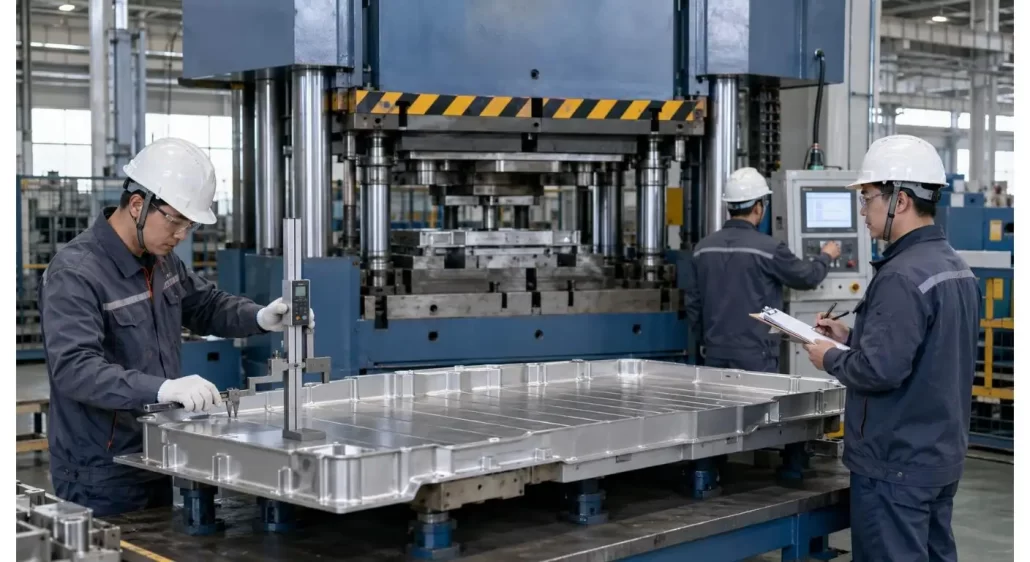
This information enables the manufacturer to analyze the frame, hydraulic circuit, control system and automation interfaces as a single production system.
| Selection Item | Data Buyer Should Provide | Why It Matters |
| Part | Geometry, material and thickness | Determines process and forming force |
| Die | Dimensions, weight and load position | Defines bed size, daylight and rigidity |
| Production | Annual volume and cycle target | Sizes the hydraulic and automation systems |
| Quality | Tolerance and traceability needs | Defines sensors and control resolution |
| Factory | Layout, power and installation limits | Prevents installation and integration conflicts |
| Safety | Destination and operating modes | Establishes guarding and control requirements |
Conclusion
These are the best hydraulic press machine for automotive manufacturing that can provide the necessary process window on actual materials, dies and production states. Although tonnage is important, it is frame rigidity, load distribution, working area, pressure–position control, cycle time, and compatibility with automation that will be critical to ensuring the machine can be productive in the long term, producing stable parts.
Given part drawings, material data, die size and planned production quantities, GUANGDUAN can analyze automotive projects, and then provide the manufacturer with a press that is configured based on factor actual process requirements instead of only nominal capacity.
FAQs
Q1. What are some auto parts that can be produced using a hydraulic press?
Body panels, oil pans, chassis parts, bearing assemblies and battery trays and composite parts can all be manufactured using hydraulic presses. The correct configuration will be varied depending on the operation (drawing, forming, calibration, assembly/compression molding).
Q2. What is the formula for calculating the needed press tonnage for an auto?
The part geometry, material strength, thickness, forming process and friction conditions are used to calculate tonnage. An engineering margin, off-center loads and blank-holder force must also be added.
Q3. Does a hydraulic press work for a high volume automotive producing operation?
Yes, if adjustable speed and full-stroke force or pressure holding is advantageous to the process. When evaluating extremely fast, short-stroke stamping, buyers should not only consider the total cycle time, but also mechanical and servo-mechanical options.
Q4. What is the importance of the frame rigidity in the automotive forming?
The forming clearance and tool alignment are affected during the loading by frame deformation. Adequate rigidity helps to control part dimensions, minimize uneven die wear and to ensure repeatability for long runs.
Q5. Is it possible to combine a hydraulic press for cars with robots?
Yes. When these interfaces and safety logic are specified during the engineering stage, it can be connected to robots, transfer systems, inspection equipment and MES platforms.
CONTACT US


Guangdong Metal Forming Machine Works Co., Ltd.
We are always providing our customers with reliable products and considerate services.
If you would like to keep touch with us directly, please go to contact us
-

Home
-

Tel
-

Email
-

Contact