
Automotive Sheet Metal Stamping Press Selection Guide
A nominal tonnage automotive stamping press with too strong a nominal tonnage can be unsuitable for production line. This required force may be too early in the stroke, or the die itself may be larger than the bed area, or the slide may be canted due to an eccentric load.
Therefore, an auto sheet metal stamping press should be selected based on the entire die and production process, rather than a capacity number.
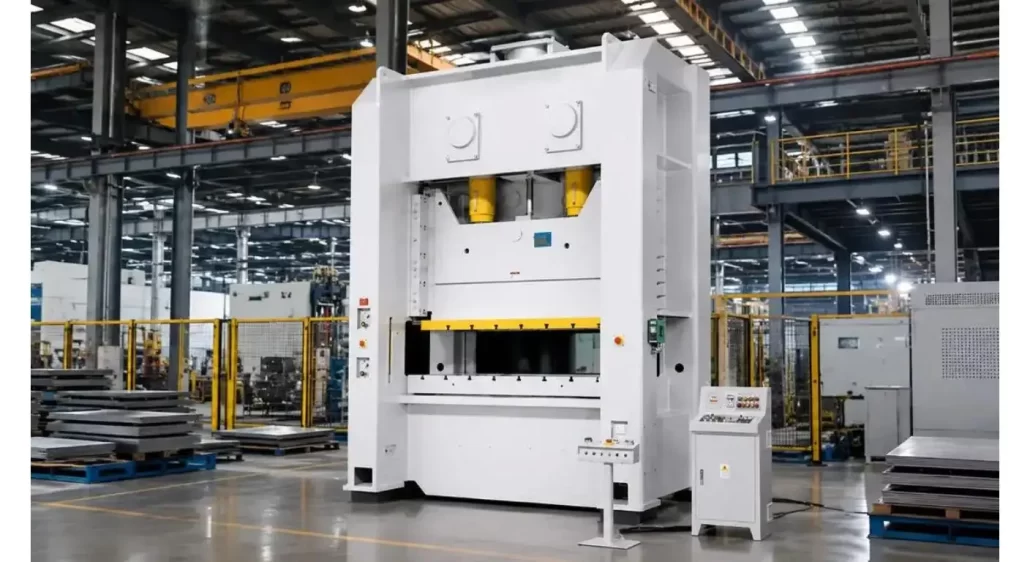
The automotive stamping press overview involves blanking, drawing, trimming and piercing and flanging that are performed to produce automotive components from sheet metal.
Build with the Stamping Architecture
Various production architectures are used for automotive parts, depending on their size, complexity and volume.
Progressive die is a single operation die that can do multiple operations as the coil material moves through the die during the press operation. Efficient for brackets, reinforcements and smaller structural elements.
A transfer press is a single machine with several die stations that transfers individual blanks between the stations. It is suitable for parts that need drawing, trimming, piercing and restriking.
A tandem line is a line that consists of several individual presses in combination with robots or transfer equipment. It is normally used for big panels with a large amount of die space.
The chosen architecture sets:
- Press-bed dimensions
- Window for feeding/transferring
- Sliding stroke and close height.
- Die cushion requirements
- Part-transfer direction
- The number of strokes a minute required for the activity.
- Automation interfaces
| Production Architecture | Suitable Parts | Main Press Requirement |
| Progressive die | Brackets and small reinforcements | Feed accuracy and eccentric-load resistance |
| Transfer press | Drawn structural components | Large die area and transfer clearance |
| Tandem press line | Doors, hoods and large panels | Press synchronization and robot access |
| Single press | Die trials and low-volume parts | Flexible setup and manual accessibility |
| Coil-fed blanking line | Flat blanks and simple profiles | Feeding speed and scrap handling |
| Multi-station press | Integrated forming sequences | Wide bolster and controlled die cushions |
Rated capacity: Must be available at the working position.
A mechanical press is not generally capable of 100% of its nominal capacity over the entire stroke of the press. Capacity is stated at a certain distance above BDC.
The forming engineer needs to correlate the press rating point with the actual load – stroke curve of the die. Even if the maximum load of a drawing operation looks acceptable, it may be necessary to use a different drive or larger machine if the drawing operation reaches peak force too early.
It is important that the assessment reflects the following:
- Peak forming force
- Position of peak force
- Work per stroke (WPS)
- Blank-holder / cushion load
- Safety margin
- Continuous operating rate
This is more reliable than just comparing models on press tonnage.
When a load is off-center, it will change the machine requirement.
Progressive and transfer dies are seldom ideal in distributing the load of the press center. One station might be pulling, and the other one might be trimming or piercing, thus not distributing the force evenly.
Too much eccentric loading may result in:
- Slide tilt
- Uneven die clearance
- Accelerated guide wear
- Parting-line movement
- Dimensional variation
- Premature tool damage
STPP mechanical punch press from Guangduan adopts reverse double crankshafts and eight-sided full guideways, which is beneficial to balance movement and enhance the ability of resisting the unbalanced loading.
The load position for every die station and the eccentric-load envelope to be permitted should be specified by the buyer.
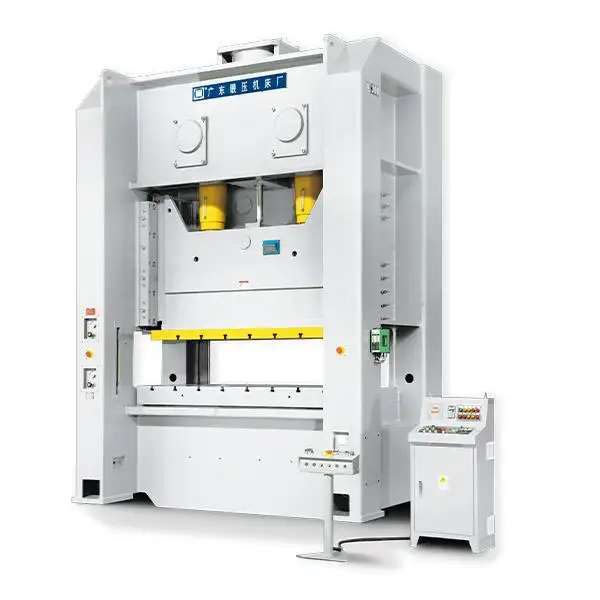
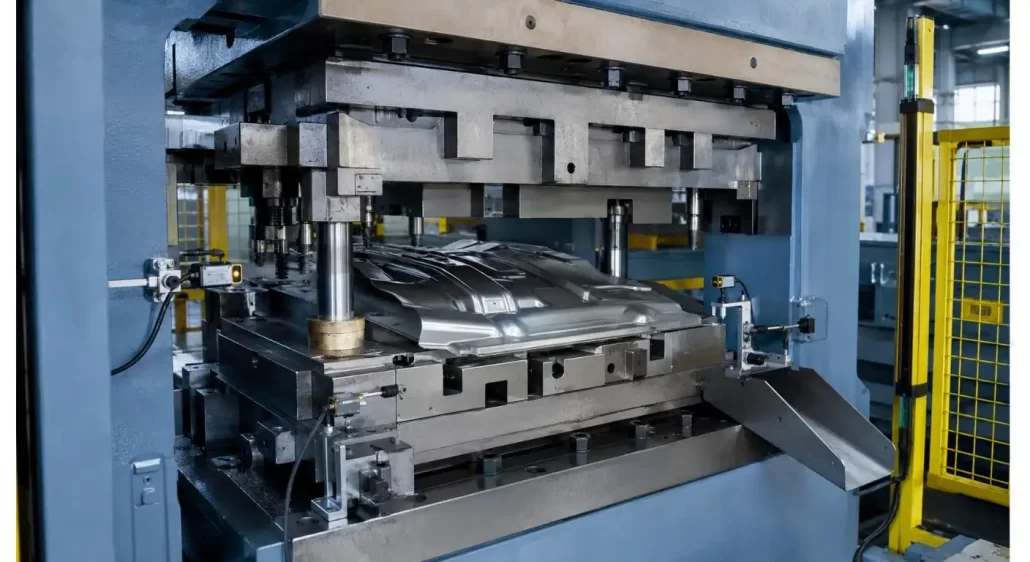
Rigidity needs to be verified using production die.
The press frame, slide and bolster elastically bend when stamped. With large automotive tooling, any small adjustments in alignment can be magnified across the width of the tooling.
Some key machine features are:
- Welded-frame rigidity
- Distance between pressure points
- Slide-guidance length
- Bolster deflection
- Slide-to-bolster parallelism
- Foundation stiffness
No-load geometric inspection is required, but it can not predict the loaded performance. Testing for acceptance should be done with a representative die or an engineered method of loading that simulates the desired force distribution.
To confirm the Complete Die Envelope.
Even then, if the press is powerful enough, it may not be physically compatible with the tooling.
Confirm:
- Bolster length and width
- Slide dimensions
- The height of the dies must not exceed or fall below the maximum and minimum limits.
- Slide adjustment range
- Stroke length
- Distance between columns
- Side openings
- Die weight
- Moving-bolster requirements
- Up and Down ejector space
GD2 straight-side multi-station press produced by GUANGDUAN is suitable for wide multi-station tooling and has interfaces with two-dimensional and three-dimensional servo production line.
The finished part must also pass the die, transfer bars and press frame when it is removed.
Die Cushions Must Match the Drawing Process
Controlled blank-holder force can be needed to ensure that large automotive panels can flow into the die cavity without wrinkling.
The evaluations to be made on a die cushion are:
- Maximum force
- Usable stroke
- There are two pressures zones.
- Pressure consistency
- Response time
- Pin layout
- Return behavior
With multi-zone cushions, different zones of the blank can be held at various forces. Important for asymmetric panels / multi-station tools.
Cushion requirements should be specified based on simulation of forming, on die data or on production trials and not as a general accessory.
Stroke Rate does NOT equal Line Output!
The press may have the ability to do a high stroke rate, but the transfer equipment, feeder, die or inspection station may hold the press back.
Sustainable cycle time should comprise of:
- Blank feeding, coiling
- Material positioning
- Press stroke
- Part release
- Transfer
- Scrap discharge
- Inspection
- Fault recovery
In the case of very large pieces, transfer acceleration has to be considered to not allow the part to vibrate and deform. A quick press setting is not useful when it reduces stability of feeding and/or the frequency of stops.
To illustrate the large-part production, GUANGDUAN’s big stamping press application is introduced here, large stamping press application needs to be accompanied by multi-station transmission, wide working area and anti unbalanced load.
Before Damage occurs Die Protection Must React.
The replacement of automotive tooling may be more costly and time consuming than the tool stoppage. Protection should alert of incorrect state prior to next stroke.
Typical functions include:
- Feed-position detection
- Double-blank detection
- Part-out confirmation
- Scrap-chute monitoring
- Misfeed detection
- Hydraulic overload protection
- Lubrication monitoring
- Die-area clearance detection
The control logic should detect the damaged component and ensure that there is no uncontrolled restart. When abnormal force occurs, overload protection minimizes damage, and misfeed sensors should keep the abnormal stroke from occurring.
Plan Die Change Part of Production Capacity
Model changes can lead to significant die-change time, which can result in lost production if models are changed often.
A changeover plan could involve:
- Moving bolster
- Die carts
- Hydraulic clamping
- Automatic connector coupling
- Die identification
- Stored production recipes
- Setup verification
- First-piece approval
In the factory layout consider the path for moving large dies, crane lifting capacity and maintenance access. If assumptions regarding changeover are not realistic, the press will be unable to achieve its estimated output per year.
Measure Continuous Production, not just individual strokes.
Representative material, tooling and transfer equipment shall be employed in the factory acceptance testing wherever possible.
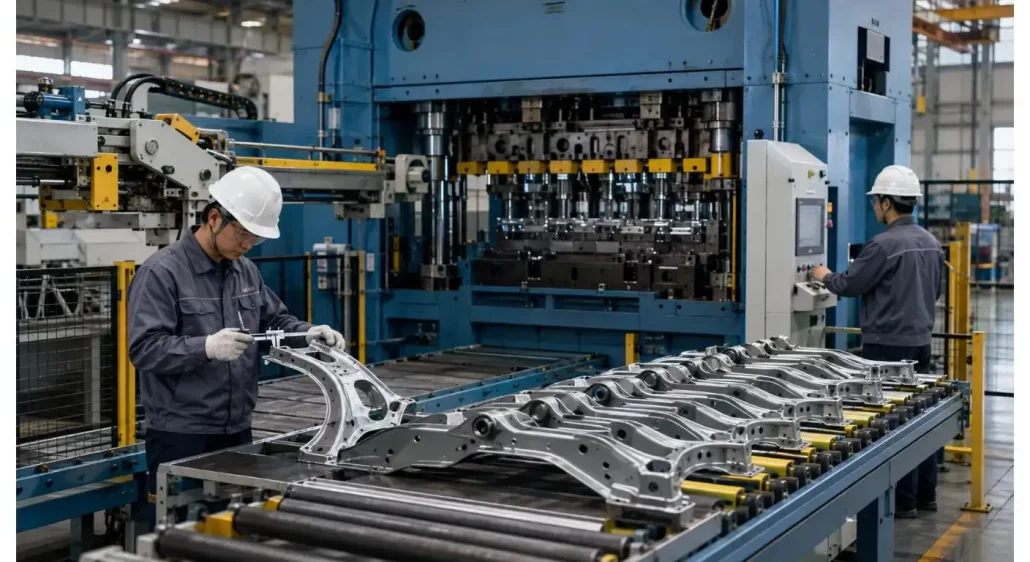
Verify:
- Loaded alignment
- Forming-force behavior
- Sustainable stroke rate
- Timing of feeding and transferring.
- Cushion performance
- If overload/misfeed occurs, a signal is sent to the control unit.
- Scrap removal
- Quality of parts from a running production process
- Planned fault recovery
After the stabilisation of the operating conditions of the press and the die, several consecutive parts should be measured.
| Acceptance Item | Test Condition | Risk Controlled |
| Rated performance | Representative load–stroke curve | Insufficient force or energy |
| Slide alignment | Loaded production condition | Tilt and uneven die clearance |
| Transfer timing | Complete automatic cycle | Part collision or unstable output |
| Cushion performance | Drawing operation under load | Wrinkling and tearing |
| Die protection | Simulated misfeed and overload | Tool and press damage |
| Continuous output | Defined production run | Unrealistic cycle estimate |
Final Engineering Check
An appropriate automotive sheet metal stamping press should be able to withstand the force, energy, size and load distribution of the die, and provide the necessary line output.
GUANGDUAN is able to analyze the tooling and production information, and based on measurable forming and automation requirements, design a mechanical stamping solution according to the nominal tonnage.
FAQ
Q1. What are some parts an automotive stamping press can make?
Can be used for body panels, reinforcements, brackets, crossmembers and other sheet metal components. Die type and press configuration will be related to part size and the order of operations.
Q2. What is a progressive vs transfer stamping?
Coil material is continuously fed through a series of die stations in a progressive stamping tooling. Transfer stamping is the transfer of individual blanks from one forming station to another.
Q3. What is the importance of press rating point?
Rated capacity of a mechanical press is the capacity to be delivered at a specified position above BDC. The die load curve should be kept within the available force and energy for the entire stroke.
Q4. Why is eccentric-load capacity important?
Multi-station dies can result in unequal forces throughout the slide. With proper guidance and rigidity of the frame, tilt and die clearance and tool wear can be controlled.
Q5. What are the methods of testing an automotive stamping press?
Representative material, tooling and automation should be used for testing. Should be verified with a continuous run: load, cycle time, protection systems and part quality.
CONTACT US


Guangdong Metal Forming Machine Works Co., Ltd.
We are always providing our customers with reliable products and considerate services.
If you would like to keep touch with us directly, please go to contact us
-

Home
-

Tel
-

Email
-

Contact