
Vehicle Parts Stamping Machine Planning by Part Family
A well performing stamping machine for a pair of small brackets might not work for a panel for a battery tray or chassis reinforcement. Issues don’t always have to be tonnage. An otherwise capable press can be eliminated by the width of the sheet, stroke, eccentric loading, and sheet format and transfer technique.
The vehicle part stamping machine should thus be designed for the entire vehicle part range that will be required during the machine’s operating life.
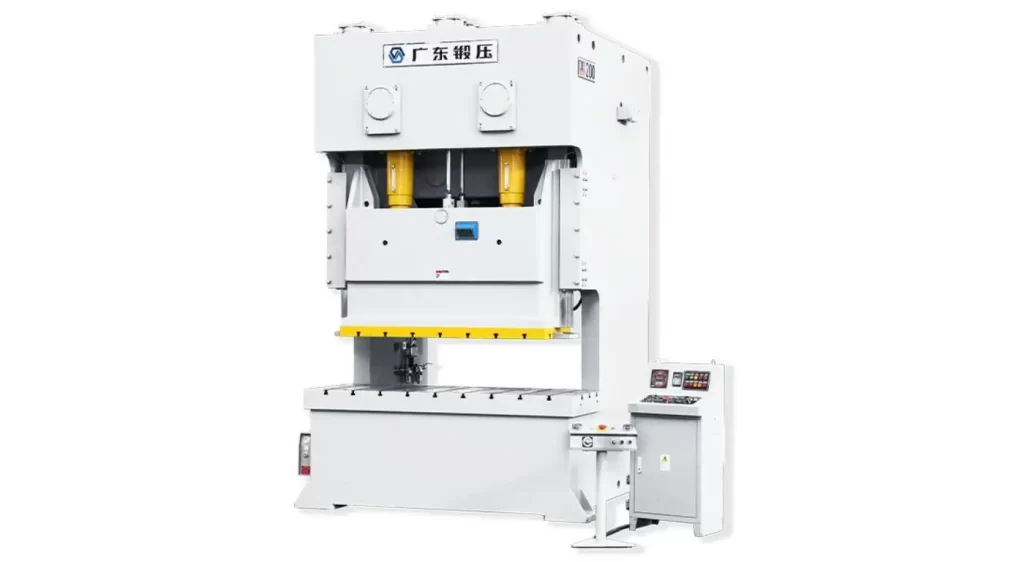
GUANGDUAN offers mechanical and hydraulic press equipment to various applications in the fields of vehicle parts. Parts program selection should start with parts program and not with one of the current production drawings.
Break up the Vehicle into Stamping Part Families
There are various forming and production needs for vehicle components.
Stamped parts are small components such as clips, brackets, sensor mounts and electrical-system supports. A coil is often used for their production and these are made by progressive dies.
Medium structural parts are seat frame parts, crossmembers, suspension brackets and reinforcements. Transfer dies or wide progressive dies may be needed for these parts.
Main components are door battery-tray panels, body sides, floor panels and door inners. They require a lot of die space and resistance to uneven forming pressure, with controlled handling.
All a priori project evaluations should be broken down into these categories:
- Flat blank dimensions
- Finished geometry
- Material and thickness
- Number of operations performed to create the shape.
- The size and mass of the piece.The size and weight of the piece.
- Annual volume
- Model production life
This is a part-family map, giving you a more solid basis for the equipment you choose than having a press for each part.
| Vehicle Part Family | Typical Production Method | Primary Equipment Need |
| Clips and small brackets | Coil-fed progressive stamping | Feed accuracy and high output |
| Seat-frame components | Progressive or transfer stamping | Flexible die space and automation |
| Chassis reinforcements | Transfer or multi-station stamping | Rigidity and eccentric-load resistance |
| Door and body inner panels | Transfer or tandem line | Large working area and part clearance |
| Floor and battery-tray panels | Large multi-point press | Wide load distribution and automation |
| Service and replacement parts | Flexible standalone press | Fast setup at lower volume |
Customize high volume parts with Progressive Dies.
In a progressive stamping process a metal strip is introduced into a series of successive stations. There are multiple operations performed in each pres stroke and moving the material.
Works well for:
- Mounting brackets
- Seat and restraint components.
- Electrical-system supports
- Small reinforcements
- Engine and Transmission brackets
The press needs to have sufficient strength to hold the length of the die, the feed pitch, and the energy and combined load of each of the stations in operation. As piercing, bending and forming occur at various places, the pressure center may move.
GUANGDUAN’s mechanical stamping die overview is an explanation on how to use progressive or transfer die in multi-operation production.
A progressive die would only be economical if the annual volume is sufficient to warrant the investment in the tool and set-up.
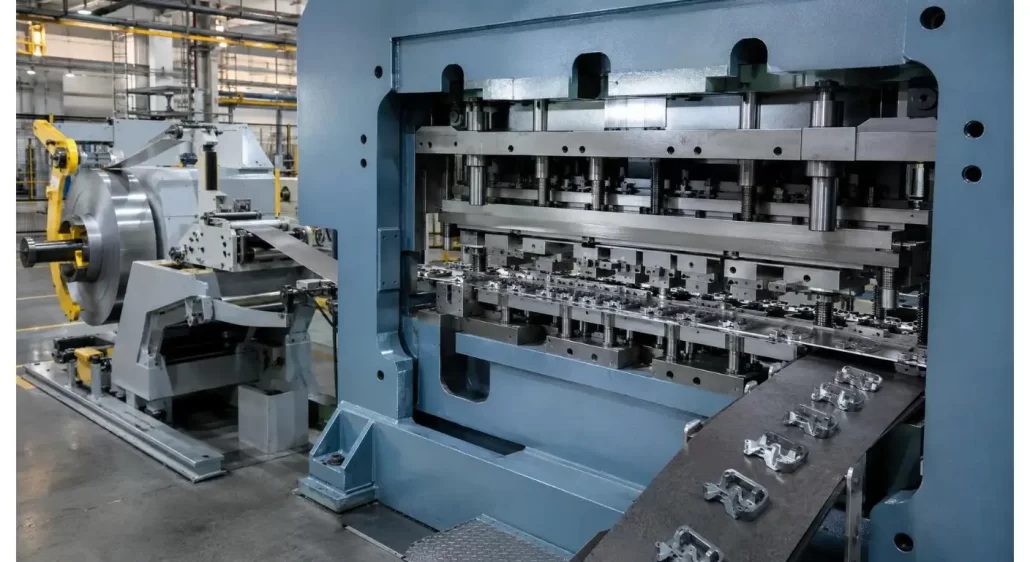
The transfer stamping process is suitable for the stamping of deeper vehicle components.
Transfer stamping is used to separate blank and transfer it to individual forming stations. The part may rotate or change orientation during operations, allowing for deeper and more complex geometries that a strip carrier may not be able to achieve.
Transfer systems are often considered for:
- Drawn chassis parts
- Crossmembers
- Seat structures
- Large reinforcements
- Oil pans and covers
- EV enclosure components
The stamping machine of the vehicle parts must be provided with adequate transfer and open space for the flat blank and the formed parts. Prevention of vibration and loss of position of thin parts requires transfer acceleration to be controlled.
GUANGDUAN’s GD2 multi-station press can be used to press in series, multi-station, and can be linked with 2D and 3D servo production lines.
The tonnage is not the only factor to consider when choosing a large panel.
Large body or floor panels exacerbate frame deflection, slide tilt and material handling issues. Different loads can be applied to either end of the slide due to a wide die.
When planning equipment, these are some of the things to take into account:
- The pressure points and their placement.The number and position of pressure points.
- Slide and bolster rigidity
- Loaded parallelism
- Die cushion zones
- Usable bed area
- Part-transfer window
- Die-change method
- Foundation requirements
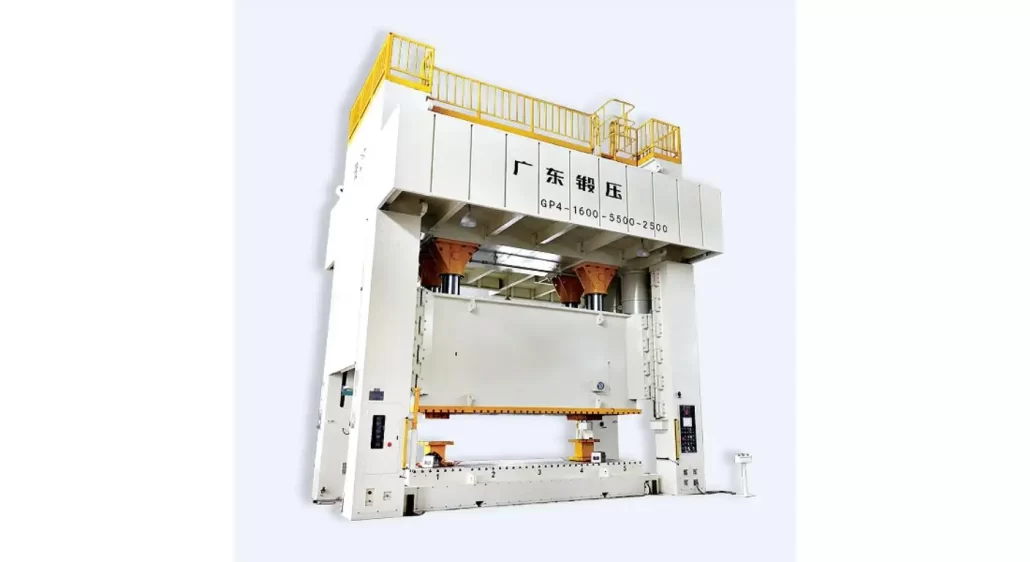
Two point and four point press designs are used to spread the force over a larger working area. GUANGDUAN’s GP2/GP4 precision mechanical presses are designed for cases where large working table and multi-pressures is required.
Even with the selection, it still needs to be checked against the real load distribution and die size.
A material change may reclassify the project
One part that is created in mild steel can be subsequently converted to the advanced high strength steel or aluminum to satisfy weight and crash performance requirements.
This change may impact on:
- Peak forming force
- Springback
- Die wear
- Lubrication
- Blank-holder pressure
- Transfer stability
- Surface-marking risk
A machine used for stamping vehicle parts, which was only chosen for the original material, might not be able to handle the later program due to its capacity and/or rigidity.
The RFQ must include the current materials as well as any planned alternative materials. The material specification should change when forming simulation or trial data is changed.
Production volume is the determining factor of an economic machine.
The quickest/largest press does not necessarily have to be the cheapest.
The low volume service part can be cost-effective manufactured on a flexible standalone press. A progressive die and coil line may be warranted with a high volume production. A transfer press that has a high rate of die change for a family of medium-sized parts can be used.
The capacity planning should cover the following:
- Annual volume
- 30 working days and shifts
- Expected equipment availability
- Scrap and rework
- Changeover time
- Planned maintenance
- The number of vehicles moved into and out of the service station.
| Planning Input | Required Data | Capacity Risk Controlled |
| Annual demand | Volume by part number | Under- or over-sized equipment |
| Product mix | Batch size and production sequence | Excessive changeover loss |
| Cycle time | Sustainable good parts per hour | Inflated output estimate |
| Availability | Maintenance and planned downtime | Missed delivery capacity |
| Quality loss | Scrap and rework assumptions | Insufficient net output |
| Program life | Launch, peak and service demand | Poor long-term utilization |
Use of sustainable good parts per hour (not maximum mechanical stroke rate) in the calculated requirement.
Capacity is Changeover when Model Changes.
Often there are multiple part numbers in the same model of a vehicle that are supplied by the same manufacturer. If the press is too slow to change dies, the amount of capacity lost during set-up may exceed the amount gained in speed.
It is advisable to have the following changeover provisions:
- Moving bolsters
- Die carts
- Hydraulic clamping
- Automatic connector coupling
- Die identification
- Stored production recipes
- Setup verification
- First-piece inspection
GUANGDUAN’s press machine for auto parts introduces Split-body Architecture and the consideration of integration for large Auto Parts presses.
When designing the factory layout, factors such as die-storage location, transportation routes and the capacity of cranes must be considered.
The automation route should follow the material route.
Parts that are coiled must be uncoiled, levelled and servo fed. Blank Fed Parts may require Destacking, Separation and Centering. Typical for large panels is the use of robotic or transfer handling.
Automation should confirm:
- Correct blank/feed position
- Part removal
- Transfer clearance
- Scrap discharge
- Lubrication status
- Die-area clearance
- Part orientation
- To communicate a single piece of information in multiple ways.
A flexible line also needs to be able to pinpoint what parts and grippers need to be replaced as soon as a new part number is introduced to production.
Start Validation must be an actual real program.
One test at a reduced speed does not indicate the ability of the line to perform a vehicle launch.
When considering the use of representative material, dies and handling equipment, acceptance should verify:
- Loaded press alignment
- Sustainable cycle time
- Transfer reliability
- Die protection
- Changeover sequence
- Part quality from a continuous run of parts
- Scrap removal
- Fault recovery
- Production records
Not only is the easiest component to include in the trial, the part family that produces the most challenging load should be part of the trial.
Final Engineering Check
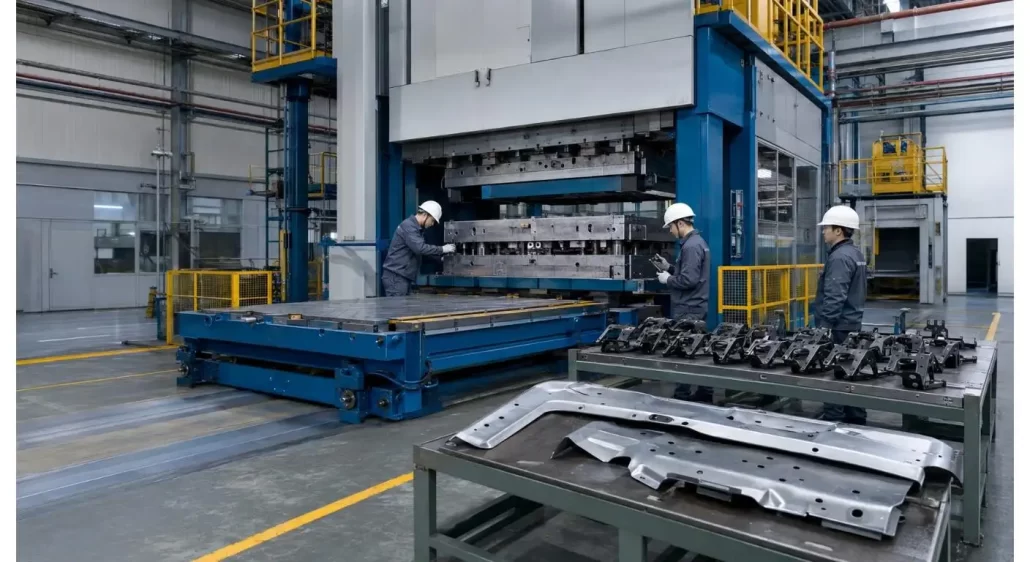
One part is not picked out for use in a suitable vehicle parts stamping machine by itself. Should include a specific family of components without compromising too much on the tool or loss of capacity or changeover time.
GUANGDUAN can consult the part drawings, die and the volume forecast to set up a stamping solution according to the actual vehicle-parts portfolio.
FAQ
Q1. What are some items that can be stamped using a stamping machine?
Could make brackets, reinforcements, seat-frame parts, body panels, crossmembers and EV enclosure parts. Press and die design ranges from simple to complex and is determined by the size and complexity of the parts.
Q2. When to apply progressive stamping?
It is appropriate for parts that have been stable and are produced in larger quantities, and can be attached to a strip for multiple operations. The initial considerations for choosing the right tooling are cost and material utilization.
Q3. When should a transfer press be used?
Transfer stamping is advantageous for deeper and more complicated parts which require moving independently at other stations. It also provides for part rotation between operations.
Q4. Can a single press make various parts of the vehicles?
Yes, it is possible to cover the whole part family by its capacity, working area, stroke and automation. Change over time and tool compatibility need to be considered as well.
Q5. What steps do you take to determine what information you need to consider when selecting a machine?
Give part drawings, material information, volume, size of dies and forming forces, and automation needs. If known, future vehicle programs should be added.
CONTACT US


Guangdong Metal Forming Machine Works Co., Ltd.
We are always providing our customers with reliable products and considerate services.
If you would like to keep touch with us directly, please go to contact us
-

Home
-

Tel
-

Email
-

Contact