
Precision Forging Press: Accuracy Under Production Load
It is possible for a forged part to pass first piece inspection and fail in continuous production. As temperature goes up, lubricant conditions change, press warms up and material batches change. These can cause a gradual change in thickness, concentricity, tooth definition or flash distribution.
The precision forging press needs to ensure that the process is continued to an acceptable part after the first acceptable part is created—it is not just about creating one correct part.
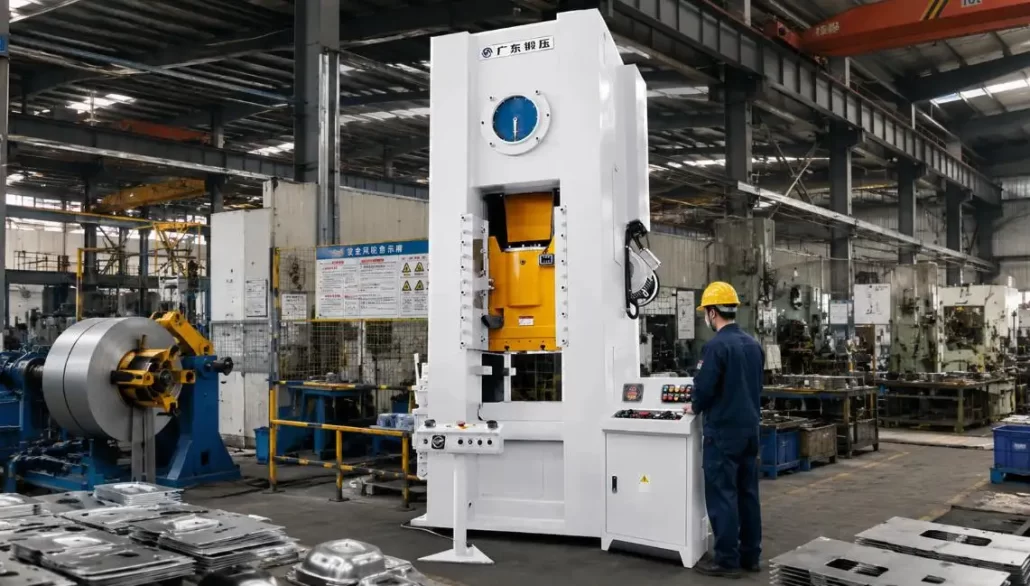
GUANGDUAN forge press range is a press range that is suitable for precision forming, cold extrusion and high-load production. Selection should be based on the repeatability of the load and temperature conditions that are representative.
Precision Forging is more than just a tight tolerance.
The goal of precision forging is to make parts as near as possible to the final shape with minimal machining operations, material removal, and material handling. Common applications include:
- Transmission gear blanks
- Bearing races
- Connecting-rods and shafts
- Create of spline and flange preforms
- Fasteners and precision hardware.
- Cold extruded cups and sleeves.
The forged dimension is just one of a number of performance indicators. Other surface characteristics such as surface definition, draft, concentricity, parting-line shift and consistency of flash and machining allowance should also be considered by manufacturers.
Value is added only when a smaller machining allowance can be consistently held throughout the production batch when the forging process is used.
Type in part requirements and convert it to press requirements.
The selection process should begin with the features that are the most important to downstream function.
Some times, concentricity between the bore surface, pitch diameter and bearing surface of a gear blank may be required. The wall thickness in a bearing race could be an important parameter. Shaft component may need to be straight or to have a stable flange position.
These requirements need to be turned into measurable press and process controls:
- The points on the bottom of the die or the die closure.
- Slide-to-bolster parallelism
- Lateral slide movement
- Forming-load repeatability
- Ejection height
- Billet positioning
- The temperature of the dies and billets.Temperature of the dies and billets.
- Lubrication consistency
This will make sure that “precision” is not a non-specific machine name.
| Forged-Part Requirement | Process Variable to Control | Evidence to Request |
| Uniform thickness | Die closure and billet volume | Consecutive-part measurements |
| Concentric features | Die alignment and billet positioning | Datum-based inspection report |
| Defined corners | Final forming load and dwell | Load curve and profile inspection |
| Stable parting line | Slide guidance and frame rigidity | Loaded alignment results |
| Reduced machining allowance | Thermal and dimensional repeatability | Capability study |
| Reliable automation | Ejection and transfer position | Full-cycle production trial |
What is the meaning of this Bottom Dead Center Controls Final Geometry?
The critical forming stage of many precision forging and coining processes is near the bottom dead center (BDC). Thinning, corner definition and material distribution will be impacted by small changes in die closure.
A crank-toggle or knuckle-joint mechanism slows the slide as it moves towards the bottom position and yields a high force in the last forming zone. The GK Series knuckle joint press of GUANGDUAN has a nominal capacity range of 6300–25000 kN with a dwell time value of about 1/18 of the cycle near the bottom dead center.
This dwell can be used to allow material flow and final calibration. However, benefits can only be realized if the correct die is designed, billet volume and thermal control are correct. An unstable preform can not be recovered with dwell time.
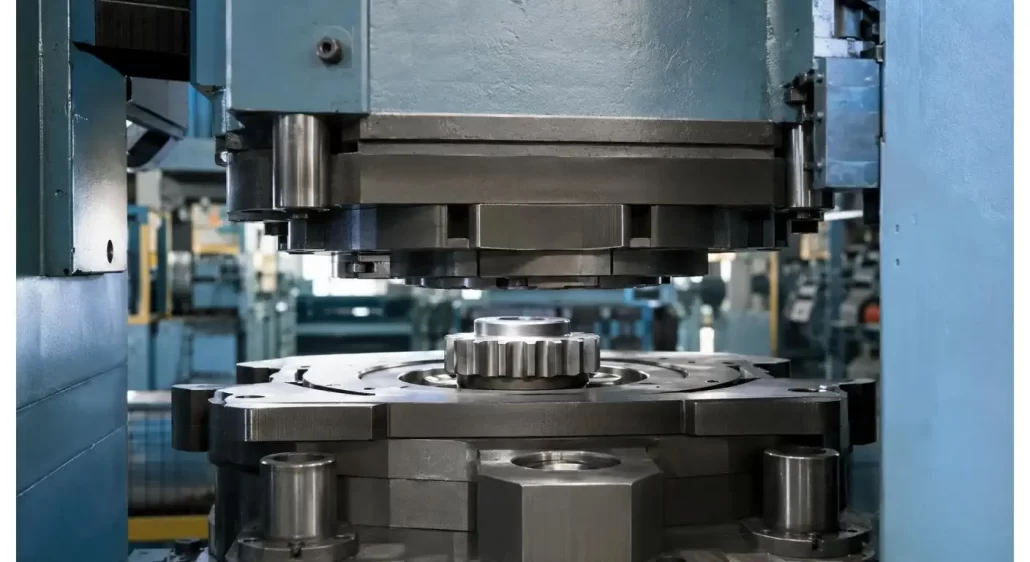
The term display resolution is not equal to part accuracy.
The display value of the GK Series die-height indicator is 0.01 mm. This will assist fine set-up adjustments, but should not be taken as an absolute assurance of all forges dimensions within 0.01 mm.
Other part variation includes:
- Attempt to avoid these issues by using frame and tooling deflection.
- Guide clearance
- Die wear
- Billet-volume variation
- Material temperature
- Elastic springback
- Measurement uncertainty
GUANGDUAN’s high precision forging press overview introduces the functions of die-height display and bottom-dead-center dwell. Please also ask for loaded repeatability and trial-part results for your application.
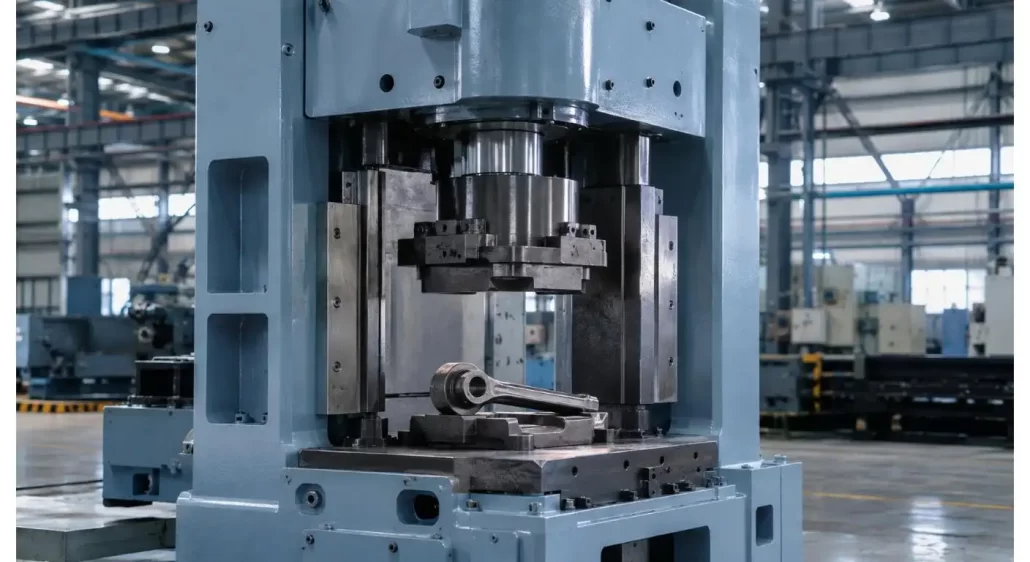
Rigidity and Guidance Protect Die Alignment
The higher the forming force, the more the frame, slide, bolster and tooling will be deflected. The effect of the upper and lower dies moving sideways can lead to an uneven flash, asymmetric geometry and localized die wear.
The following is a list of points to be considered when examining a precision forging press:
- Structure consists of frames that are connected to each other.
- Slide-guidance arrangement
- Support and push parallelism.Strengthen and introduce parallelism.
- The ability of crankshafts or toggle bearings to absorb forces.
- Permitted off-center load
- Addressing foundation and anchoring needs.Considering foundation and anchoring needs.
GUANGDUAN’s JH31 closed-type single-point press adopts monolithic box-type body, four-surface full-guideway slide, which is suitable for applications that need to form a closed frame and use mechanical slides for guidance.
Although the no-load alignment report and precision may be useful, a representative production load should be used to verify precision.
Stable Ejection is a part of dimensional control.
The accuracy of forgings may be lost after forming stroke. Any component that lodges in the die or is ejected unevenly may become distorted as it is ejected, or damage a critical surface.
A system of air ejection should match:
- Forged-part geometry
- Ejection force
- Required ejector stroke
- Part temperature
- The location where the robot or transfer is picked up.
- Cycle-time target
GK Series comes standard with mechanical lower ejector. Part present and ejection complete signals should be part of the press and transfer controls for automated production.
It is important to include the thermal stability in the process window.
Different challenges exist when applying precision forging in the cold, warm and hot states.
Cold forging provides good dimensional accuracy and surface finish; however, high forming force and lubrication are required. Hot forging reduces material flow stress but introduces thermal expansion, temperature variation of the dies and scales. Warm forging is a process used to produce intermediate process window.
For all of the following, acceptable ranges should be defined during a production trial:
- Billet temperature
- Die temperature
- Transfer time
- Lubricant quantity
- Forming load
- Ejection timing
It’s possible to get misleading conclusions from measuring the first cold-tool parts. The die should continue to be inspected once the stable die production temperature is achieved.
Evaluate the precision of a measurement using process capability.
If a single conforming part is returned it does not prove a good process. Trial production should consist of many pieces in a row so that there is a time dimension that shows variation.
The validation plan should be reviewed to confirm that the following:
- CDs and DDs
- For each stroke load signature is carried out.
- A record of the setup and die height.Record of the setup and die height.
- Warm-up behavior
- Tool wear trend
- Scrap and rework causes include the following causes
- Measurement-system suitability
- Process capability for critical features for chips.
GUANGDUAN is also talking about high precision forging products, in which the rigidity, guide accuracy and repeatable die-setup are emphasized. These machine properties should all eventually be related to measured part properties.
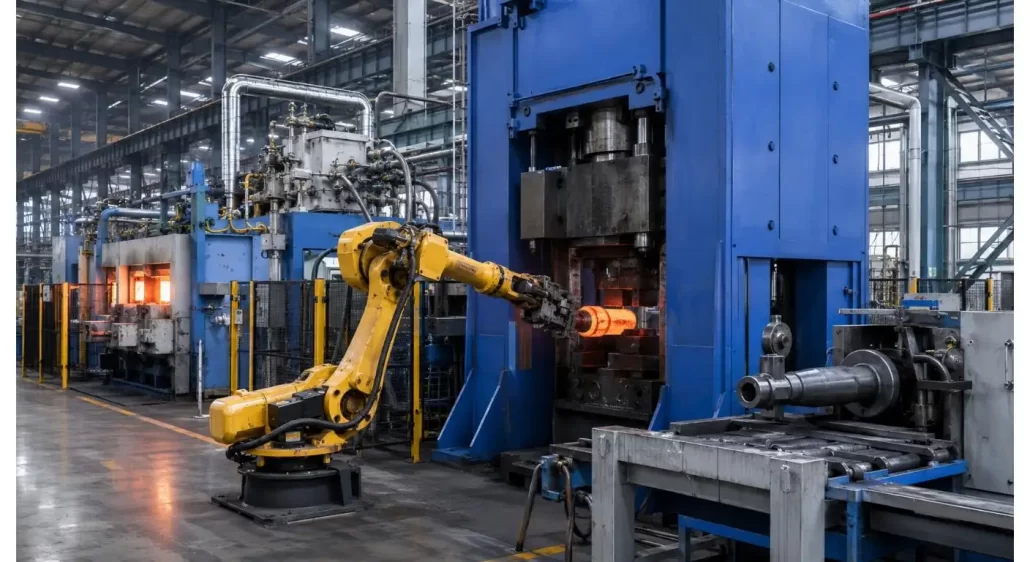
The most critical aspect of automation is ensuring that the precision chain is maintained.
The benefits of automation for consistency are only possible when the variables involved in the forged part are under control.
The following components can be part of a precision forging cell:
- Introducing the chicks to the feed.
- The temperature and heat verification.
- Die lubrication
- Robotic loading
- Press-load monitoring
- Controlled ejection
- In-line gauging
- Part segregation
- Production-data recording
In order to obtain a stable result, a precise press must be complemented by a means to stabilize the result, such as the robot inserting the billet off-center or the transfer time varying. All machine and handling systems should be commissioned as a whole production cell.
Create Acceptance Criteria Based on Evidence
The part drawing, materials, billet, forging sequence, die dimension and production rate and critical tolerances should all be provided in the RFQ.
If acceptance is to be linked to evidence then:
- This is essential for the correct functioning of the loaded slide and die.
- Repeated bottom-position behavior
- Stable production load
- Ejection reliability
- Consecutive-part inspection
- Cycle-time verification
- Tests for safety and overload conditions.
This gives a measurable definition of precision prior to equipment manufacturing.
| Validation Stage | Main Check | Purpose |
| Cold setup | Die height and alignment | Establish initial machine condition |
| First-piece trial | Filling and basic dimensions | Confirm the process route |
| Thermal stabilization | Die and billet temperature | Identify warm-up variation |
| Continuous run | Load, ejection and cycle time | Verify production stability |
| Dimensional study | Critical features across the run | Assess repeatability |
| Final acceptance | Safety, controls and records | Confirm complete-cell performance |
Final Engineering Check
When a precision forging press can minimize variation, machining allowance and adjustment throughout a complete production run it can be valuable. Die-height resolution, tonnage and control features are important but not in and of themselves guarantees part accuracy.
Final decision to be made: linking press motion, rigidity, tooling, temperature, ejection and automation to verified dimensional results. GUANGDUAN can analyse these inputs to set up a forging solution in the real production process.
FAQ
Q1. What is the meaning of precision forging press?
A press that holds the die closed, aligned and formed under control for near-net-shape parts. The accuracy has to be checked by subsequent production results.
Q2. What is precision forging used for?
Common applications include parts such as gear blanks, bearing races, shafts, flanges, fasteners and cold-extruded parts. Controlled geometry and reduced machining allowance for these parts.
Q3. What is precision forging and why use knuckle joint presses?
In their mechanism, the higher force is achieved in the slower motion close to the bottom dead center. This helps with the final forming, coining and dimensional calibration.
Q4. If the display is 0.01 mm high does this mean the parts are 0.01 mm high?
No. Display resolution is an indicator, not the overall accuracy of forged parts. There are also other factors that impact results including tool deflection, temperature, and billet variation and measurement uncertainty.
Q5. How to test precision in forging?
Check the temperature stability of the tool, and then check the consecutive parts after the tooling is stable for operation. Include dimensional data with forming-load, set-up and process-condition data.
CONTACT US


Guangdong Metal Forming Machine Works Co., Ltd.
We are always providing our customers with reliable products and considerate services.
If you would like to keep touch with us directly, please go to contact us
-

Home
-

Tel
-

Email
-

Contact