
Double Action Forging Press Mechanics and Process Control
As OEMs ask for lighter, more complex, and safety-critical parts, the limits of conventional single-action presses show up in daily production: flanges fold, wall thickness drifts, and dies wear out earlier than planned. A well-engineered Double Action Forging Press from GUANGDUAN changes this picture by separating forming force from holding control and giving process engineers a much finer “steering wheel” for metal flow.
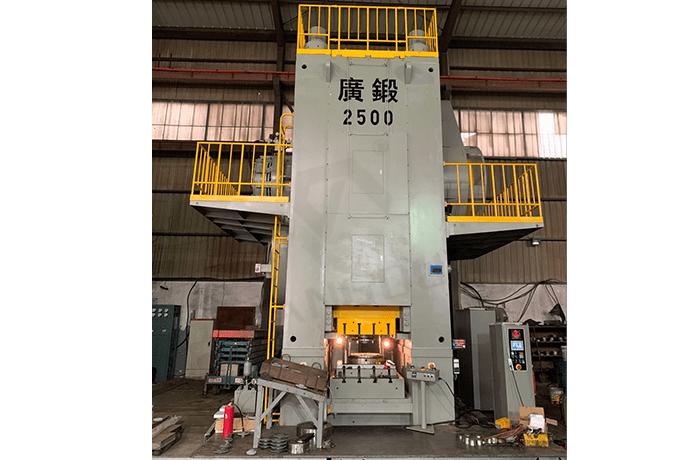
Why Double Action Forging Press Mechanics Matter?
Many defects that look random in closed-die forging have the same root cause: poor control of how material fills the cavity. Non-uniform thickness, cracked fillets, or unfilled corners usually point back to the press being forced into a compromise setting. With a single slide supplying all the force, engineers must choose between fully filling the die or protecting thin sections and critical transitions. Someone always loses.
A Double Action Forging Press introduces a second, independently controlled slide so the process no longer relies on compromise. The inner slide supplies the main forming load, while the outer slide acts as a controlled blank holder to stabilize the preform. Instead of turning up tonnage, adding extra hits, or accepting more rework, you can tune both forming and holding forces so that dimensional accuracy, surface quality, and die life are achieved at production speed.
- What Defines a Double Action Forging Press?
In simple terms, a Double Action Forging Press is a closed-die press with two concentric, separately driven slides:
•An inner slide (inner ram) that applies the main forming force
•An outer slide that clamps or restrains the billet, flange, or preform
This layout allows:
•Independent adjustment of forming and holding forces
•Custom stroke profiles for both slides
•Greater robustness when forging thin, wide, or asymmetric parts

In a typical cycle, the outer slide first reaches a defined holding pressure and fixes the workpiece in position. Only then does the inner slide start the forming stroke. By the time the system reaches bottom dead centre, metal has been guided into functional features instead of escaping along the easiest path. This controlled sequence is the mechanical advantage that sets a Double Action Forging Press apart from traditional single-action presses.
Core Mechanics, Force Coordination, and GUANGDUAN Expertise
In GUANGDUAN’s Double Action Forging Press designs, the inner ram is built with high rigidity and precise guidance so it can carry peak forming loads with minimal deflection. The outer ram, with a larger contact area, is optimized to work as an active blank holder that distributes pressure exactly where metal flow must be restrained.
A typical GUANGDUAN configuration uses PLC-based control to coordinate:
•Independent or synchronized motion of the inner and outer slides
•Adjustable holding-pressure curves for the outer slide
•Accurate and repeatable bottom dead centre positioning
Experience from GUANGDUAN’s GK knuckle joint presses feeds directly into Double Action Forging Press solutions. Crank-toggle mechanisms that create a dwell near bottom dead centre, rigid frames, and fine die-height adjustment are all used to keep the forming window narrow and stable, even for demanding geometries and higher-strength materials.
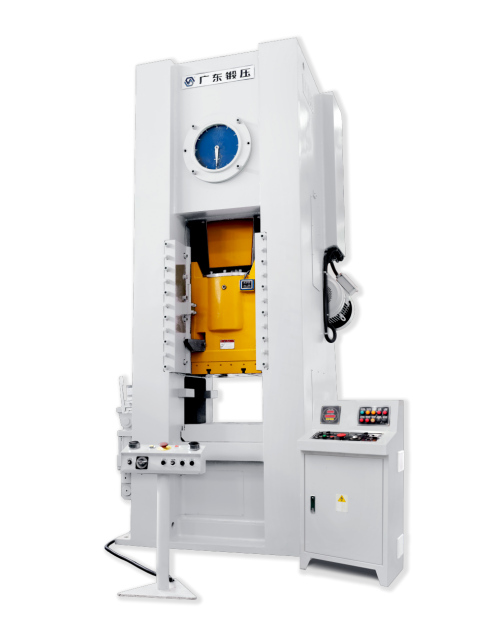
Where a Double Action Forging Press Delivers the Biggest Gains
When correctly sized, tooled, and commissioned, a Double Action Forging Press delivers benefits that are easy to see in production data:
•More predictable metal flow in deep or multi-level cavities
•Lower tendency to wrinkle at flanges and edges
•Better wall-thickness consistency and dimensional stability over long runs
•Reduced peak loading on dies, extending tool life and time between regrinds
For GUANGDUAN customers, these gains show up as fewer unplanned stoppages, less scrap and rework, and tighter control of cost per piece throughout the program.
Typical applications include:
•Automotive and transportation forgings – gear blanks, clutch parts, hubs, shafts, and structural pieces where concentricity, spline accuracy, and fatigue performance are critical.
•Industrial and general mechanical parts – rings, flanges, and precision forgings that must maintain run-out and thickness across complex sections.
•Thin-walled and near-net-shape forgings – components with deep pockets, narrow ribs, or asymmetric shapes that are hard to fill on a single-action press without overstressing the die.
In these areas, upgrading to a Double Action Forging Press often allows manufacturers to avoid more machining-intensive, higher-cost process chains.
Drive Concepts, Tooling Integration, and Press Selection
Double Action Forging Press installations can be built around mechanical or hydraulic drive concepts, depending on priorities.
Mechanical double action presses typically use crank or knuckle mechanisms for the inner slide, combined with mechanically or hydraulically driven blank holders. They are well suited where stroke rate, energy efficiency, and long-term mechanical robustness are key.
Hydraulic double action presses can be programmed with tailored force–speed profiles, including controlled dwells and soft load ramps. As a result, they perform especially well on strain-rate-sensitive materials and part designs that require a more gentle forming process.
GUANGDUAN incorporates proven elements from its GK series – press capacities up to 25,000 kN, large bolsters, rigid frames, and reliable ejector systems – into its Double Action Forging Press portfolio. PLC-based control and recipe management let engineers store full parameter sets for each part: slide speeds, force profiles for inner and outer slides, ejector timing, and safety logic.
Tooling design must follow the same logic. Dies for a Double Action Forging Press are not simply scaled-up single-action tools. They must deliberately direct metal into functional areas while avoiding overload in non-critical zones. Insert design, division of work between inner and outer actions, and robust alignment concepts all play a role in tool life and process stability.
ü Operation, Future Development, and Next Steps with GUANGDUAN
Even the best Double Action Forging Press cannot deliver its full potential if controls, tooling, and maintenance are not aligned. Among the most common challenges are out-of-sync slides, incorrect or drifting holding pressures, and the gradual shift of die alignment. Safeguarding the original process window requires routine sensor calibration, disciplined tracking of force–displacement behaviour, and well-planned preventive maintenance activities.
Looking ahead, Double Action Forging Press systems are becoming tightly integrated with digital manufacturing. Real-time monitoring, closed-loop motion control, links to MES and quality databases, and energy-optimized drives turn the press into a data-rich forming platform at the centre of a smart forging line.
For engineering and production teams who are rethinking their forming strategy or planning to replace legacy presses, GUANGDUAN offers support from concept to commissioning. By sharing target components, volume expectations, and current bottlenecks, decision-makers can work with GUANGDUAN specialists to define a Double Action Forging Press configuration that aligns with long-term goals for quality, stability, and competitiveness.
CONTACT US


Guangdong Metal Forming Machine Works Co., Ltd.
We are always providing our customers with reliable products and considerate services.
If you would like to keep touch with us directly, please go to contact us
-

Home
-

Tel
-

Email
-

Contact