
Engine Component Forging: How High-Volume Plants Protect Die Life
Engine Component Forging buyers now look beyond tonnage. They want forging lines that can maintain stable performance at the most critical stage of the stroke, reduce rework, protect die investment, and deliver repeatable output for modern automotive supply chains. In many plants, the main problem is not force, but instability near bottom dead centre. At that point, metal flow, cavity filling, die loading, and dimensional control become more sensitive. If slide motion is unstable, the result can be inconsistent part quality, faster die wear, extra machining, more rework, and weaker profitability in long production runs.
Why Rework and Tooling Loss Have Become Bigger Business Risks
Overseas buyers and distributors are dealing with a market that rewards consistency more than simple machine strength. Automotive suppliers need manufacturing systems that support lower deviation, cleaner traceability, and more reliable output. IATF 16949 is built around defect prevention and the reduction of variation and waste in the automotive supply chain, which means forging equipment is increasingly judged by how well it supports controlled and repeatable production rather than isolated peak force claims.
That matters even more as automotive programs continue to evolve. Major component manufacturers are highlighting lightweight, highly precise, and power-dense products for conventional and electrified platforms, and they are backing that direction with advanced forging, machining, measurement, and process control capabilities. In practical terms, this means presses used in engine and driveline component production have to contribute to quality stability, not just raw deformation power.
Where GUANGDUAN Fits Into This Need
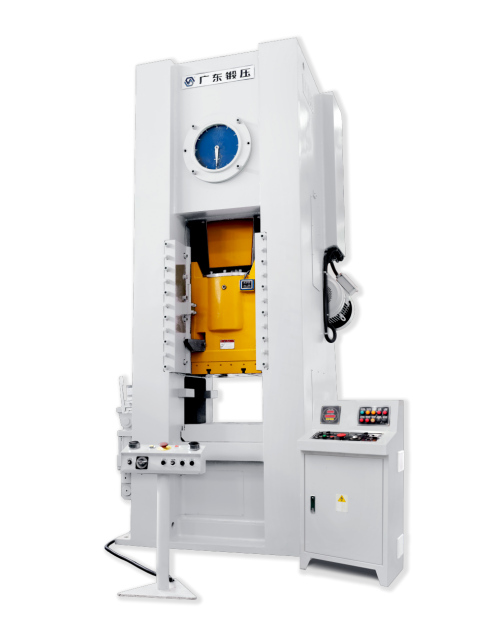
For this reason, GUANGDUAN’s GK Series Knuckle Joint Press speaks to a more relevant buying question: how does the machine help the plant lower variation at the exact moment where part quality is won or lost?
The answer starts with the machine’s crank toggle mechanism. In the GK Series, the slide can dwell at bottom dead centre for around 1/18 of a cycle. That dwell is important because it gives the material more stable forming time under pressure at the critical end of the stroke. In production terms, that can help improve die filling, support more consistent fine stamping and extrusion results, and reduce the instability that often drives rework and uneven die loading. Similar knuckle joint press designs are widely associated with precision forming and bottom-dead-centre holding force, especially for applications that require higher accuracy in short-stroke, high-pressure work.
The GK Series also brings together several details that matter in real factory use:
• Capacity from 6300KN to 25000KN for different production needs
• Bolster sizes from 700 × 700 mm to 1200 × 1200 mm for broader die matching
• 0.01 mm die height indicator accuracy for finer setup control
• Mechanical lower ejector device as standard for smoother part discharge
• PLC-based control for more structured, repeatable machine operation
• Different clutch-brake configurations by machine range to match working demands
These features are useful because they affect more than machine specification sheets. They influence how quickly operators can stabilize production, how well the die setup can be repeated, and how much avoidable variation enters the process during long runs.
Why Better Motion Control Helps Protect Die Life
Tooling cost is a major concern in Engine Component Forging, especially where output volumes are high and die performance directly affects delivery schedules and unit cost. A press that manages force application more smoothly at the critical stage of forming can help reduce the shock and inconsistency that shorten die life. That does not mean tooling challenges disappear, but it does mean the press is working with the process rather than against it.
This is also where the GK Series aligns with broader near-net-shape manufacturing logic. Near-net-shape forging is valued because parts come out closer to final geometry, which can save time, material, and downstream machining effort. When the press supports more stable forming at bottom dead centre, manufacturers are in a better position to pursue that kind of output discipline. Less unstable filling can translate into fewer corrections, better dimensional consistency, and lower total process waste.
For buyers, that creates a stronger commercial case:
• Lower rework pressure
• Better tooling utilization
• More stable long-run output
• Less unnecessary machining burden
• Stronger cost control across the whole production cycle
Why This Theme Also Matches Manufacturing Trends
Another reason this topic resonates with overseas buyers is that rework reduction and die protection fit directly into the larger move toward smart manufacturing. NIST continues to position smart manufacturing around trusted data use, better decision-making, and real-time improvement across industrial systems. It also highlights predictive maintenance and data-driven production control as ways manufacturers can reduce unexpected downtime and improve operational performance.
That trend matters for forging plants because tooling damage, unstable setup, and repeat defects are not just shop-floor annoyances. They are data points in a plant’s broader competitiveness. A press that supports more precise settings, repeatable control, and cleaner operating discipline is easier to integrate into modern maintenance planning, quality documentation, and automation-oriented production management.
This is where GUANGDUAN has a timely position. The GK Series is not just offering force. It offers a motion characteristic and control structure that help forging plants answer today’s more important questions: Can output stay consistent across shifts? Can tooling investment be used more efficiently? Can the machine support cleaner process control as production becomes more standardized and more digital?
Final Takeaway for Buyers and Distributors
A different theme for Engine Component Forging is this: the next competitive advantage does not come from chasing tonnage alone. It comes from reducing the hidden costs that erode margins every day — rework, unstable quality, die wear, and inconsistent forming performance.
That is why GUANGDUAN’s GK Series Knuckle Joint Press deserves attention. Its bottom-dead-centre dwell, precise die height indication, PLC-based control, and production-focused configuration make it relevant to what forging plants actually need now: better consistency, better die protection, and better readiness for modern automotive manufacturing expectations. For merchants, distributors, and procurement teams serving engine and powertrain component projects, that is a more convincing value story than force alone.
CONTACT US


Guangdong Metal Forming Machine Works Co., Ltd.
We are always providing our customers with reliable products and considerate services.
If you would like to keep touch with us directly, please go to contact us
-

Home
-

Tel
-

Email
-

Contact