
Heavy Forging Press: Cut Labor Pressure And Support Automation
Heavy Forging Press investment is no longer only about forming force. For many overseas buyers, the bigger question in 2026 is whether a press can help reduce labor dependence, improve workflow consistency, and fit into a more automated production environment. That change is closely tied to wider manufacturing trends, as producers continue increasing investment in smart manufacturing, automation, and digital production systems to stay competitive under ongoing labor and operating pressure.
Why Labor Pressure Has Become a Real Forging Bottleneck
In many forging plants, the most expensive problem is not always insufficient tonnage. It is unstable production caused by labor-intensive handling, slower setup, inconsistent operation between shifts, and difficulty maintaining output when experienced operators are limited. Across manufacturing, labor and skills pressure remain persistent, even as companies accelerate digital transformation and automation investment to improve resilience and efficiency.
For buyers in automotive parts, motorcycle components, hardware, instrumentation, and gas appliance production, that pressure shows up in practical ways:
• More manual intervention during loading and unloading
• Longer die change and adjustment time
• Greater dependence on operator experience
• Higher variation between production runs
• More difficulty scaling output without adding labor
This is why many procurement teams now evaluate a Heavy Forging Press not just by force rating, but by how well it supports safer, smoother, and more automated production.
The Market Is Rewarding Presses That Fit Smarter Factories
The broader manufacturing direction makes this shift easier to understand. Deloitte’s 2026 manufacturing outlook says most surveyed executives plan to devote a meaningful share of improvement budgets to smart manufacturing initiatives, with strong interest in foundational tools that improve agility, resilience, and competitiveness. That means new production equipment is increasingly expected to support connected, more efficient, and less labor-dependent operations.
At the same time, the forging and metal forming sectors continue to benefit from demand in transportation, industrial equipment, infrastructure, and advanced materials applications. Industry outlooks increasingly connect future growth with automation, production efficiency, and higher process control, not just output scale.
For buyers, the implication is clear: a Heavy Forging Press that still relies too heavily on manual coordination may create long-term operating pressure, even if its tonnage looks competitive at the quotation stage.
How GUANGDUAN Responds to This New Production Reality
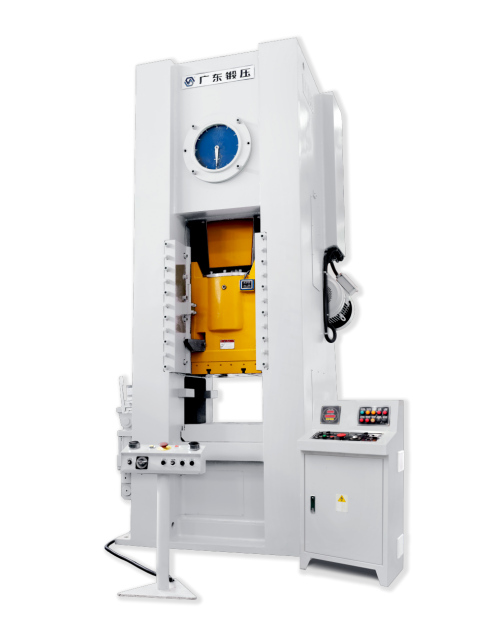
GUANGDUAN’s closed type single point forge press is well positioned for this market shift because its design logic goes beyond force delivery. The press’s values revolve around rigidity and stable guiding, operational control and protection of equipment, and compatibility with automation-oriented production systems.
For buyers facing labor challenges and considering automation, the following machine features stand out:
•The monolithic box-type chassis construction rigidity ensures the machine’s stability during aggressive operational load demands.
•The eccentric shaft crank design combines convincing bearing capacity with reliable force transmission.
•The wet-type clutch construction promotes an extended service life and, consequently, minimizes downtime for maintenance due to wear.
•The slide blocks with four-surface guiding hold more precisely, which leads to improved repeatability.
• The digital display, in conjunction with the mechanical die height adjustment, provides more clarity and ease for the setup process.
• The hydraulic overload protection system available on some models helps to reduce the risk of damage to your equipment and tools.
• The Remote Control, PLC, and pneumatics provide operational flexibility through the ability to perform multiple, single, and micro motion stroking as well as continuous flow operational.
• The optional addition of a photo-electric system increases operational protection.
• The addition of automatic systems for feeding and uncoiling leveling devices increases the level of automation within the production line.
Regarding purchasers, a Heavy Forging Press’s value is determined significantly by how well it alleviates the burden on operators while maintaining line stability and productivity.
Why Automation Compatibility Matters More Than Before
Many factories are not trying to eliminate people entirely. They are trying to reduce repetitive manual work, lower dependence on hard-to-replace skilled operators, and improve consistency across different shifts and production schedules. This is where GUANGDUAN offers a practical advantage.
When a forge press can be integrated with automatic feeding and uncoiling leveling devices, the production line becomes easier to standardize. Manual handling steps can be reduced. Feeding rhythm becomes more controlled. Output becomes easier to scale without relying on the same level of operator intervention in every cycle.
That kind of compatibility is becoming more important as metal forming plants look for practical paths toward automation. Industry coverage in press-line automation continues to emphasize workflow integration, handling efficiency, and better coordination between core equipment and material feeding systems.
In that environment, GUANGDUAN’s design is not just about press performance. It is about helping the machine fit the direction the factory is already moving toward.
Stable Guidance and Protection Also Reduce Hidden Labor Costs
Labor pressure is not only about headcount. It is also about the extra work created by unstable machines. When slide motion is inconsistent, when setup adjustment is unclear, or when overload events damage tooling, plants often spend more labor on inspection, troubleshooting, die correction, maintenance coordination, and repeated runs.
GUANGDUAN addresses these hidden cost drivers through structural rigidity, full-guideway precision, overload protection, and digitally displayed die height adjustment. These features support easier setup control, more stable forming behavior, and better protection for the machine and tooling.
That has a direct commercial effect. A Heavy Forging Press with better operating stability can help:
• Reduce repeated adjustments during production
• Improve consistency between batches
• Lower unplanned stoppages linked to overload or drift
• Make operator training easier
• Support faster transition toward semi-automatic or automatic production lines
For distributors and overseas buyers, those are strong selling points because they connect machine design to measurable operational value.
Safety Is Also Part of Modern Production Readiness
Another reason buyers are thinking differently is that safety is now more closely tied to productivity and workforce management. OSHA’s forging machine standards place clear responsibility on employers to maintain forge shop equipment in safe operating condition, and machine guarding remains a core requirement in industrial production environments.
That makes GUANGDUAN’s optional photo-electric protection especially relevant. Safer operation does more than reduce risk exposure. It also helps plants create more standardized workflows, improve operator confidence, and align better with modern procurement expectations around equipment responsibility and production discipline.
For many buyers, that is no longer a secondary issue. It is part of what defines whether a Heavy Forging Press is ready for long-term industrial use.
What Overseas Buyers Should Focus On Now
When evaluating a Heavy Forging Press today, buyers should look beyond force rating and ask more useful questions:
• Can this machine reduce manual dependence in daily production?
• Is the structure rigid enough for stable long-cycle operation?
• How easy is setup adjustment during die changes?
• Does it support overload protection?
• Can it work with feeding and leveling equipment for automation upgrades?
• Does it offer safety options that support modern factory requirements?
These questions are more closely tied to long-term productivity than tonnage alone.
Final Thought
The strongest Heavy Forging Press value proposition in 2026 is not simply higher force. It is the ability to help manufacturers run more stable lines, reduce labor pressure, improve safety, and move toward automation with less friction. That is exactly where GUANGDUAN’s design approach stands out.
By combining a rigid machine body, precise guideway support, practical control modes, overload protection, and optional automation and safety systems, GUANGDUAN offers a solution that fits both current production demands and future factory upgrades. For buyers who want a Heavy Forging Press that supports real operational progress, this is a far more persuasive story than tonnage alone.
CONTACT US


Guangdong Metal Forming Machine Works Co., Ltd.
We are always providing our customers with reliable products and considerate services.
If you would like to keep touch with us directly, please go to contact us
-

Home
-

Tel
-

Email
-

Contact