
Forging Press Machine: Precision And Stability Matter More Than Tonnage
Forging Press Machine buyers now compare equipment on more than tonnage alone. For overseas procurement teams, distributors, and plant managers, the real question in 2026 is whether a press can deliver stable bottom-dead-center performance, repeatable forming quality, and easier production control in a market that is moving toward smarter manufacturing, tighter tolerances, and more resilient supply chains. NIST has pointed to AI, automation, and resilient domestic supply chains as major themes shaping manufacturing competitiveness, while smart manufacturing efforts continue to focus on trusted technology adoption and measurable production improvement.

The Industry Pain Point Is No Longer Just Force Output
Many forging plants already have enough nominal capacity on paper. The real operational pain point often emerges later on the shop floor:
• Inconsistent forming results near bottom dead centre
• Tooling stress caused by unstable slide action
• Higher setup sensitivity across different dies and workpieces
• Greater difficulty maintaining repeatability in fine stamping and extrusion processes
• Limited confidence in documentation, parameter control, and overall process visibility
For buyers, that combination reaches beyond production yield. It affects die life, rework rates, labor requirements, and the ability to standardize output across shifts or manufacturing locations. In a competitive manufacturing environment, a press that cannot maintain stable, traceable, and repeatable production is more likely to slow efficiency gains and restrict growth potential. That is precisely where GUANGDUAN positions its solution.
Why Knuckle Joint Technology Still Matters in Modern Forging
The GUANGDUAN GK Series Knuckle Joint Press is designed as a forging press platform for applications that demand high forming precision and strong bottom-position control. Its capacity ranges from 6300KN to 25000KN, with bolster sizes from 700 × 700 mm to 1200 × 1200 mm, giving buyers flexibility for different production scales and tooling layouts.
What makes the structure valuable is not only its force range, but the motion profile. The machine uses a crank toggle mechanism, allowing the slide to dwell at bottom dead centre for around 1/18 of a cycle. That matters because many difficult forming and extrusion operations benefit from a more controlled and stable working window at the critical point of contact.
In practical terms, that means:
• Better support for precision forming
• More stable pressure application near the forming point
• Improved consistency in fine stamping and extrusion processes
• Reduced sensitivity to minor process variation during critical deformation stages
For overseas buyers comparing different press types, this is a meaningful advantage. A machine designed for intelligent motion control can bring more real manufacturing value than one that only claims greater force.
How GUANGDUAN Responds to What Buyers Need Today
Manufacturers today are expected to produce faster, more consistently, and with better process control. NIST has also emphasized that traditional industries are under pressure to adopt technologies that help them manufacture more cost-effectively and with fewer resource constraints.
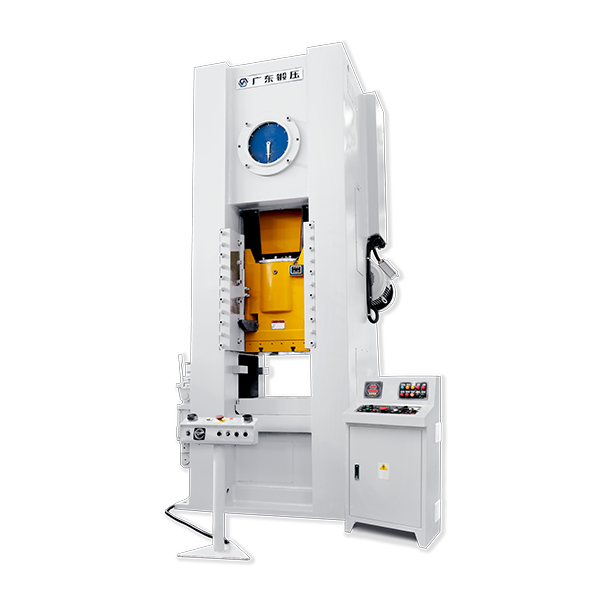
GUANGDUAN’s GK Series aligns with that direction in several ways.
• Precision Visibility Supports Better Setup Control
The die height indicator offers an accuracy display value of 0.01 mm. For a buyer, that is not just a specification line. It helps operators manage setup with more confidence, reduces adjustment uncertainty, and supports better consistency when changing dies or validating production conditions.
• PLC Control Improves Daily Usability
The machine is PLC-controlled, which strengthens production control and supports more standardized operation. For plants that want easier training, clearer parameter handling, and more stable machine behavior, this is a practical benefit. It also fits the broader move toward digitally managed manufacturing environments.
• Clutch And Brake Selection Matches Different Machine Sizes
The GK-630 series uses a pneumatic wet integrated friction clutch brake, while the GK-800 to GK-2500 models adopt a pneumatic dry split friction clutch brake. This configuration logic reflects application-oriented machine design rather than one-size-fits-all standardization. Buyers usually appreciate that because it suggests the platform has been engineered around real operating demands.
• Standard Lower Ejector Adds Process Value
A mechanical lower ejector device is included as a standard configuration. That helps extend process capability in forming applications where workpiece release and production continuity matter. It also supports more efficient die operation in fine stamping and extrusion work.
Why This Matters for Procurement Teams and Distributors
In many purchasing decisions, the wrong question is still being asked: “How many tons do we need?” A better question is: “How reliably can this press turn capacity into stable production?”
That distinction matters more now because forged component demand is increasingly tied to higher-performance sectors, including lightweight automotive structures and aerospace parts. These segments reward consistency, dimensional stability, and production discipline, not just force output.
For procurement teams, a stronger equipment case usually includes:
• Reliable forming behavior at the most critical stage of the stroke
• Easier setup verification and reduced adjustment error
• Better fit for precision-oriented stamping and extrusion work
• More confidence in process consistency across operators
• A machine platform that is easier to integrate into modern production management
This is where GUANGDUAN has a clear commercial story. Its knuckle joint press design addresses a core production issue that many plants still struggle with: how to improve forming precision and process stability without making operation unnecessarily complex.
A Forging Press Machine Must Now Support the Next Stage of Manufacturing
The market is moving toward smarter, more connected, and more quality-driven production. Buyers are watching automation, digitalization, traceability, and production resilience more closely than before. NIST’s recent manufacturing outlook makes that direction clear, and market growth data across forging-related sectors reinforces the same message: demand is expanding, but expectations are rising with it.
For that reason, a modern Forging Press Machine should not be judged by tonnage alone. It should be judged by how well it supports stable forming, setup accuracy, process control, and long-term production value.
GUANGDUAN answers that requirement with a knuckle joint press platform built for precision-sensitive forging, fine stamping, and extrusion work. For buyers who want a machine that matches today’s manufacturing direction instead of yesterday’s specification habits, that is the real advantage.
CONTACT US


Guangdong Metal Forming Machine Works Co., Ltd.
We are always providing our customers with reliable products and considerate services.
If you would like to keep touch with us directly, please go to contact us
-

Home
-

Tel
-

Email
-

Contact