
Forging for Automotive Industry: Crankshaft Design and Load Capacity Explained
The design of the crankshaft correlates directly with the conversion of the power generated by the motor to the slide and the forming force. Within Forging for the Automotive Industry, the crankshaft’s configuration, the bearing support, the rigidity of the frame, the guides for the slides, the clutch, and the overload protection devices all have an effect on the design’s load capacity, the stability of the stroke, and resistance to repeated and eccentric loading.
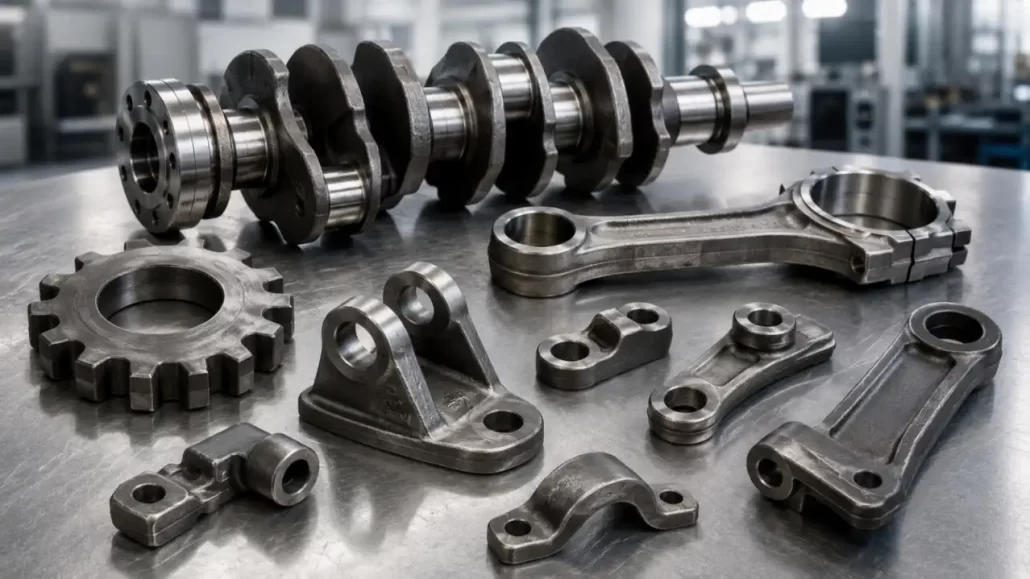
The production of automotive parts is characterized by many cycles of loading, a wide variety of die sizes, high precision of bottom dead center, and a continuous working system. For this reason, the rated tonnage of an automotive forging press is not an adequate measure of its working capacity. The total load transmitting system needs to be considered.
What Is the Function of the Crankshaft in Forging for the Automotive Industry?
The crankshaft is a key element of the drive system of a mechanical press. Crankshaft’s primary role is to provide a means for the slide to undergo the motion of the die.
The crankshaft’s roles include:
•Transferring forming forces to the die
•Defining the characteristics of the slide motion
•Withstanding bending and torsional loads of a cyclic nature
•Enduring repeated production cycles
•Affecting the force that is available at the bottom dead center.
In Forging for Automotive Industry, the crankshaft is not solely responsible for carrying the forming load. The forming force is transmitted through the slide, the connecting rod, the crankshaft, the bearings and the frame of the press. Production stability is compromised if any of the components in the load path are deficient in rigidity or alignment.
How Does an Eccentric-Shaft Crankshaft Work?
The working portion of this eccentric shaft crankshaft consists of an offset portion of the shaft. The offset portion causes the connecting rod and the slide to be displaced in the direction of the offset and through a fixed stroke due to the rotating connecting rod.
Eccentricity is the mechanism that links the slide and controls the travel path. Bearing supports that are properly positioned can help in accommodating larger forming loads along larger shaft journals.
Some potential benefits of an eccentric shaft mechanism are as follows:
•Compact transmission design
•Broad bearing surfaces of shafts
•Consistent performance over many cycles
•Compatibility with closed-frame presses
•Feasible use in medium to large tonnage single-stroke presses
An eccentric shaft also does not ensure the overall system possesses high precision. Other factors that must be accounted for are manufacturing tolerances, bearing clearances, lubrication, frame stiffness, connecting-rod length, and slide guidance.
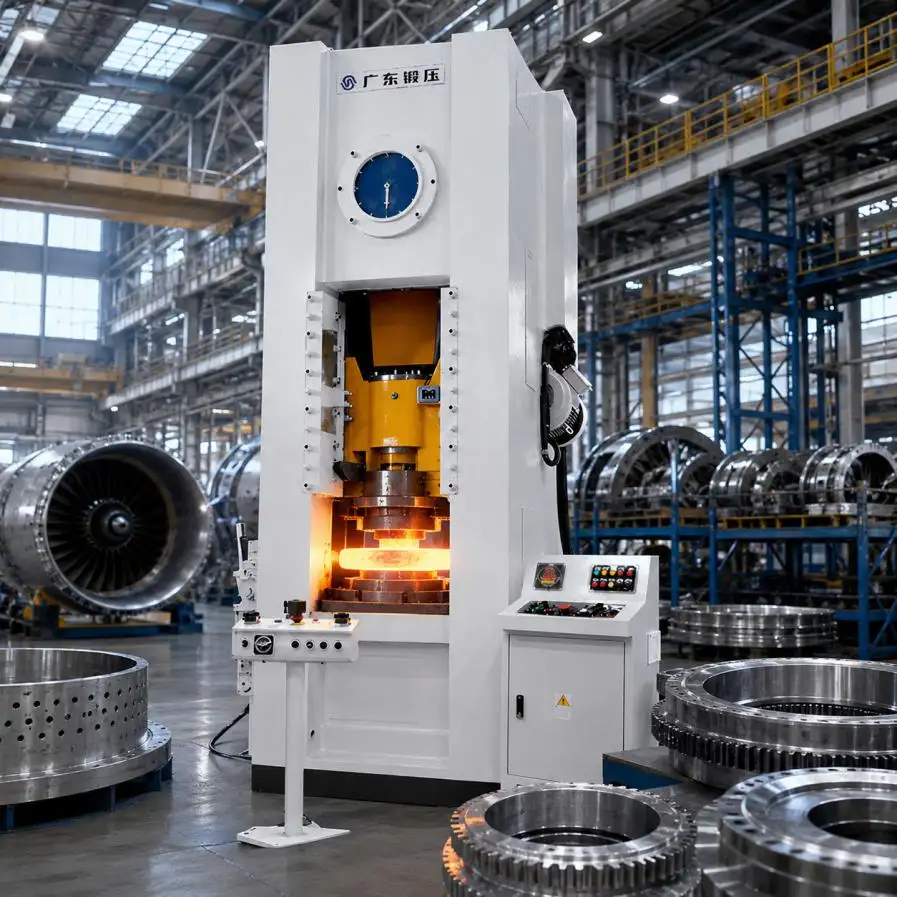
What Determines Automotive Forge Press Load Capacity?
The practical load capacity of equipment used for Forging for Automotive Industry depends on several connected structures.
| Structural Factor | Effect on Load Capacity | Evaluation Focus |
| Crankshaft diameter and material | Influences bending and torsional resistance | Journal size, heat treatment, machining accuracy |
| Bearing support | Distributes crankshaft loads | Bearing area, support span, lubrication |
| Connecting rod | Transfers force to the slide | Strength, rigidity, adjustment mechanism |
| Closed frame | Limits structural deflection | Column, crown, and bolster rigidity |
| Slide guidance | Controls tilt and lateral movement | Guide length, clearance, guide surfaces |
| Clutch and brake | Manage power engagement and stopping | Thermal capacity, response, service life |
| Overload protection | Reduces damage from excessive loads | Protection type, response, reset method |
Rated pressure is generally available only at a specified crank angle or distance above bottom dead center. Buyers should examine the pressure-stroke curve instead of assuming that full rated force is available throughout the complete stroke.
The Importance of Rigidity and Guiding Slides
When considering closed frames and rigidity, the alignment of the crankshaft and the continuous path of driving forces through the crown, the columns, and the bolster, aid in the reduction of the elastic strain, and help in maintaining the parallelism of the die, considering the repeated nature of the production.
The GUANGDUAN JH31 Series employs a closed single-point structure with a narrow table. A rigid, integrated box frame is used in most of the models. Some models use a preloaded frame with four tie rods. These concepts address frame rigidity and the stability of load transfer.
The Slide with Full Four Surface Guideway Precision:
•Eliminates the play of the slide in the front and back, and sideways
•Reduces tilt of the slide due to uneven load distribution
•Enhances parallelism of the slide and bolster
•Eliminates lateral forces on the crankshaft
•Facilitates controlled and uniform closing of the die
Although four-surface guiding helps control off-centered loads, it does not eliminate the effects of poor die configuration. The working section of the die should, therefore, be positioned as close as possible to the center of the press.
Comparison of Automotive Press Types
Different press technologies suit different applications in Forging for Automotive Industry.
| Press Type | Main Advantage | Main Limitation | Typical Application |
| Closed single-point mechanical press | Compact structure and stable cycle rate | Limited performance with wide off-center dies | Brackets, connectors, small structural parts |
| Closed double-point mechanical press | Better load distribution across wide beds | More complex transmission | Large panels and long dies |
| Open-frame press | Easy die access | Greater frame opening deflection | Small and medium-duty stamping |
| Servo mechanical press | Programmable slide motion | Higher control complexity and cost | Precision forming and complex drawing |
| Hydraulic press | Controllable force throughout the stroke | Generally slower cycle rate | Press fitting, correction, and deep drawing |
A closed single-point press is usually suitable for concentrated loads, medium-sized dies, and high-volume production. Wide dies, multiple forming stations, or severe eccentric loading may require double-point or multi-point equipment.
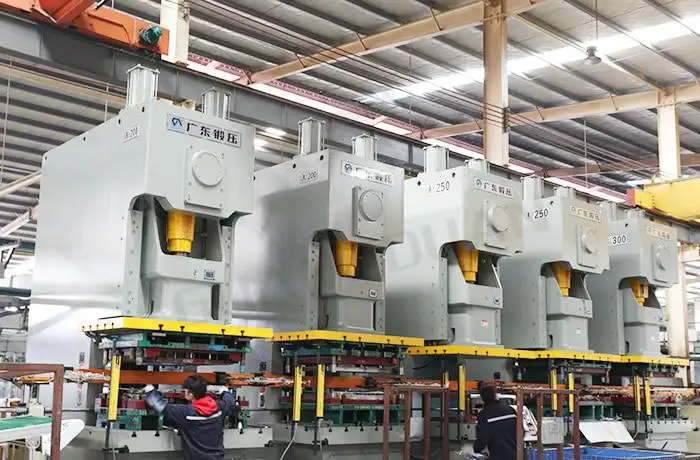
Comparison of Single-Point Press Configurations
Within the same press series, higher tonnage does not simply mean better performance.
| Comparison | Medium-Tonnage Press | Large-Tonnage Press |
| Typical parts | Small and medium components | Thicker or larger components |
| Crankshaft system | Standard cyclic loads | Higher bending and torsional resistance |
| Die area | Compact single-station dies | Larger or heavier dies |
| Overload protection | Mechanical unlocking may be used | Hydraulic protection is commonly applied |
| Installation | Relatively simple foundation | Greater foundation and lifting requirements |
In the JH31 Series, JH31-200 to JH31-300 models use a wedge-type die-unlocking device, while JH31-400, JH31-630, and JH31-800 models use hydraulic overload protection.
Oversizing may increase procurement cost, energy use, foundation requirements, maintenance expenses, and unused production capacity. Selection should therefore match the forming process rather than tonnage alone.
Wet Clutch Performance in Automotive Production
The JH31 Series’ wet clutch employs lubrication and facilitated dissipation of heat by the oil. This configuration allows the design to have smooth engagements and multiple production cycles.
Wet clutches are typically the better choice for service life and operational consistency. Although dry clutches may have a simpler design, it is critical to assess heat generation and wear due to friction. Actual suitability depends on stroke frequency, engagement rate, maintenance conditions, and production schedule.
Suitable Automotive Applications
A closed single-point automotive forging press can be used for:
•Mounting brackets and connecting plates
•Reinforcement components
•Lock and hinge parts
•Seat and motor-system metal components
•Brake-system stampings
•Small chassis connectors
•Progressive-die hardware parts
For thick blanking, tonnage, working energy, and bolster rigidity must be considered. For precise sizing, stable bottom-dead-center accuracy is needed. For progressive-die production, feeding precision and control of continuous stroke are required.
Operating Modes, Safety, and Automation
The JH31 Series has the following modes: continuous, single stroke, and micro-motion. These are achieved with PLC and pneumatic control.
•Continuous stroke: High-volume production (automatic)
•Single stroke: Low-volume operation, manual loading and testing
•Micro-motion: Clearance inspection, calibration, and die setting
Optional photoelectric safety devices can enhance the safety of the operation. Automatic feeding, uncoiling, leveling, and other auxiliary devices can be added. For effective automation, the press, die, feeder, safety devices, and material-detection systems must work in synchronized control.
Final Considerations for Forging for the Automotive Industry
In Forging for the Automotive Industry, due to the design of the crankshaft, some of the prismatic forms may require a large press. The load capacity must be considered regarding the whole press system. Bearings and connecting rods, combined with slide and frame rigidity, determine the performance of the clutch and the system’s overload protection. Double-point, servo, or hydraulic presses may be more appropriate for wide dies, complex drawing, or significant off-center loads.
GUANGDUAN’s JH31 Series combines a closed box-type frame, eccentric-shaft crankshaft, wet clutch, four-surface slide guidance, mechanical die-height adjustment, and PLC-pneumatic control. Share your material, component drawings, die dimensions, required force, production rate, and automation plan with GUANGDUAN to evaluate a suitable Forging for Automotive Industry press configuration.
FAQs
Q1. What automotive parts can GUANGDUAN JH31 forge presses create?
The JH31 Series can produce various automotive metal parts through stamping, blanking, sizing, shallow drawing, and pressure-setting, including brackets, connecting plates, reinforcements, hinges, locks, and more.
Q2. What type of frame does GUANGDUAN JH31 Series have?
The JH31 Series incorporates a narrow-table closed single-point structure. Most models integrate a monolithic box-type frame; however, some models utilize a four-tie-rod preloaded structure to enhance frame rigidity and load stability.
Q3. Why does GUANGDUAN incorporate an eccentric-shaft crankshaft?
GUANGDUAN incorporated an eccentric-shaft crankshaft as it allows for a compact design of the mechanical transmission system, while still being able to withstand heavy loads and having uniform and stable motion for the slide during the working cycle. Its performance is highly dependent on the quality of the bearing, the lubrication system, the rigidity of the frame, and the precision of the assembly.
Q4. Is the GUANGDUAN JH31 Series applicable to off-center loads?
The four-surface full-guideway slide of the JH31 Series helps control slide tilt and also aids in lateral movement. However, forming sections and dies should still be located as close to the center of pressure as possible, and the allowable eccentric load should be checked.
Q5. What overload protection is used on GUANGDUAN JH31 presses?
Hydraulic overload protection is featured on the JH31-400, JH31-630, and JH31-800 models. The JH31-200, -300 models feature a wedge-type device that releases dies as a means of overload protection.
CONTACT US


Guangdong Metal Forming Machine Works Co., Ltd.
We are always providing our customers with reliable products and considerate services.
If you would like to keep touch with us directly, please go to contact us
-

Home
-

Tel
-

Email
-

Contact