
Industrial Metal Forging Press Equipment for Fine Stamping and Cold Extrusion
Industrial Metal Forging Press Equipment used for fine stamping and cold extrusion must provide more than sufficient nominal force. Slide motion, bottom dead center dwell, frame rigidity, die-height control, bolster dimensions, ejector configuration, and clutch-brake response all influence forming consistency and finished-part accuracy.
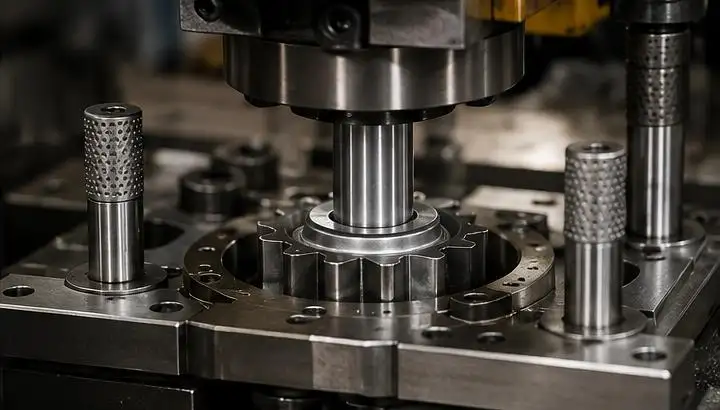
Fine stamping requires stable die clearance and repeatable slide positioning. Cold extrusion requires high forming force, controlled material flow, rigid tooling support, and reliable part ejection. Knuckle joint presses are one category of Industrial Metal Forging Press Equipment designed to provide favorable force and motion characteristics near the bottom dead center.
What Is Industrial Metal Forging Press Equipment?
Industrial Metal Forging Press Equipment converts mechanical or hydraulic energy into controlled forming force for processes such as:
•Fine stamping and blanking
•Cold extrusion
•Coining and embossing
•Sizing and calibration
•Precision forging
•General metal forming
The category includes knuckle joint presses, conventional crank presses, servo mechanical presses, hydraulic presses, cold extrusion presses, and fine blanking presses.
Although these machines perform similar metal-forming tasks, their slide curves, pressure characteristics, speed ranges, control methods, and suitable applications differ significantly.
Why Fine Stamping and Cold Extrusion Need Specialized Motion
Fine stamping combines cutting with controlled plastic deformation. Cold extrusion forces metal to flow inside a closed or partially closed die cavity. These processes therefore place different demands on Industrial Metal Forging Press Equipment.
| Process Requirement | Fine Stamping | Cold Extrusion |
| Main deformation | Shearing and local deformation | Bulk material flow |
| Load characteristic | Rapid and accurately controlled | High peak and concentrated load |
| Slide requirement | Accurate guidance and repeatability | Low-speed final forming |
| Tooling requirement | Consistent clearance | High rigidity and wear resistance |
| Ejection demand | Depends on the part | Usually important |
| Key press factors | Guidance, die height, dynamic accuracy | Force, rigidity, dwell and ejection |
Nominal capacity alone does not indicate whether a press can maintain die alignment or deliver sufficient force at the correct slide position. Buyers should also examine the complete load curve, frame deflection, off-center loading, slide guidance, and ejector requirements.
How a Knuckle Joint Mechanism Supports Precision Forming
A knuckle joint press uses a crank-toggle mechanism to control slide movement. The motor and flywheel store and transfer energy, while the crank drives the toggle linkage.
As the slide approaches the bottom dead center:
•Slide speed decreases
•Mechanical force multiplication increases
•The die remains near its closed position longer
•Material has a more stable forming window
•Coining, sizing, and extrusion can be completed under controlled motion
GUANGDUAN‘s GK Series uses this crank-toggle mechanism. The slide can dwell near the bottom dead center for approximately 1/18 of one operating cycle.
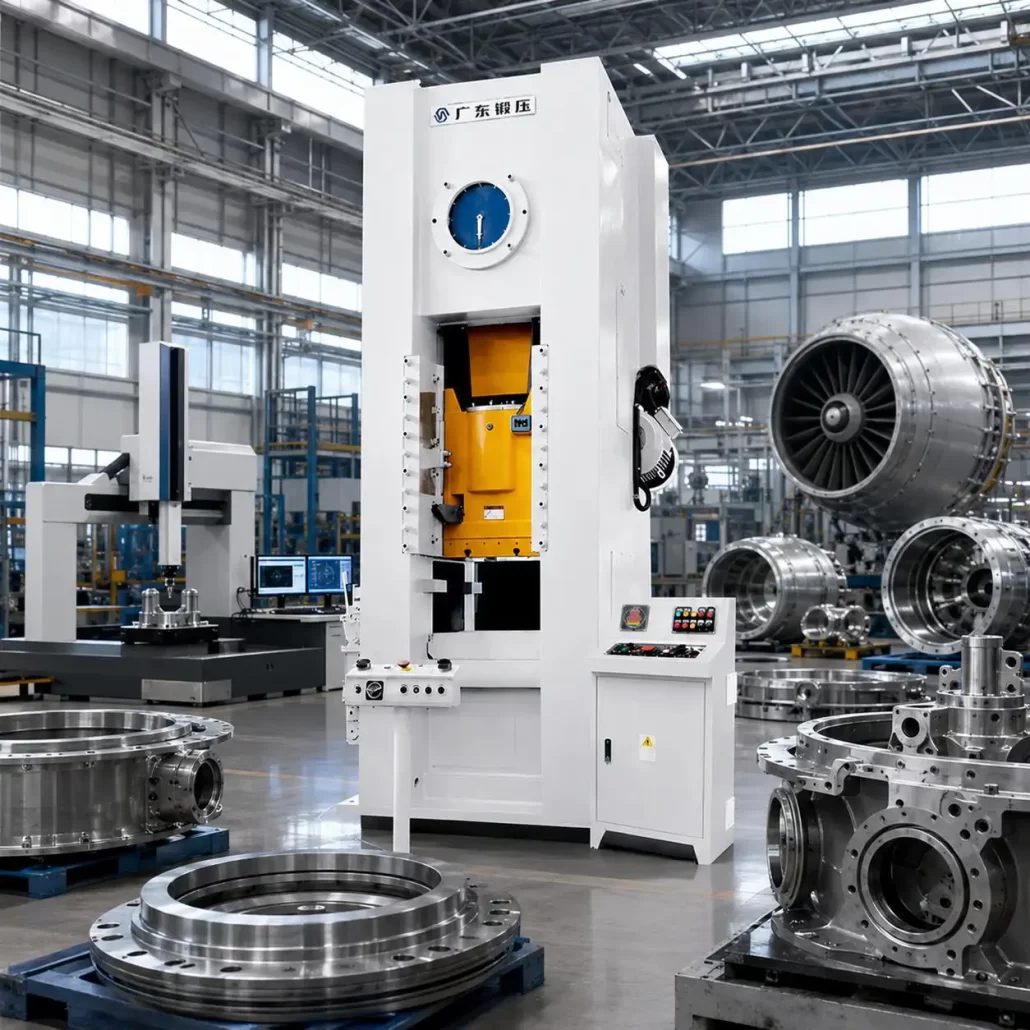
This dwell can improve the stability of certain extrusion and sizing operations when the press, tooling, lubrication, material, and operating parameters are correctly matched.
How Bottom Dead Center Dwell Affects Forming
Dwell at bottom dead center extends the duration of active pressing and aids in maintaining die closure during the final stage of the forming process. It may allow for:
•More stable filling of the cavity
•More stable coining and sizing
•Less influence of the rapid slide reversal
•Better timing of part ejection
•More uniform forming of intricate profiles
A lengthened dwell does not always improve the system. Material properties, lubrication, tooling temperature, production speed, and die design must also be considered. Conventional punching or shallow drawing may not benefit from the same motion characteristics.
Comparison of Press Technologies
Different Industrial Metal Forging Press Equipment technologies should be compared according to the intended process rather than ranked by one specification.
| Press Type | Main Advantage | Limitation | Typical Application |
| Knuckle joint press | High final-stage force and dwell | Relatively fixed motion curve | Cold extrusion, coining, sizing |
| Crank press | Fast cycle and mature structure | Short bottom dwell | Blanking and general stamping |
| Servo press | Programmable slide motion | Higher control complexity | Multi-stage precision forming |
| Hydraulic press | Controllable force through the stroke | Usually slower | Deep drawing and large deformation |
| Fine blanking press | Controlled multi-force operation | Complex tooling system | Precision sheared components |
A knuckle joint press is suitable when low slide speed, high final-stage force, and short dwell are important. A servo press is more appropriate when programmable motion is required, while hydraulic equipment suits applications needing force control over a longer stroke.
Selecting the Right Knuckle Joint Press Configuration
The GUANGDUAN GK Series covers nominal capacities from 6300 to 25000 kN, with bolster dimensions ranging from approximately 700 × 700 mm to 1200 × 1200 mm.
| Capacity Range | Possible Application Direction | Main Evaluation Points |
| 6300–8000 kN | Medium and small precision parts | Die size, cycle rate and ejection |
| 10000–16000 kN | Automotive parts and fasteners | Frame rigidity and off-center load |
| 16000–25000 kN | Large or high-resistance parts | Energy, foundation and installation |
Actual press capacity must be calculated from the material, blank dimensions, reduction ratio, forming stages, tooling, and load curve.
Frame construction is also subject to review. Continuous structural rigidity is an advantage of an integral frame and also allows for easier construction. On the other hand, a frame that is split may help to ease the transport of larger equipment. Ultimately, the construction will depend on the particular model and how the frame will be installed.
Clutch-Brake, Die Height, and Ejection
The GK-630 uses a pneumatic wet integrated friction clutch-brake. GK-800 through GK-2500 models use pneumatic dry split friction clutch-brake systems. Selection should consider operating frequency, thermal load, lubrication, maintenance, and stopping requirements.
Each die-height indicator is capable of a measurement increment of 0.01 mm. While great for making adjustments or setting up, display precision should not be mistaken for total forming precision. Final forming precision is contingent upon several factors including slide repeatability, forming tools, frame deflection, and material consistency.
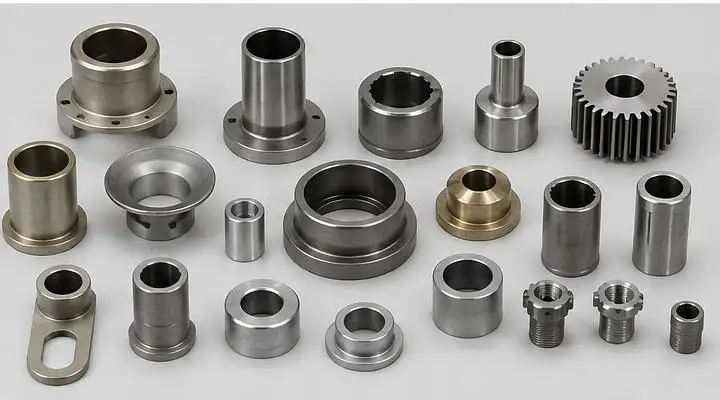
Each unit comes standard with a mechanical lower ejector. The lower ejector serves the function of removing the formed part from the lower die and allows for the possibility of forming the part in a fully automated process. The ejector forces, stroke, and position as well as the means of connecting to the die should be determined for each specific case.
PLC Control and Production Coordination
PLC control allows for:
•Single stroke, continuous, and setup modes
•Clutch-brake coordination
•Interlocking safety doors and light curtains
•Monitoring and controlling lubrication and air pressure
•Fault signaling and production counting
•Feeder and robot integration
As in any manufacturing process, PLC control enhances consistency of the process. However, rigidity of the press along with the factors of the manufacturing process and the workpiece greatly influence the quality of the finished part.
Process and Press Technology Integration
When selecting Industrial Metal Forging Press Equipment, consideration requires more than the comparison of rated tonnage. Pressing and stamping processes require a high level of precision in die clearance, die and stamping height, and repeatability of movement to the bottom dead center. Cold extrusion processes require even more emphasis on frame rigidity, the dwell of the slide, and the reliability of ejection and of the lubricant transfer medium.
Knuckle joint, crank, servo, hydraulic, and fine blanking presses each serve different process requirements. The appropriate configuration should be based on the part, material, tooling, load curve, production rate, and automation plan.
Discuss Your Project With GUANGDUAN
Planning a fine stamping or cold extrusion project? Share your material, blank dimensions, forming stages, required force, die size, production rate, and ejector requirements with GUANGDUAN. Its engineering team can evaluate whether a knuckle joint press or another Industrial Metal Forging Press Equipment configuration is better matched to your process.
FAQs
Q1. What bolster sizes are offered within the GUANGDUAN knuckle joint presses?
Bolster sizes vary depending on the model, but are typically in the range of 700 mm x 700 mm to 1200 mm x 1200 mm. Buyers need to confirm the effective die installation area, mounting layout, feeder clearance, and service space.
Q2. What is the capacity of the GUANGDUAN GK Series knuckle joint press?
The GUANGDUAN GK Series offers a range of 6300 kN up to 25000 kN. When selecting the most suitable capacity, the considerations should include the material, the size of the blank, the number of forming stages, the required forming force, the dimensions of the die and the production rate.
Q3. Can GUANGDUAN Industrial Metal Forging Press Equipment be used for cold extrusion?
The GK Series knuckle joint press is suitable for certain applications of cold extrusion, coining, sizing and precision forming. This is due to the design of the crank with toggle mechanism which reduces the speed of the slide and increases the force at the bottom dead center.
Q4. In what ways can the GK Series assist in fine stamping?
Fine stamping is enabled in the GK Series due to a rigid construction of the press, controlled slided movement, clear indication of die height, and the combination of clutch and brake controls, along with PLC. The quality of the final stamping is also dependent on the die clearance and the precision of the tooling, along with the consistency of the material and the stability of the feed.
Q5. What is the bottom dead center dwell of the GUANGDUAN GK Series?
The slide of the GK Series can dwell near the bottom dead center for approximately 1/18 of the total cycle time. This characteristic of motion can assist the flow of material, closure of the die, coining, and sizing, provided the rest of the process is designed correctly.
CONTACT US


Guangdong Metal Forming Machine Works Co., Ltd.
We are always providing our customers with reliable products and considerate services.
If you would like to keep touch with us directly, please go to contact us
-

Home
-

Tel
-

Email
-

Contact