
Choosing a High-Tonnage Press for Reliable Aerospace Component Forming
Solely relying on tonnage, a high tonnage press will not be chosen for aerospace production. A pair of machines of the same rated capacity can be very different when it comes to a large aluminum skin, a forging of a titanium component or the correction of geometry in a structural part.
The right press must apply the necessary pressure at the right part of the stroke, and manage deflection, speed, temperature and loading off-center. So it is important that aerospace manufacturers start with the part and the forming process not a general machine specification.
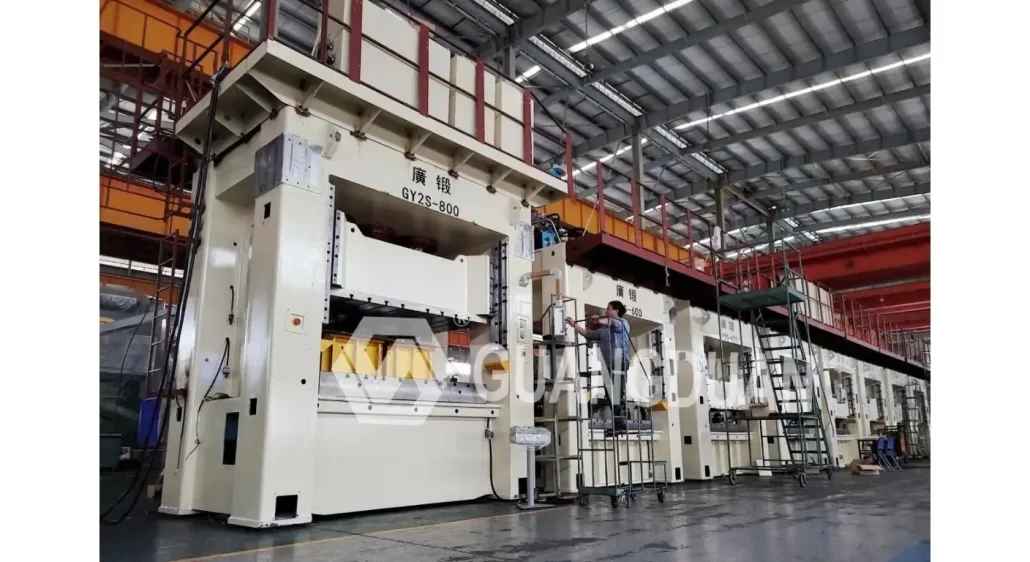
What is Special about an Aerospace Press Application?
Some of the challenging aspects of making aerospace parts are their size, high-cost alloys, complex shapes, and tight tolerances. Press work usually involves forming aluminum panels, hot forming titanium, forging components for landing gear or engines, stretch forming and composite molding or precision straightening.
An unstable process is especially costly because of the amount of materials needed. Wrinkles, cracks, springback or dimensional variation may occur due to uneven pressure and excessive deflection of the frame or an uncontrolled forming speed and will not be noticed until inspection.
The high tonnage press should, therefore, be assessed as part of the total operation using tooling, heating, material handling, controls and quality-data needs.
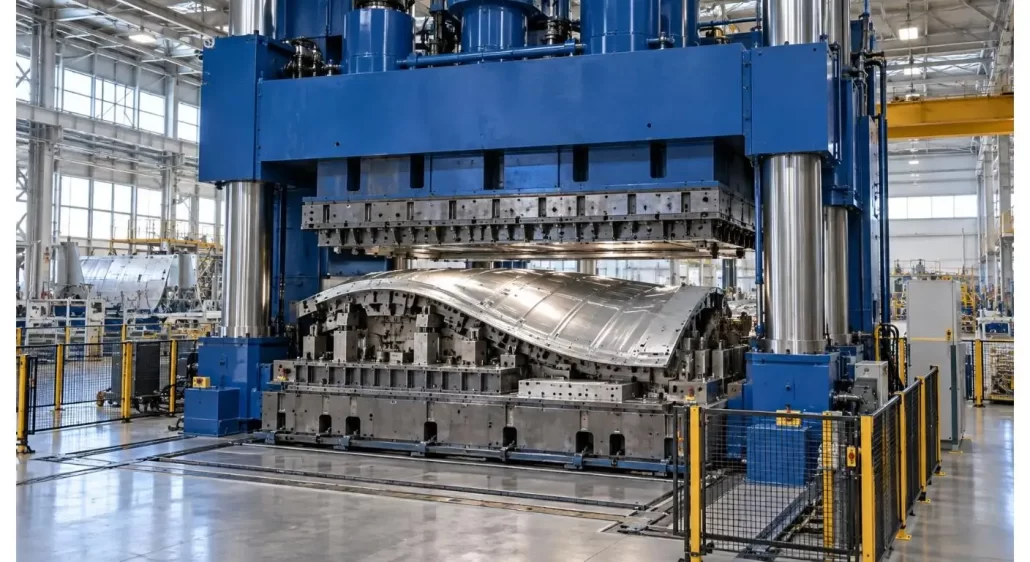
Practice beginning with the Part and Forming Process.
The first step is to determine the biggest possible part family that the press is to be used for. Note the grade of material, initial blank/billet size, geometry of finished product, forming temperature, tool dimensions, volume to be formed and tolerances required.
There are different load, speed and temperature requirements from titanium hot forming, aluminum sheet forming and closed-die forging. Even for components produced out of the same alloy, the necessary equipment might be different, as draw depth, contact area, thickness and geometry of the material can affect the force required for forming.
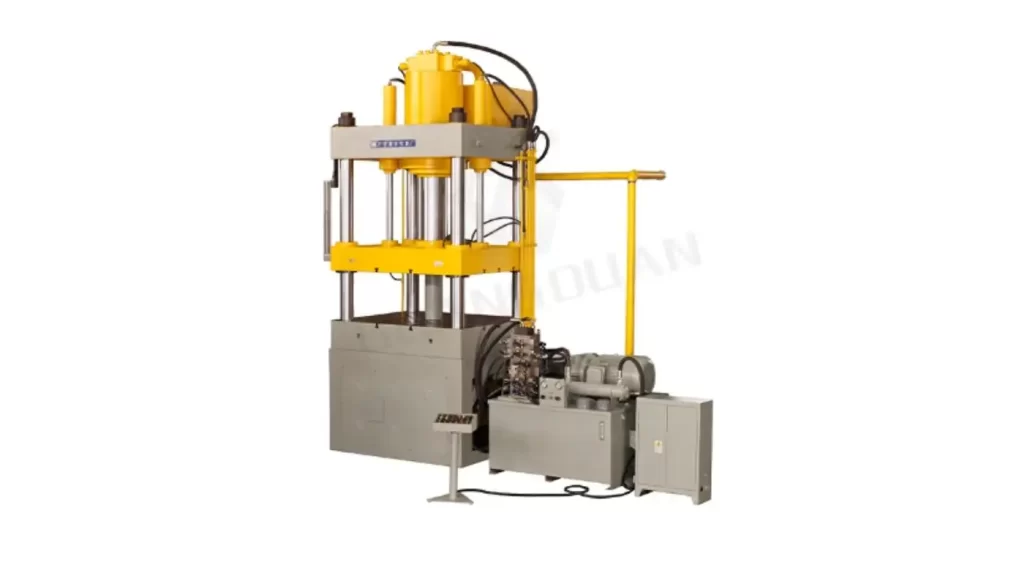
Manufacturers thinking about using controlled force forming may want to check out the hydraulic press configurations that are available. When it’s necessary to have adjustable speed, dwell time and force over a relatively long stroke, hydraulic systems are one of the possibilities to consider.
Determine the maximum tonnage that can be loaded onto the barge.
Required capacity to be based on a verified process-load calculation or measured data from similar tooling. Add forming force, blank-holder or die-cushion force, friction, material behavior due to temperature and an appropriate operating margin.
It’s as important as the position where full force comes available. A press that has a tonnage rating closer to the bottom of the stroke that is needed could still not be a good choice if the highest resistance is at an earlier part of the stroke.
Don’t add too much capacity margin for no reason. Don’t use an oversized machine, as this will escalate the loading requirement on the floor, energy consumption, cost of tooling, and maintenance costs without enhancing the process.
| Verification Item | Information to Confirm | Evidence to Request |
| Rated capacity | Maximum available press force | Machine specification |
| Load curve | Available force through the stroke | Force-stroke diagram |
| Operating margin | Capacity above calculated process load | Load calculation |
| Die-cushion force | Required blank-holder capacity | Cushion force curve |
| Off-center load | Allowable eccentric load | Structural calculation |
| Force accuracy | Actual versus commanded force | Calibration report |
Test the rigidity of the frame, and test the off-center load capacity.
Aerospace tooling can have a big surface area to work on, or have an uneven load due to material touching the die surface. The deflection of the machine frame in both the vertical and angular directions must be limited by the press frame, slide and bolster under these conditions.
Request allowable off-center loading, frame-deflection calculations, slide-guidance design and bolster deflection at rated load from supplier. These figures are more helpful than the general term “high rigidity.”
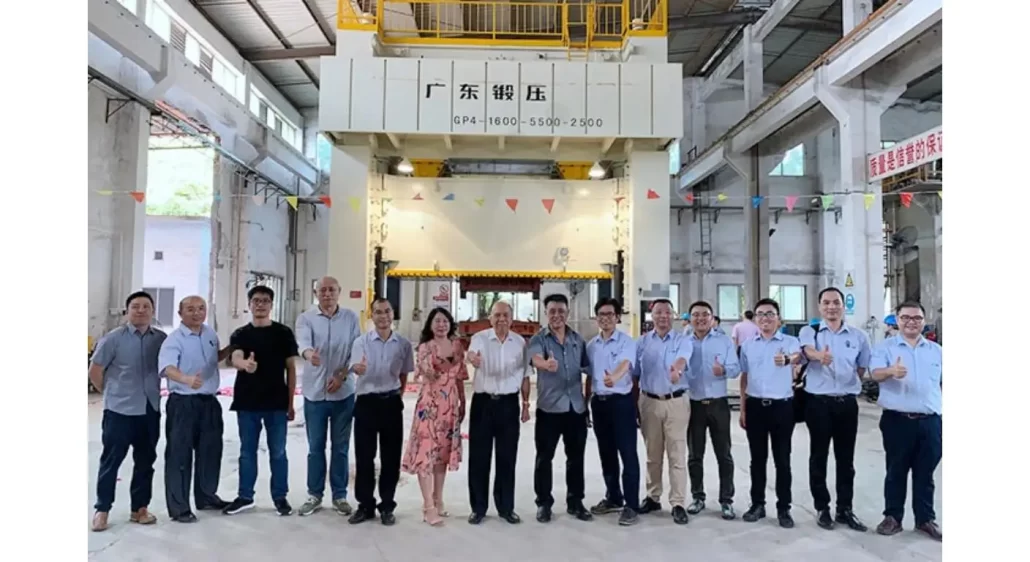
Straight-side structures or gantries are often assessed for large dies, where the closed frame will be able to offer increased load distribution than an open one. The large gantry servo hydraulic press project of Guangduan is a combination of high capacity and welded box structure and guided slide and closed-loop control.
The Working Area should be the same size as the Tooling.
The usable bed size is to be determined based on the entire die, not just the finished die. Provide clamping, die connection, heating, sensor, ejector and maintenance access.
Check daylight and stroke, minimum and maximum die height, slide size and slide moving-bolster requirements. Adequate daylight can be even more important than press force in tall tooling applications. Slide stability is influenced by number and spacing of drive points (long dies).
The foundation, building height and installation of the route of the major components should also be checked, prior to the press layout being approved.
Control Aerospace Alloy Forming Conditions.
These material properties are different for various materials such as Aluminium, Titanium, Nickel alloys and High strength steels. A motion profile should be selected for aerospace work that is provided by the press.
Programmable approach, forming, dwell and return speeds can be controlled by either hydraulic or servo-hydraulic control. Alternatively, forging operations can demand high-energy, high-die-protection and precise bottom-dead-center performance. When considering a bulk deformation process, buyers can compare the features and performance of a forge press.
When requesting for hot-forming use, provide: Platen/die-heating temperature, uniformity, insulation, sensor positions, thermal protection for machine parts. Data on temperature, force, position must be captured to be able to review each cycle as a process record.
Ensure Closed Loop Control and Traceable Data.
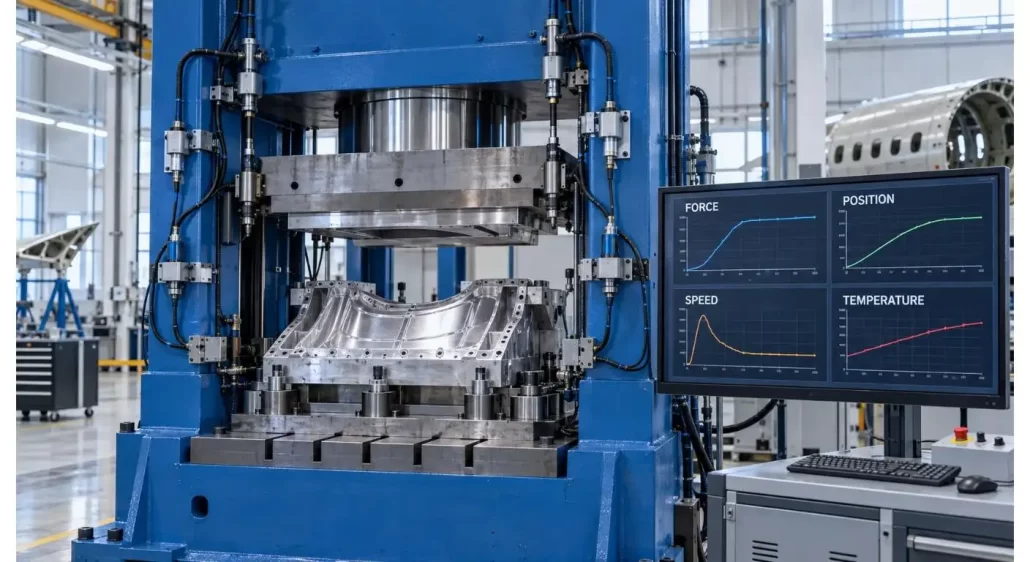
The ability to measure actual force, position, speed and temperature is useful for aerospace production, where it is not possible to rely entirely on programmed settings. Closed loop control allows the use of sensor feedback to adjust the press response during the cycle.
The control system should detect any deviations, prevent unsafe cycles, and record production information. Part/batch number, recipe, peak force, displacement, dwell time, temperature and alarm history are among the required information.
Prior to ordering, ensure the data-export format is verified, data storage period, levels of user access, recipe protection and integration with the factory’s MES or quality system. The whole stamping and automation solutions of Guangduan are the embodiments of integration of sensors, handling equipment and production monitoring.
Design Tooling, Automation and Safe Handling in conjunction.
It’s challenging to manually position large aerospace blanks or forgings. Orientation, transfer path and part support can have an impact on operator safety as well as forming repeatability.
Depending on the process, the line can be fitted with robots, manipulators, moving bolsters, quick die change systems, die clamps or synchronized heating equipment. It is important to agree the interface positions, loads allowed and responsibilities for control between the press supplier and the tooling engineer before manufacturing starts.
Areas to be guarded, interlocks, emergency stops, pressure protection, access for maintenance and how to release a part after an interrupted cycle should be included in safety planning.
| Aerospace Process | Main Press Requirement | Critical Validation |
| Aluminum panel forming | Large bed and controlled drawing speed | Wrinkling and springback |
| Titanium hot forming | Temperature control and long dwell | Thermal uniformity |
| Structural forging | High force and rigid die support | Load stability |
| Composite molding | Uniform pressure over a large area | Platen parallelism |
| Precision straightening | Fine force and position adjustment | Dimensional repeatability |
Veto the Production Release
The process to be reproduced by factory acceptance testing should be as close as possible to the intended process. Only a test of an unloaded press verifies frame behavior, force accuracy or temperature stability during the production process.
Set clear and measurable standards for acceptance prior to contract with the customer. These can cover, among others, force accuracy, pressure stability, slide parallelism, position repeatability, bed deflection, temperature uniformity, cycle time and data-recording performance.
If production tooling is not available, a test tool or calibrated load arrangement shall be used, and agreed to by both parties. Site acceptance shall include critical checks after installation and confirmation of foundation, utilities, guarding, automation/communication interfaces.
Conclusion
The larger the capacity of the machine, the better, is not the case for the best high tonnage press for aerospace. It is the press which keeps the force, alignment, speed and temperature under control in the necessary area of work.
Part-based specification, proven structural performance and realistic acceptance test decrease equipment-selection risks. They also provide an enhanced base for repeatable aerospace production and future process expansion.
FAQs
Q1. Which of the following type of presses are used in aerospace forming?
Hydraulic and servo-hydraulic presses are often thought of for operations that must have a adjustable force, speed and dwell. There may be a need for different drive systems for forging and high volume stamping.
Q2. How many tons of press is needed?
The tonnage varies with the strength of the material, thickness, surface area, shape, friction, temperature and process. Where the peak force is generated during the stroke must be determined in the calculation, too.
Q3. Why is it important that the frame deflects?
Too much deflection may result in out-of-line tooling and unequal loading. This can create variations in thickness, springback, die wear and die rejects.
Q4. With larger presses, is bigger always better?
No, because excess capacity will not compensate for an inappropriate stroke, bed size, accuracy of control or deflection. It could also lead to higher investment and operating expenses.
Q5. Which of the following is useful in an aerospace press RFQ?
Describe part drawings, materials, forming temp., load data, die dimensions, tolerances, quantity, automation requirements and acceptance criteria.
CONTACT US


Guangdong Metal Forming Machine Works Co., Ltd.
We are always providing our customers with reliable products and considerate services.
If you would like to keep touch with us directly, please go to contact us
-

Home
-

Tel
-

Email
-

Contact