
Multi-Directional Forging Press for Hollow and Branched Forging Parts
A Multi-Directional Forging Press uses forming force from multiple directions throughout a synchronous forging cycle. Unlike standard vertical forging, this method can push metal into lateral cavities and fill hollow sections or branches. It can also create bosses and other complex features
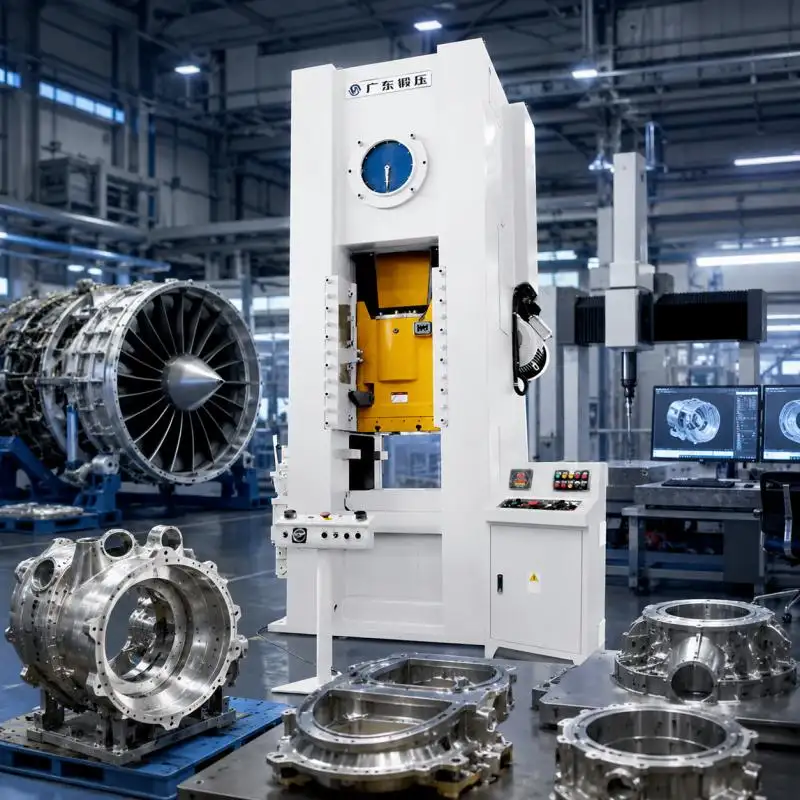
This method is especially useful to create forging components that are hollow and/or branched. These components require metal to flow both axially and radially. Without multi-directional loading, companies can experience incomplete filling, uneven or excessive wall thickness, folding, eccentricity, excessive flash, and large machining allowances.
What is a Multi-Directional Forging Press?
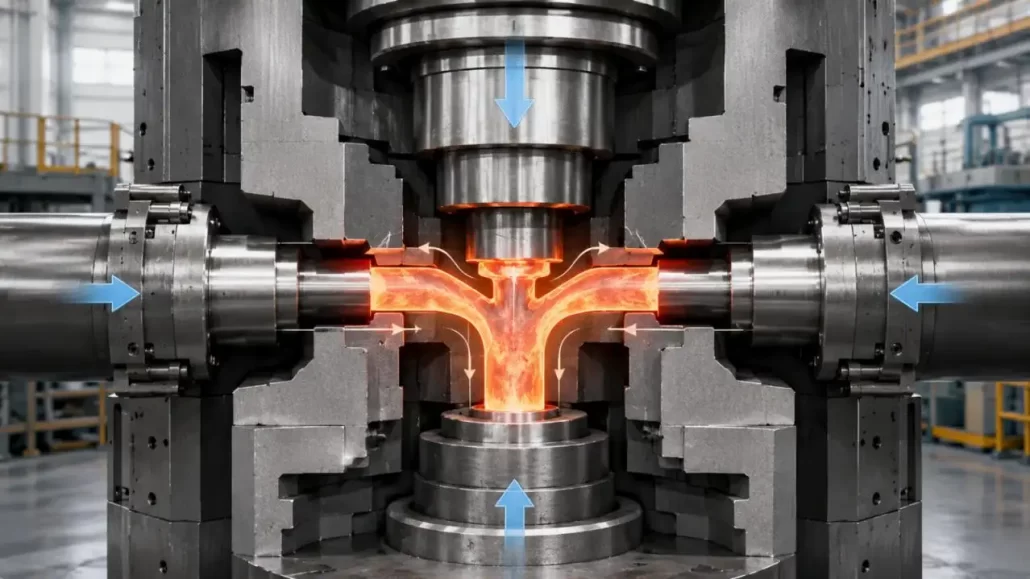
A Multi-Directional Forging Press is a synchronizing forming system. Unlike a press that is simply outfitted with multiple slides, the main slide, side rams, mandrels, punches, dies, and ejectors all operate in a set sequence of pressure, position, speed, and timing.
| System Component | Main Function |
| Main slide | Provides the principal forming force by closing the die |
| Side rams | Form branches, side bosses, and lateral cavities |
| Mandrel or punch | Controls internal holes, hollow sections, and wall thickness |
| Die system | Restricts and directs metal flow |
| Control system | Coordinates pressure, displacement, speed, and sequence |
| Ejector system | Releases the forging while limiting deformation |
A multi-ram forging press, when properly designed and configured, can perform multiple forming actions in a single die-closing cycle. This greatly minimizes the need for transfer and repositioning.
Why Are Hollow and Branched Forging Parts Difficult to Produce?
Complex Metal Flow Paths
Conventional forging mainly moves material vertically. Branched forging components, however, require part of the billet to flow sideways into separate die cavities.
Poor billet distribution or incorrect loading sequences may cause:
•Incomplete filling at branch ends
•Local material accumulation
•Folding or cold shuts
•Interrupted fiber flow
•Sudden increases in forming load
Hollow-Section Control
Hollow component forging requires accurate coordination between the outer die and the internal mandrel. Mandrel misalignment, uneven radial flow, and poor billet centering, can cause problems with both eccentricity of hole and inconsistency of wall thickness.
Thin sections are prone to cracking. Unsuitable conditions of temperature, reduction ratio, and lubrication can contribute to this.
Asymmetrical Die Loading
Creating branches and multiple bosses results in uneven die loads. High levels of asymmetric die loading can cause slide tilt, local die wear, variation in part dimensions, and excessive loading on the press guides.
How are Hollow Parts Formed in a Multi-Directional Forging Press?
While the forming sequence tends to be part-specific, the overall procedure may be broken down into five generalized steps.
•Design volumes in the billet and pre-form to account for the outer surfaces, inner voids and the thickness of the walls.
•Vertical Pre-Forming: During this step the main slide compresses the billet and positions it into the appropriate forming zones.
•Mandrel Penetration: A mandrel (or punch) is used to form the hollow section and also shapes the surfaces.
•Lateral Compression: During this step, the lateral rams force the material into the radial voids, as well as the lateral bosses or cross features.
•Finally, the press performs its calibration and the ejector removes the part.
Any number of actions can occur simultaneously. The sequence is defined by material flow, cavity design, forging temperature, and the accuracy of the dimensions required.
How are Branch Parts Formed in a Multi-Directional Forging Press?
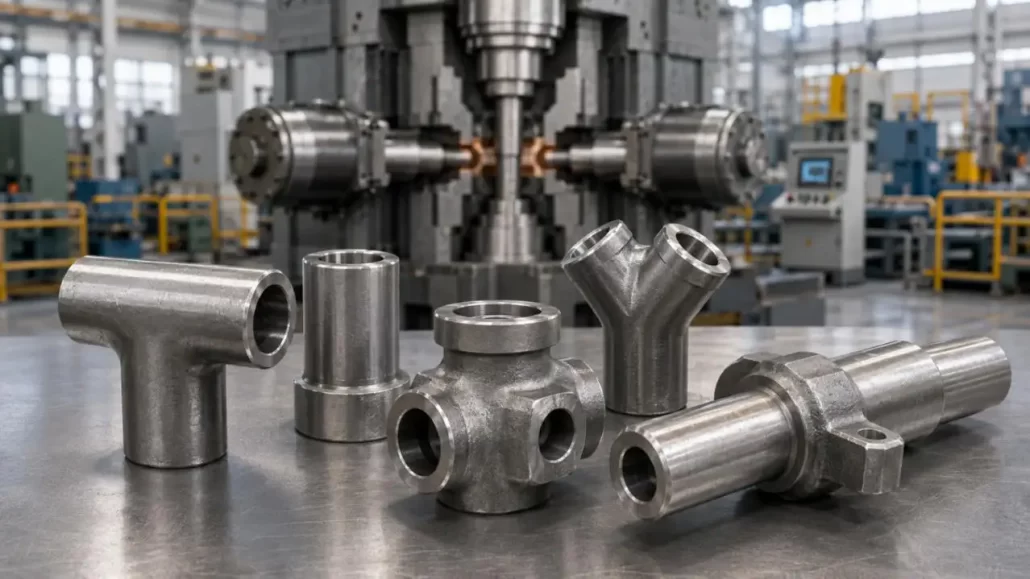
The main slide is responsible for the central body of the part, whilst side rams are responsible for filling the branch cavities. This is especially the case for T and Y shaped parts.
Examples of typical applications are:
•Pipe fittings (T and Y shapes)
•Valve-body forgings
•Hydraulic connectors (multiple ports)
•Forged shafts (with T and Y shaped bosses)
•Automotive chassis parts
•Hollow steering parts
•Multi-boss gear blanks
Main Benefits of Hollow and Branched Components
| Process Benefits | Pragmatic Effects |
| Multi-directional flow of metal | Improves the filling of lateral and branched cavities |
| Fewer forming stages | Decreases transfer, repositioning, and secondary extrusion |
| Continuity of fiber-flow | Grain flow is aligned with the contour of the part |
| Minimal machining allowance | Decreases drilling, milling, and removal of material |
| Greater dimensional consistency | Reduces cumulative errors of positioning |
| Hollow sections of uniform thickness | Improves concentricity and uniformity of wall thickness |
| Less flash | More efficient use of material |
Drawbacks are that Multi-Directional Forging Presses incur additional costs for complex dies, precise ram synchronization, advanced process development, and careful maintenance. They are not ideal for simple, low-volume parts.
Multi-Directional Forging Press Configuration Comparison
| Configuration | Basic | Intermediate | Advanced |
| Forming directions | Main slide plus one side-ram set | Main slide plus multiple side rams | Independently controlled multi-axis system |
| Control | Fixed sequence | PLC sequence control | Closed-loop pressure and displacement control |
| Synchronization | Basic mechanical synchronization | Sensor or encoder feedback | Real-time multi-axis compensation |
| Monitoring | Limit switches | Load and die protection | Cavity pressure, temperature, and data tracking |
| Automation | Manual handling | Robot or conveyor integration | Automated line with traceability |
| Typical parts | Simple lateral features | Medium-complexity hollow and branched parts | High-precision near-net-shape forgings |
The highest specification is not always the best choice. Selection should reflect branch quantity, loading directions, peak force, tolerance, production rate, and automation requirements.
Cold, Warm, and Hot Multi-Directional Forging
| Factor | Cold Forging | Warm Forging | Hot Forging |
| Material resistance | High | Medium | Low |
| Forming load | High | Medium | Low |
| Dimensional accuracy | High | Medium | Low |
| Cavity filling | Early stage difficulty | Intermediate stage difficulty | Late stage difficulty |
| Die thermal load | Low | Medium | High |
| Typical application | Small precision hollow parts | Complex automotive parts | Large branched forgings |
Warm forging maintains a balance among material formability, surface condition, dimensional accuracy, and press load. The final temperature is influenced by material grade, oxidation risk, die life and design, and geometry of the final component.
Typical Defects and Corrective Measures
| Defect | Cause | Corrective Measure |
| Incomplete filling | Insufficient lateral material | Preform and side-ram stroke optimized |
| Folding | Contradictory paths of metal-flow | Modified die radii and changed loading sequence |
| Uneven wall thickness | Misalignment of mandrel and/or billet | Improved positioning and guidance |
| Cracking | Unsuitable temperature combined with high deformation | Temperature control and staged loading |
| Eccentric branches | Partial ramming synchronization | Positioning feedback control and ramming synchronization |
| Trapped air | Insufficient venting of the cavity | Added vents and filling sequence changed |
When Is a Multi-Directional Forging Press Not Required?
A standard press may be more suitable when vertical forming, precision stamping, coining, sizing, or standard cold extrusion is required.
A Multi-Directional Forging Press may also be difficult to justify when the component has no complex side cavity, production volume is low, or tooling and control costs cannot be distributed across sufficient output.
Final Evaluation
A Multi-Directional Forging Press is ideal for the simultaneous control of axial and lateral metal flows that occur during the forging of hollow or branched shapes. It has the potential to enhance the filling of cavities and the uniformity of metal flow and fibers. It may also improve the overall dimensional accuracy of the workpieces and the overall efficiency in the utilization of the material. It even has the capability of minimizing the post-forging machining and secondary forming operations.
Nonetheless, the part geometry and material properties, the forging temperature, the loading sequence, the acceptable tolerances, and the anticipated production quantities should always govern the choice of the equipment.
In reference to a practical assessment of the solutions for multi-directional presses, mechanical, hydraulic, and knuckle joint, manufacturers ought to supply GUANGDUAN with the drawings of the parts, specifications for the materials, billets, the required force, die dimensions, production rates, and the degree of automation.
FAQs
Q1. What is a Multi-Directional Forging Press?
This technology constrains material in multiple directions to create complex branched or hollow components.
Q2. What components are appropriate for multi-directional forging?
Examples include hollow shafts, branched automotive parts, valve bodies, pipe fittings, and hydraulic connectors.
Q3. What is the benefit of using side rams?
They help fill the branches of the component by pushing material into the side cavities.
Q4. Does this technology limit the amount of post processing required?
Definitely. This technology can create very close to net shape components with little allowance which can greatly reduce the need for post processing like drilling, milling and trimming.
Q5. What about cold forging? Is multi-directional forging appropriate for that as well?
This technology can be used for cold, warm, and hot forging really depending on what material is being used and the geometry of the component.
CONTACT US


Guangdong Metal Forming Machine Works Co., Ltd.
We are always providing our customers with reliable products and considerate services.
If you would like to keep touch with us directly, please go to contact us
-

Home
-

Tel
-

Email
-

Contact