
How Does a Warm Forging Press Machine Improve Material Formability?
The Warm Forging Press Machine processes metal shapes known as billets. Heating billets changes the flow characteristics of the metal. When compared to traditional hot forging, higher precision of dimensions and surface finish is easier to achieve.
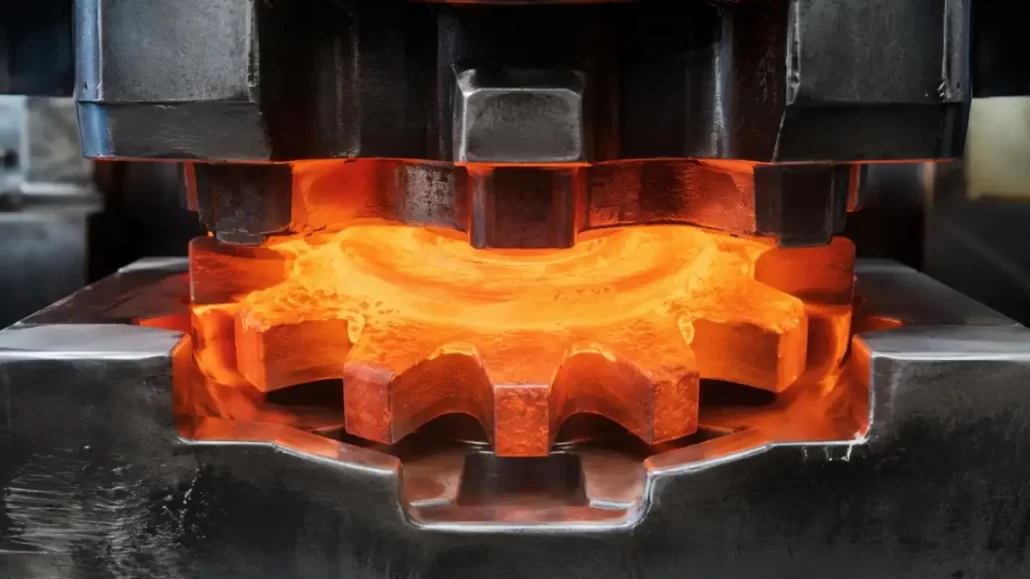
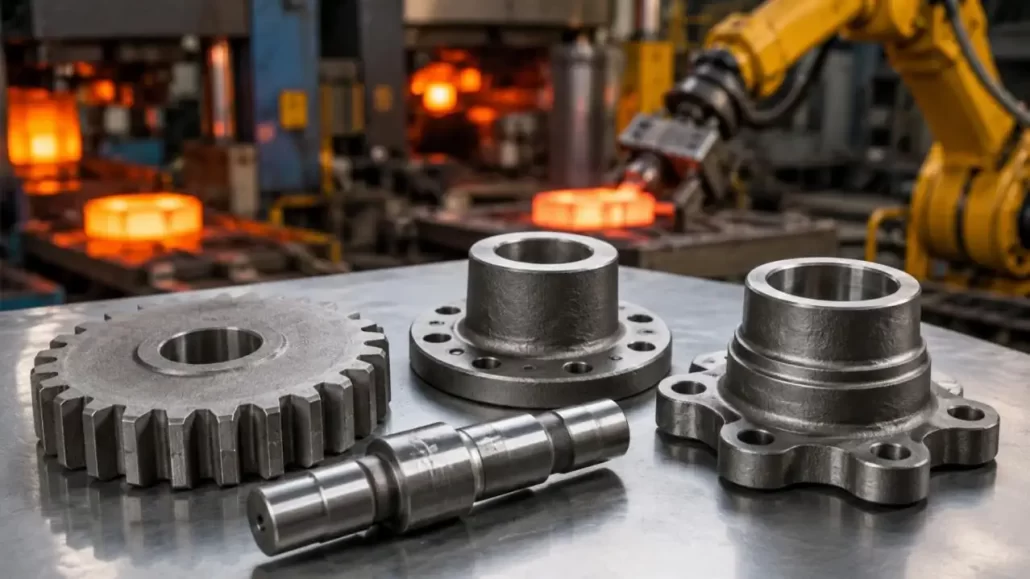
This nearly thermally relaxed state of the material allows for improved formability. Material formability is described as the degree to which the material can be formed without producing cracks, folds, or causing incomplete filling of the die. This is a significant consideration in the production of flanges, gears, components with deep and narrow cavities, stepped shafts, and similar components.
There are many other factors that influence the quality of the forging beyond temperature. For example; forming force, slide velocity, rigidity of the frame, die design, lubrication, transfer time of the billet, among others, can impact the consistency of the process as well.
What Is a Warm Forging Press Machine?
A Warm Forging Press Machine applies controlled mechanical or hydraulic force to a preheated metal billet placed inside a forming die. The operating temperature is normally higher than cold forging temperatures but lower than conventional hot forging temperatures.
The appropriate temperature depends on:
•Material grade and alloy composition
•Required deformation
•Part geometry
•Surface-quality requirements
•Die material and lubrication
•Production cycle time
A complete warm forging system may include the press body, billet heater, temperature sensor, die-heating or cooling equipment, lubrication system, feeder, robot, and process-control unit. The press and heating system must therefore be evaluated together.
How Does Warm Forging Enhance Material Formability?
Reduced Material Flow Stress
Reducing the temperature of the billet will reduce the resistance to plastic deformation. Consequently, a Warm Forging Press Machine will Form some complex components with lower peak loads when compared to a similar cold-forging operation.
The reduced flow stress of materials will
•Decrease concentration of load on the die
•Improve the flow of material into intricate die cavities
•Allow more complex shapes to be formed in a single operation
•Decrease the tendency to fill die cavities
The results of warm forging will vary with the material and will be best predicted with process modeling and verified with forming trials.
Ductility and Edge Cracking
Warm forging increases the ductility of materials in concentrated deformation zones. This decreases edge cracking during the formation of complex parts such as Alloy Steel Gears, Transmission Components, and Shafts.
Die and part temperature control during warm forging is critical. A billet that is too cold will not fill the die (possibly resulting in cracks). Conversely, an over heated billet may be inconsistent in surface dimensions.
Die Filling
Warm forging enhances die filling, reducing under filling and folds.
Near-net-shape production with a Warm Forging Press Machine will minimize the need for additional machining, assuming proper die alignment and repeatability of the process.
Springback
Warm forging minimizes the elastic recovery when compared to cold forging, resulting in improved consistency of the dimensions of flanges, boars, gear profiles and other surfaces.
Balanced Surface Quality and Oxidation
When comparing different forging techniques, warm forging demonstrates the greatest potential for minimizing oxidation and enhancing the surface quality of the forged materials compared to hot forging. However, like hot forging, warm forging can also lead to the formation of a surface scale and surface quality variations.
Which Press Characteristics Affect Formability?
| Press Characteristics | Effects on Forming |
| Rated force | Overcoming deformation resistance |
| Force position | Where the press applies force at different slide positions |
| Slide stroke | Length of forming space and influence on die and forming stages |
| Slide speed | Effect on filling behavior and contact time |
| Frame rigidity | Die deflection and parallelism |
| Guide accuracy | Alignment of upper and lower dies |
| Overload protection | Limits damage during abnormal forming |
| Automatic feeding | Minimizes thermal change of billets between operations |
A closed-frame forging press can improve forming stability; however, this does not mean that it is a Warm Forging Press Machine. It can also depend on a variety of other factors.
Warm Forging vs Cold Forging vs Hot Forging
| Factor | Cold forging | Warm forging | Hot forging |
| Flow stress | High | Moderate | Lower |
| Dimensional accuracy | High | Relatively high | Moderate |
| Oxidation | Limited | Controllable | More significant |
| Forming load | High | Moderate | Lower |
| Die thermal load | Low | Moderate | High |
| Typical parts | Fasteners, small shafts | Gears, shafts, flanges | Large blanks and forgings |
Cold forging is suitable for high-accuracy parts when material deformation is manageable. Hot forging supports major deformation and large components. A Warm Forging Press Machine is useful when manufacturers need a balance among forming load, die filling, accuracy, oxidation, and machining allowance.
Mechanical vs Hydraulic Warm Forging Press Machine
| Factor | Mechanical press | Hydraulic press |
| Production speed | Generally faster | Generally slower |
| Force behavior | Changes with crank position | Available over a longer stroke |
| Stroke repeatability | High | Flexible control |
| Holding pressure | Limited | Strong |
| Typical use | High-volume die forging | Deep forming and calibration |
Selection should be based on the component geometry, required pressure curve, cycle time, stroke control, and holding requirements—not only nominal tonnage.
How Temperature, Speed, and Lubrication Work Together
Billet temperature must be uniform. Insufficient heat increases forming force and underfill risk, while excessive heat may cause oxidation and dimensional variation.
The pace of transfer and forming should not be too slow to an extent that you start losing temperature. However, if the pace of transfer and forming is too fast, it will cause disturbance in the flow.
Lubrication affects friction, die filling, surface finish, tool wear, and part release. A stable Warm Forging Press Machine process therefore requires coordinated control of temperature, speed, lubrication, and die condition.
Common Warm-Forging Problems
| Problem | Possible cause | Improvement |
| Incomplete filling | Low temperature or insufficient force | Adjust heating, force, or preform |
| Edge cracking | Low ductility or concentrated strain | Optimize temperature and die radii |
| Folding | Poor billet or flow-path design | Revise preform and die geometry |
| Dimensional variation | Frame deflection or temperature fluctuation | Improve rigidity and process control |
| Rapid die wear | Heat, friction, or localized load | Review die material and lubrication |
Evaluating the GUANGDUAN JH31 Series
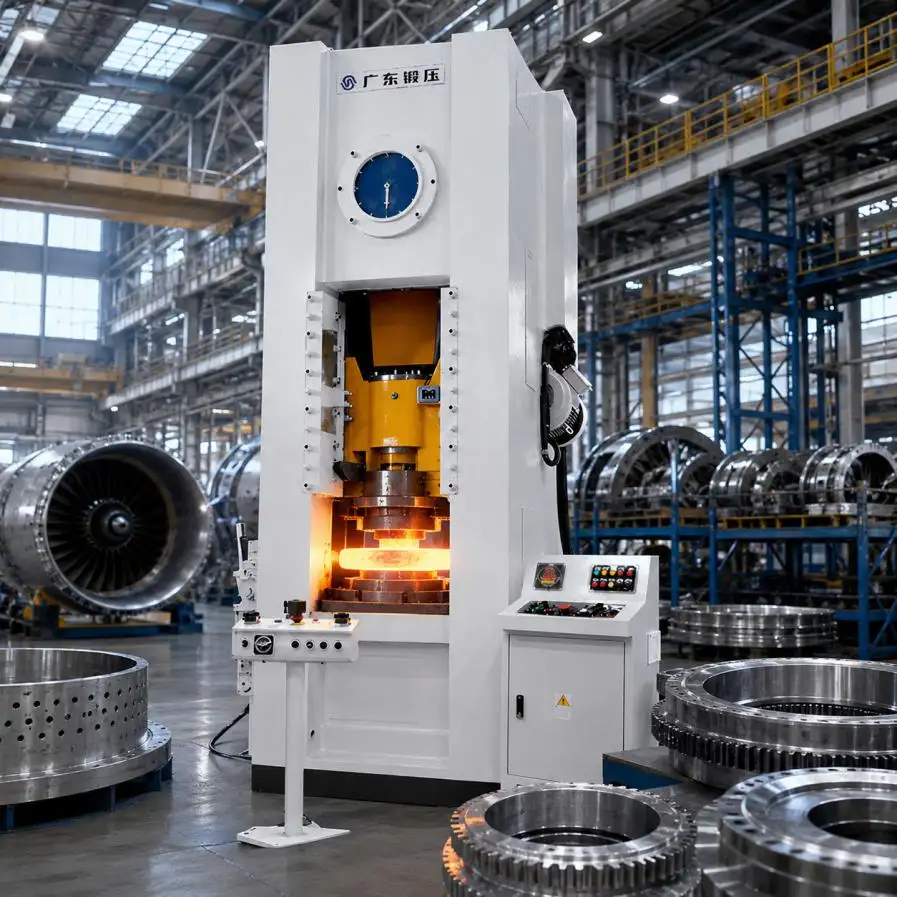
The GUANGDUAN JH31 Series uses a narrow-table closed single-point design with a monolithic box-type frame. Selected models use a four-tie-rod preloaded structure.
Its main structural and control features include:
• Eccentric-shaft crankshaft with strong load capacity
• Wet clutch for repeated production cycles
• Four-surface full slide guidance
• Mechanical die-height adjustment with digital display
• PLC and pneumatic control
• Continuous, single-stroke, and micro-motion modes
• Optional photoelectric protection and automatic feeding
• Hydraulic overload protection or wedge-type die release, depending on model
The closed frame and full slide guidance can support die alignment and forming repeatability. Automatic feeding can also reduce manual handling and billet temperature loss.
Matching Material Formability With the Right Press
The Warm Forging Press Machine helps to reduce flow stress of materials, enhances ductility, helps with die filling, and decreases springback. The Warm Forging Press Machine provides these advantages due to the synergistic control of temperature, press rigidity, guidance, speed, lubrication and tooling.
Provide GUANGDUAN with the material grade, billet size, heating temperature, part drawing, required force, die dimensions, cycle time, and automation plan. Its engineering team can evaluate whether the JH31 frame structure, operating modes, die space, protection systems, and feeding options match the actual forging or metal-forming process.
FAQs
Q1. How is the die height adjusted on the JH31 Series?
The JH31 Series has a digital readout for mechanical die height adjustment. This allows operators to die set more precisely and ensures invariable setup for each tooling operation.
Q2. What is the frame structure of the GUANGDUAN JH31 Series?
The GUANGDUAN JH31 Series utilizes a closed type, single point, narrow-table frame structure. The majority of its models are of a monolithic box structure, while some select models utilize a four tie rod structure, which aids in the rigidity against forming loads.
Q3. How does the JH31 Series improve die alignment?
The slide is designed with four surface full guide ways. Such a guiding structure assists in the alignment of the upper and lower die, and helps in the reduction of lateral movement and enhances the overall repeatability of the process in forging, stamping, and setting of the pressure.
Q4. What type of drive system does the JH31 Series use?
The JH31 Series has a mechanical drive system that is suited for repetitive forming cycles. It is an eccentric-shaft crankshaft of high bearing capacity, which offers a stable stroke for a rapid production rate.
Q5. Does the GUANGDUAN JH31 Series include overload protection?
Certain models within the GUANGDUAN JH31 Series do include overload protection. The JH31-400, JH31-630, and JH31-800 models include hydraulic overload protection. The JH31-200, JH31-300 models include a die release wedge type mechanism. The type of overload protection is model dependent.
CONTACT US


Guangdong Metal Forming Machine Works Co., Ltd.
We are always providing our customers with reliable products and considerate services.
If you would like to keep touch with us directly, please go to contact us
-

Home
-

Tel
-

Email
-

Contact