
Plate Bending Machine Selection Beyond Tonnage
A steel plate can come out of the machine at the proper angle, but not be acceptable for assembly. The inside radius can be too small, the bend line may be curved, or the two ends may curve in different directions when under load, caused by the deflection of the ram and table.
That’s why you shouldn’t choose a plate bending machine just because it has the highest tonnage. The evaluation of material, thickness, bend length, tooling, bend radius and part geometry and production volume must be considered together.
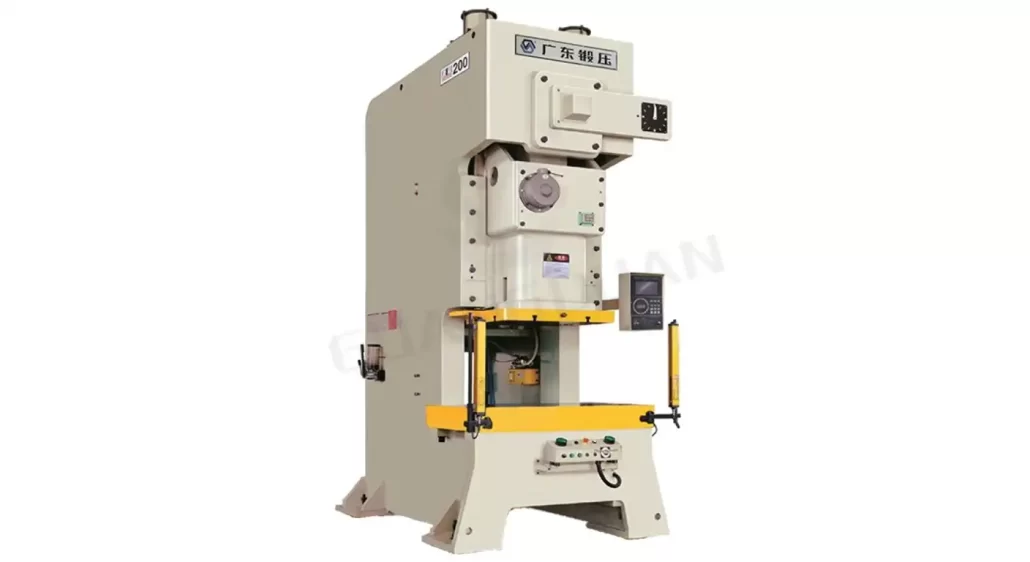
GUANGDUAN provides the hydraulic press system, which could be used for drawing, forming, aligning, bending and folding. The final machine configuration should be from drawings and process calculations, and not be a general machine category.
Explain if the Part needs to be bent or rolled
Plate bending machine can refer to two types of machine.
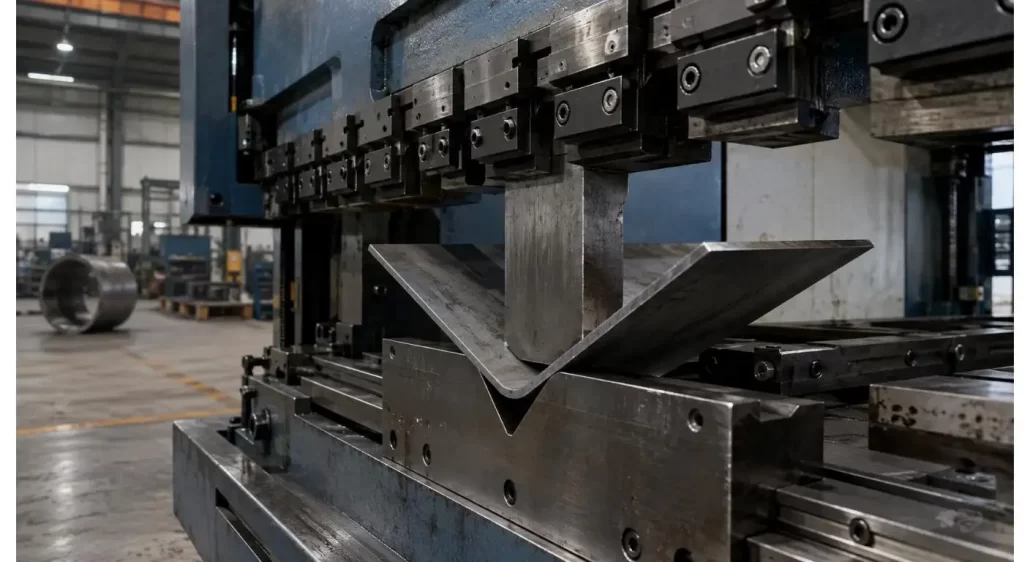
A press-type bending machine is used to bend plate between an upper punch and lower die. Produces straight bend lines, flanges, channels, angles and formed profiles.
A three-roll or four-roll machine gradually rolls the plate into cylinders, cones and large radius shells. More suitable for tank, pipe and pressure-vessel bodies.
Custom tooling can also be installed on a hydraulic forming press to form large curves or multiple stage shapes that cannot be obtained in one bend in a straight-line forming operation.
Define what it is you want to achieve prior to choosing equipment:
- A straight fold
- A channel or a box shape; a profile.
- A local offset
- A big, curved sheet of paper.
- A cylindrical shell
- A shape that is custom die formed
| Required Geometry | Recommended Process | Typical Application |
| Straight bend line | Press bending | Brackets, frames and flanges |
| Channel profile | Multi-step press bending | Vehicle and structural components |
| Local offset | Custom punch-and-die forming | Mounting and clearance features |
| Large-radius open curve | Roll bending or custom forming | Curved panels and covers |
| Complete cylinder | Three-roll or four-roll bending | Tanks, pipes and shells |
| Complex pressed contour | Hydraulic die forming | Special industrial panels |
Bending Force Starts with Material & Tooling
The amount of force required is related to the tensile strength of the material, the bending length of the material and the square of the plate thickness. A wider lower-die opening typically results in less force and a larger inside radius.
The calculation should take into account:
- The ability of materials to withstand stretching.
- The thickness of the sheets varies from minimum to maximum.
- Total bend length
- V-die opening
- Punch radius
- The final step of the process is air bending, bottoming or coining.
- Grain direction
- Required safety margin
Only the words “10 mm steel plate” are insufficient in a quotation. Very different machine loads are produced through a short bend in mild steel versus a full length bend in high strength steel.
GUANGDUAN has provided an overview of hydraulic presses for metal covers angle bending, channel forming and hemming applications.
Avoid the use of Do Not Use Maximum Tonnage as the Normal Process
The bending force calculated must not exceed the rated capacity of the machine, tooling and worktable. Often running at full load can cause excessive deflection, hydraulic temperature and wear.
Also, force distribution is important. Even though total load is below nominal capacity, a short part set off from the machine center results in an eccentric load.
The buyer should request the supplier to state:
- Permitted full-length load
- Permitted concentrated load
- Off-center loading limits
- This will increase the deflection of the ram and bolsters.
- Tool load rating
- Required foundation
When more than one part of the process is used, or if there are several bending points in one die, then the pressure center of the entire tool has to be determined.
Working Area Can Reject an Otherwise Suitable Machine
There is no guarantee that the plate, tool and finished piece will fit if the force is adequate.
Confirm:
- The length and width of a table.
- Distance between columns
- Maximum daylight
- Ram stroke
- Tool height
- Front and side access.
- Plate support requirements
- Ideal space after bending
The deep channels and return flanges may collide with ram, frame or columns. So, the production drawing should be reviewed both in the flat and fully bent condition.
GUANGDUAN’s Y28 hydraulic press is a four-column hydraulic press that can be adjusted in working pressure and stroke to be used for thin plate drawing, aligning, bending and folding. The frame and working area may need to be different for larger/heavier parts.
There are deflection changes at long bends.
A long plate bent is like two loaded beams – the ram and table. They have the property of elastically deflecting and may experience less penetration in the center of the bend compared to the ends.
Control measures may be:
- A stiffer frame and bolster.
- Crowning compensation
- Segmented tooling adjustment
- Multiple synchronized cylinders
- Place feedback on the ram, on both sides.
- Trial correction based on measured angles
Evaluating machine straightness should be done under load. Any parallelism measurement without load will not provide a true indication of bend deflection if there is a long heavy bend involved.
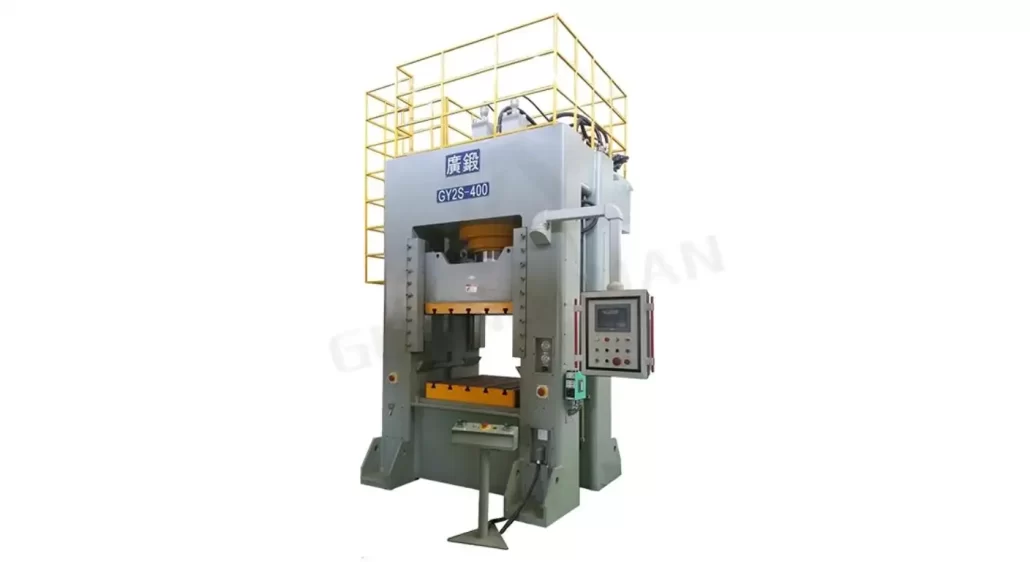
GUANGDUAN’s GY2S hydraulic press platform is equipped with a welded box structure, eight-sided slide guidance and closed-loop pressure and position control for high load forming.
Springback is a material variable and must be treated as such.
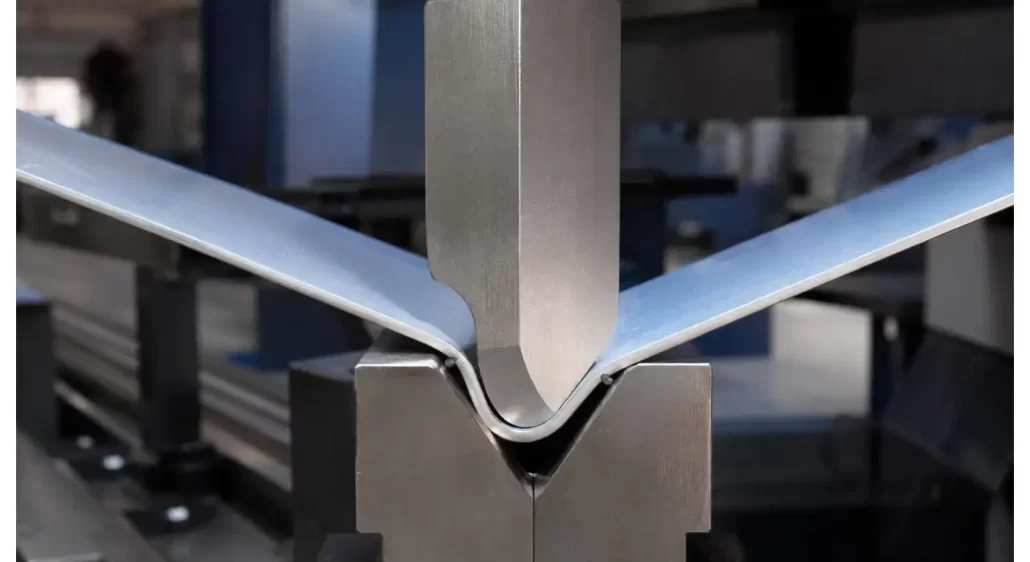
Once the tool has separated the plate, the angle will open due to the elastic recovery. The higher the grade of steel, stainless steel, alu and the greater the bend radius to thickness ratios, the more important the springback becomes.
Compensation may require:
- Controlled overbending
- A smaller angle programmed into the computer.
- Bottoming or calibration
- Material-specific process recipes
- Consistent grain orientation
- Inspection of the first production parts is carried out as needed.
The final angle cannot be determined from the pressure. Other factors such as position of the tool, tooling geometry, material properties and the variation of material batches must also be controlled.
The bend shape isn’t the only aspect of the tooling that defines it.
These are the parameters that change depending on punch and die selection – force, inside radius, marking and cracking risk. Capacity of the tooling must be checked as carefully as the machine.
Review:
- Punch angle and tip radius.
- The angle of the opening and shoulder radius.
- Cutting length and segmentation.
- Tool hardness
- Clamping method
- Surface protection
- Alignment and changeover method
With the bending of polished stainless steel or aluminum or coated plate, protective films or non-marking contact surfaces may be needed. These measures can also be an impact on bend consistency and should be incorporated into trials.
Part Handling Becomes a Quality Variable
If the plates are large they may sag or rotate due to their own mass. Manual support can result in inconsistent positioning and cause safety issues.
The production cell can be configured to use:
- Front support arms
- Roller tables
- Lifting devices
- Robotic handling
- Positioning stops
- Two-person operating procedures
- Part-presence sensors
It is essential that the bend line remains in relation to the tooling and that the component is not allowed to move in an unsafe manner as it is bent.
Check the Complete Part (Not One Bend)
The test bend is not a true representation of a long production component. The testing of material should be performed by the specified material and representative length and actual tooling, if possible, for the acceptance testing.
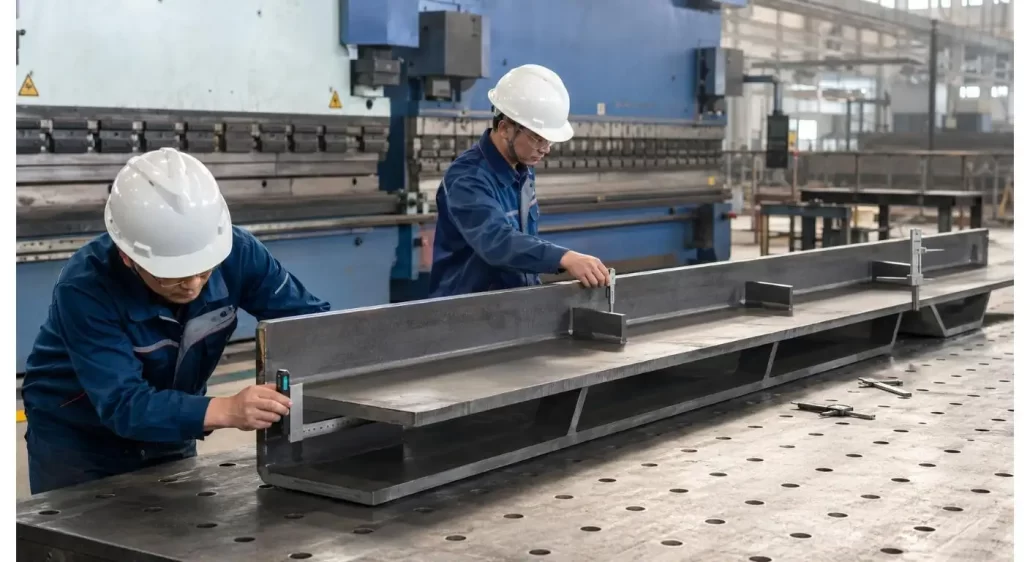
Verify:
- Bends at both ends and in the middle.
- Inside radius
- Flange dimensions
- Bends that are straight.Straight bends.
- Surface marking
- Cracking or thinning
- Cycle time
- Part-removal clearance
If multiple bends, calculate tolerance at the end of all bends.
| Inspection Item | Measurement Position | Process Risk Revealed |
| Bend angle | Left, center and right | Machine or tooling deflection |
| Inside radius | Representative sections | Incorrect punch or die selection |
| Flange length | Both ends and center | Positioning or angle variation |
| Bend straightness | Full bend line | Uneven load distribution |
| Surface condition | Tool-contact areas | Marking or coating damage |
| Final assembly size | Completed multi-bend part | Tolerance accumulation |
Create an RFQ for Useful Plate Bending.Complete an RFQ for Useful Plate Bending.
An RFQ should contain the following information:
- Drawings for parts or shapes that are flat.
- The range of material grades and thicknesses.
- Maximum bend length
- Bend angles and inside radiuses.
- Tooling concept
- Annual production volume
- Loading method
- Angle and dimensional tolerances.
- Surface-protection requirements
- The design of factories and safety requirements in factories
With this information, the manufacturer can now examine the entire force, working area, frame structure, controls and handling equipment as a group.
Final Engineering Check
The required angle and radius should be produced by a suitable bending machine without need for excessive machine deflection, surface defects or manual correction throughout the entire part.
While tonnage is still a factor, tooling, work area, springback, load distribution and handling are the factors that make or break the production. GUANGDUAN can analyze the shape of the plates and process needs and suggest the configuration of hydraulic forming for the application.
FAQ
Q1. What is a plate bending machine?
Equipment to bend the flat metal plate into angles, channels, curves or other shapes. There are two different methods of forming, namely, press-type bending and roll bending.
Q2. How do you calculate the force on a plate bending?
The strength of materials, thickness, length of bends, opening die and bending method are the primary factors determining force. The load has to be supported by the machine structure and the tooling.
Q3. Why are there angle differences over a long bend?
The penetration around the center can be decreased by ram and table deflection. The angle can also vary with tool positioning, material differences, uneven tool support, etc.
Q4. What is done to control springback?
Controlled overbending, tooling selection and material-specific settings and calibration can help compensate for springback. The actual material grade and thickness should be utilized in trial bends.
Q5. Is it possible to bend thick plate using a hydraulic press?
Yes, if the capacity, frame, tooling and working area of the lift is designed for the load. Don’t always assume that a thin-plate forming press should be used for heavy plate.
CONTACT US


Guangdong Metal Forming Machine Works Co., Ltd.
We are always providing our customers with reliable products and considerate services.
If you would like to keep touch with us directly, please go to contact us
-

Home
-

Tel
-

Email
-

Contact