
Choosing a Programmable Forging Press for Consistent Production
A programmable forging press should be a controlled and repeatable machine cycle of a proven forging process. It isn’t just about the PLC or touch screen.
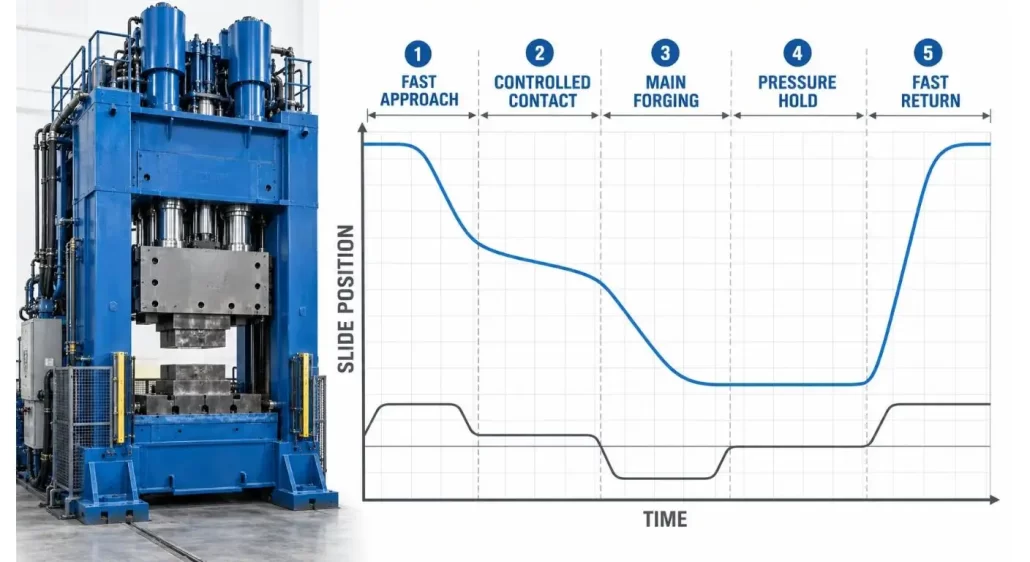
Useful programmability enables engineers to program the movement of the slide approaching the billet, generating forming force, traversing through the critical die positions, holding the pressure and returning. These settings can vary based on material, billet temp, part shape and forging phase.
The correct press should have the appropriate mechanical capacity, along with sensors and protected production recipes and movement control.
The need for process-specific programming in forging processes.
During a single press cycle, conditions of the forging can vary quickly. As billet fills die cavity, area of contact and resistance of material increases. The force needed to deform the material also varies with temperature.
Hot forging requires a rapid transfer and appropriate deformation rate to prevent excessive billet heat loss. Warm Forging is carried out within a smaller temperature window, and Cold Forging results in higher loads and large die pressure.
It may be that a fixed machine cycle is not optimum for all three processes. The press motion can be programmed to mimic the real material and die behaviour.
Set a Forging Process Window
Determine the acceptable range for billet temperature, forming force, slide position, speed and dwell before selecting the control functions.
The process window should be indicative of process conditions that give complete die fill without laps, cracks, excessive flash or premature tool wear. It should also specify the acceptable variation in billet size, and condition of materials.
An unrealistic process can’t be fixed by programming. The approved ranges shall be determined by calculation, simulation, testing or based on similar parts’ data.
Match each of the Press Types with the Required Control
Hydraulic forging presses can be adjusted in both force and speed, with a long working stroke. They can be helpful in processes where slow deformation is required, pressure holding or multiple controlled motion stages are necessary.
Mechanical forging presses have repeatable motion and high output, and have a relationship between the press force and the slide speed, which depends on the drive geometry. The stroke rate, shut height, and feeding and auxiliary equipment can be controlled by programmable functions.
Knuckle-joint presses are able to deliver a slow, high force movement at bottom dead center. Guangduan’s forge press series includes various types of hot/cold forging press drives.
The selection of the correct choice is dependent on the process control being dominated by force, position, energy or production rate.
Set the ‘Complete Forging Stroke’.
Useful forging program splits the machine cycle into meaningful stages. The slide can be fast and slow on approach, slow at contact and then form at a given speed and hold in place for a specified period.
Return motion can also be programmed in conjunction with ejection, lubrication and robotic handling. An increase in the movement speed in the areas outside forming zone can short the cycle time without affecting the critical deformation stage.
Slide position or process feedback to define each transition. Time only sequences can be unreliable with billet or tooling changes.
| Stroke Stage | Programmable Setting | Process Objective |
| Fast approach | Speed and transition position | Reduce idle cycle time |
| Die approach | Reduced slide speed | Prevent billet movement |
| Main forming | Speed, force and position | Control material flow |
| Final filling | Force limit and final position | Complete die cavity |
| Pressure hold | Dwell time | Stabilize final geometry |
| Return | Speed and stop position | Coordinate part removal |
Define and make use of Build Recipes for Materials and Part Families
A single forging press can be used to make parts made from various materials, billet sizes and die sets. There should be a different recipe for each approved combination.
Part number, Die number, Material, Temperature range, Forming speed, Force limit, Final position, Dwell time and ejector setting can be used in a recipe.
Recipe naming, recipe revision control is important. Operators should be able to choose an approved programme without having to key in all of the values and unauthorised users should not be able to alter protected limits.
Measure the force and position simultaneously.
Force cannot indicate whether or not the die was in the proper position. Position alone is not proof of whether material behaved normally.
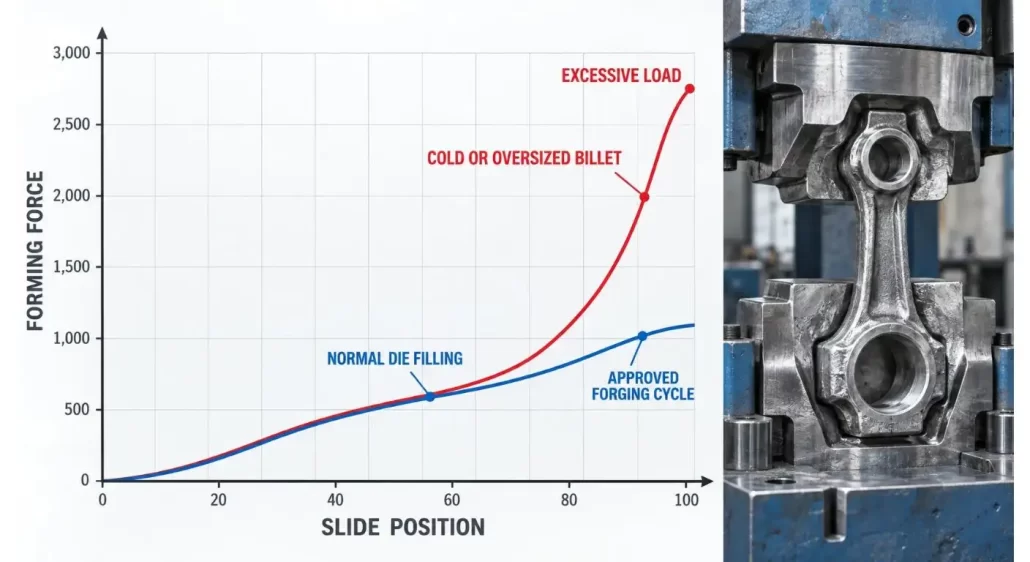
Each forging cycle can be better described using a force-position curve. If there is force increase at an unusual position, it could be that the billet was too big, the temperature was too low, the lubrication was inadequate or the material was not installed properly in the die.
Pressure sensors, load cells and position encoders should possess the appropriate range, resolution and sampling rate. Maintenance plan should contain calibration procedures.
Guangduan’s big servo hydraulic press project integrates pressure and displacement sensing and programmable closed loop control.
The safety of the press and forging dies
Forging dies are subjected to concentrated loads, heat and repeated impact or pressure. Programmable press must be able to abort the next cycle if monitored conditions indicate that a risk exists.
Limit peak force, final position, cycle time and temperatures. Depending on the severity, the system may sound an alarm or terminate next stroke or abort current stroke.
Die protection should also address proper placement of billets, ejector return and transfer-equipment clearance. No matter how sophisticated the motion program is, it can’t save a die when a billet of the wrong size or shape is placed in the forming area.
Coordinate Billet Temperature with the Recipe
Billet temperature affects the material flow stress and hence the forging load. If a material is being pressed below the desired hot billet temp, the tooling can still become overloaded in a program approved for a hot billet.
A pyrometer or temperature sensor will allow verification that the billet is in the approved recipe range. The use of a control system to prevent, reject or direct an out of range billet should be used.
The temperature data can also be stored with the force-position curve. This will make it easier to recognize when the machine-control problem is occurring versus the material-temperature problem.
Incorporate Ejection, Lubrication and Handling
The forging process is not complete as soon as the slide is in the final position. The part needs to be removed from the die, the ejector needs to be returned to its original position and the lubricant needs to be applied before a new billet is fed into the die.
These devices should be controlled in the press program by confirmed signals. Permission for transfer should not be granted unless slide, ejector and safety mechanisms are in proper position.
If robots or manipulators are applied, the press and handling system should have a determined sequence. The metal-forming automation solutions from Guangduan exhibit how presses, sensors and material handling systems can all be controlled as a single entity.
Extend Tool Life by using Process Data.
Beyond part acceptance, forged data can be used to validate the product. Cycle counts, peak-force trends, lubrication alarms and temperature history can be used to plan die service for maintenance.
A gradual increase in force may be caused by scale buildup, changing lubrication or tool wear. If the change is sudden, it could mean that the billet is wrong or that the insert is damaged.
Maintenance requirements should be based on equilibrium production, not guess. The target is to find a significant process shift that will cause a replication of the defects or failure of the tool.
| Monitored Condition | Possible Cause | Machine Response |
| Excessive force | Cold or oversized billet | Stop forging cycle |
| Final position not reached | Incomplete die filling | Hold part for inspection |
| Billet temperature low | Transfer or heater delay | Reject billet |
| Force rising gradually | Tool wear or scale buildup | Maintenance warning |
| Ejector not returned | Stuck part or sensor fault | Prevent next stroke |
| Recipe mismatch | Wrong die or material | Block production start |
Validates each programmable function.
Verify all motion stages, recipes, sensor and protection limits during factory acceptance testing. The press should show that command values are met on a representative forging load.
Test recipe selection and user permissions, as well as alarm responses and data storage. Set up scenarios like too much force, wrong temp and billet and ejector failure.
The 2500-ton knuckle-joint forging press made by Guangduan is a interesting case to talk about precision control, die cushion, slide adjustment and automatic die changing.
Conclusion
A programmable forging press proves its worth when its movement, force and protection functions are in line with the forging procedure. With a PLC and HMI alone, there is no guarantee.
Process-based recipes, force-position monitoring and temperature verification ensures repeatability and protects the tooling. These functions are verified by comprehensive acceptance testing under practical forging conditions.
FAQs
Q1. What can be programmed on a forging press?
Depending on the drive, slide speed, force, position, dwell and ejector timing and auxiliary equipment can be programmed by the engineers. The functions available should be verified for the proposed machine.
Q2. Why use both force and position?
Their relationship depicts the billet behavior in filling the die. An abnormal curve may be caused due to temperature, material, lubrication or tooling issues.
Q3. Will a single programmable press make various parts?
Yes, provided that its force, die space, stroke and controls span the entire range of the part. A controlled recipe is to be used with each combination of approved material and tool.
Q4. How does a programmable press help to protect forging dies?
Can monitor load, position, billet presence and ejector status. A cycle can be prevented or stopped if the values are above the approved limits.
Q5. Should forging recipes be tried out prior to delivery?
Yes. A representative load should be used in the factory to test recipe load, motion stages, sensors, alarms, permissions and data storage.
CONTACT US


Guangdong Metal Forming Machine Works Co., Ltd.
We are always providing our customers with reliable products and considerate services.
If you would like to keep touch with us directly, please go to contact us
-

Home
-

Tel
-

Email
-

Contact