
Choosing the Right Press Machine for Automotive Component Production
Automotive components can be as thin as exterior panels or as thick as chassis reinforcements, even forged transmission parts. One universal press design is not able to produce these components in an efficient manner.
If you are stamping large volumes of brackets a mechanical stamping press might be a good choice, if stamping body panels, a large straight-side press might be required. Requirements for force, stroke, speed and tooling vary with the type of forgings being made, such as drivetrain forgings or deep-drawn housings and components for EV batteries.
The first step in making equipment choices is to identify each family of parts and the forming process along with the desired production target.
Class 1st Automotive Component.
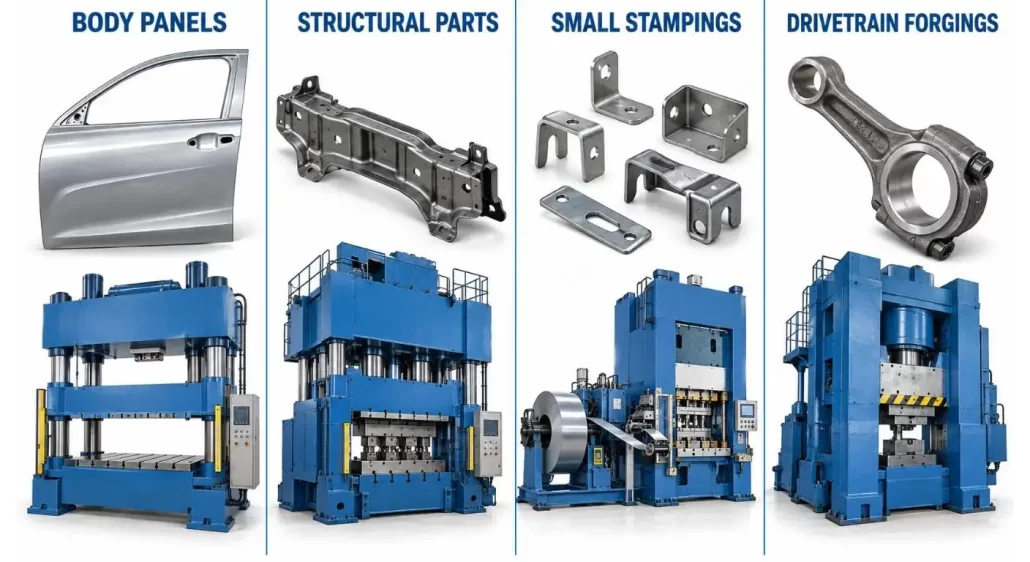
Classify the planned component by function, material and manufacturing process before discussing about machine tonnage.
Body parts comprise doors, roofs, fenders and other large sheet-metal parts. These structural elements are crossmembers, pillars, rails and reinforcements. Connecting Rods, Forging Shafts & Transmission Parts are examples of powertrain & drivetrain components.
Smaller stamped parts such as brackets, clips, covers and mounting plates. EV manufacturing involves producing battery trays, motor laminations, electrical enclosures and thermal-management components.
This classification is useful in identifying if the project requires stamping, deep drawing or precision blanking, forging or a combination of these operations.
Match Forming Process to Material
Mild steel, advanced high strength steels, stainless steel and aluminum are increasingly being used by automotive manufacturers. The force, speed, and tool geometry affect different materials in different ways.
Fast blanking and stamping can be achieved with thin mild steel. High strength steel will generate more force and can experience a significant amount of springback. With aluminium, the vehicle has to be lighter but there is a requirement for special care during surface handling and material flow.
Forged drivetrain parts can begin with billet stock that has been heated, instead of sheet material. They have to be produced with an all new pressure, energy and die set up.
Prior to the choice of press type and capacity, it is important, therefore, to define the properties of the material.
If you need to stamp something repeatedly, select a Mechanical Press.
Mechanical presses transform the rotational motion of a motor into repeatable slide motion. They are extensively applied in blanking, punching, bending and forming of automotive sheet metal parts.
They can be adapted to brackets, reinforcements, covers etc., which are parts that have regular production requirements due to a high cycle rate. Progressive dies are used to perform multiple operations as the coil is moved through the die.
Purchasers need to check the placement of rated force when in stroke. Guangduan’s mechanical press lines feature open back, straight side, double point and four point press with various part sizes.
Controlled Forming with Hydraulic Presses.
Hydraulic presses offer variable force and speed on an extended stroke. They are frequently tested for deep drawing, large structural components, straightening and pressure dwell process applications.
Adjustable motion may be used to manage the flow of material in deep-wall or complicated shapes. Hydraulic die cushions may also control blank-holder force in the drawing process.
Guangduan’s hydraulic press machine systems are of a double-action type and servo-controlled type, supporting different forming needs.
Choose Forging Presses – For high strength components.
Hot, warm or cold forging can be used for the production of connecting rods, shafts, transmission parts and other load-bearing components. These processes enhance the move of materials and assist high component strength.
Billet material, forming temperature, needed energy, die space and die production rate are the factors for selection of the forging-press. Mechanical, hydraulic and knuckle-joint systems are different types of motion and load characteristics.
Forgeability of available forging press configurations should be found out from the actual forging sequence and not just the part weight.
| Component Family | Typical Process | Press Feature to Prioritize |
| Outer body panels | Drawing and restriking | Large bed and cushion control |
| Chassis reinforcements | Stamping and forming | Rigid straight-side frame |
| Small brackets | Progressive stamping | High cycle rate |
| Deep housings | Multi-stage drawing | Long stroke and adjustable force |
| Drivetrain components | Hot or cold forging | High load and stable die support |
| EV battery trays | Large-part forming | Multi-point drive and automation |
Figure out how much force to use, don’t necessarily figure out how big the parts are.
Sometimes a high tonnage is not needed to perform a high tonnage operation on a physically large panel, and sometimes a compact high-strength part can require a high tonnage.
Determine the force needed in all blanking, drawing, bending, restriking, coining and forging processes. If multiple operations are performed in the same die, these operations may overlap.
The specification should list out the peak force and where it occurs in the stroke. Blank-holder or die-cushion force must be listed separately and an engineering margin should be used as per process.
Inspect Working Area & Machine Geometry
The die needs to fit into the press and allow for clamping, sensors, connections and maintenance. Check for bolster area, slide area, daylight, stroke and die-height adjustment.
Two or four point drive systems may be required for long dies. Differences in offset loads can also be caused by the use of large tools as they contact different areas of the material.
Request the following: Allowable Die Weight, Upper Tool Weight, Eccentric Load and Frame Deflection from the manufacturer. Part quality and tooling life are impacted by these values.
Plan the Tooling and Production Method Together
Progressive dies, transfer dies, tandem lines or individual tools can be used to make automotive parts. Geometry, part size, annual part quantity and changeover frequency are all important factors in determining the correct approach.
Progressive dies are suitable for the manufacture of small parts from coiled material. Transfer systems can be used to transport separate blanks or partially formed components, and tandem lines can be used to accommodate large panels that involve multiple forming steps.
Before finalizing the equipment, the machine and tooling supplier should agree on: Station pitch, Shut height, Cushion requirements, Transfer clearance and part release method.
Explain the concept of Right Level of Automation
Automation should alleviate a production constraint, not just make equipment more complicated. Coil-fed brackets can require an uncoiler, a straightener and a servo feeder. For large blanks, it may be necessary to destack and use robots for transfer.
Grippers for hot forgings must be capable of withstanding heat and quick transfer from the furnace. For large body parts, handling systems must be in place to avoid flexing or surface damage.
The automotive multi-station press project at Guangduan features a 1250-ton press and includes unstacking, 3-axis transfer and finished part discharge.
Consider Changeover and Future Programs
Automotive contracts and vehicle platforms change over time. The machine chosen for one part family should also be evaluated for realistic future part families.
Stroke or programmable control and extra bed area will allow equipment to be used for longer. But oversize can result in unnecessary investment, space and energy use with no real value.
If you have high-mix production, consider bolsters, quick-die clamps, automatic slide adjustment and stored process recipes. These features can help minimize any downtime not associated with production between batches.
Control and watch Critical Process Conditions.
Changes that impact part quality can be detected by press monitoring. Some parameters to be considered are forming force, slide position, cushion pressure, feeder pitch, motor load and cycle time.
Production trials should be used to develop limits. If the curve is abnormal, it may mean that the material is wrong, tool wear is to blame or the blank is not being fed.
The system should specify if an abnormal cycle results in a warning, a halt of production and/or a return for further inspection.
| Monitoring Item | Possible Problem Detected | Required Response |
| Peak forming force | Wrong material or tool wear | Stop or inspect part |
| Force-position curve | Forming instability | Compare with approved window |
| Cushion pressure | Wrinkling or tearing risk | Correct cushion setting |
| Feeder position | Incorrect material pitch | Prevent next stroke |
| Transfer status | Missing or misplaced part | Stop press cycle |
| Cycle time | Equipment or handling delay | Review bottleneck |
Test the Machine using Representative Components.
Where practical, the factory acceptance tests should simulate the planned process. If a press has been able to operate successfully without tooling, it has not proven itself in producing an automotive component.
Test for force, slide parallelism, cushion operation, transfer timing and repeated cycle performance using a production die or a representative load.
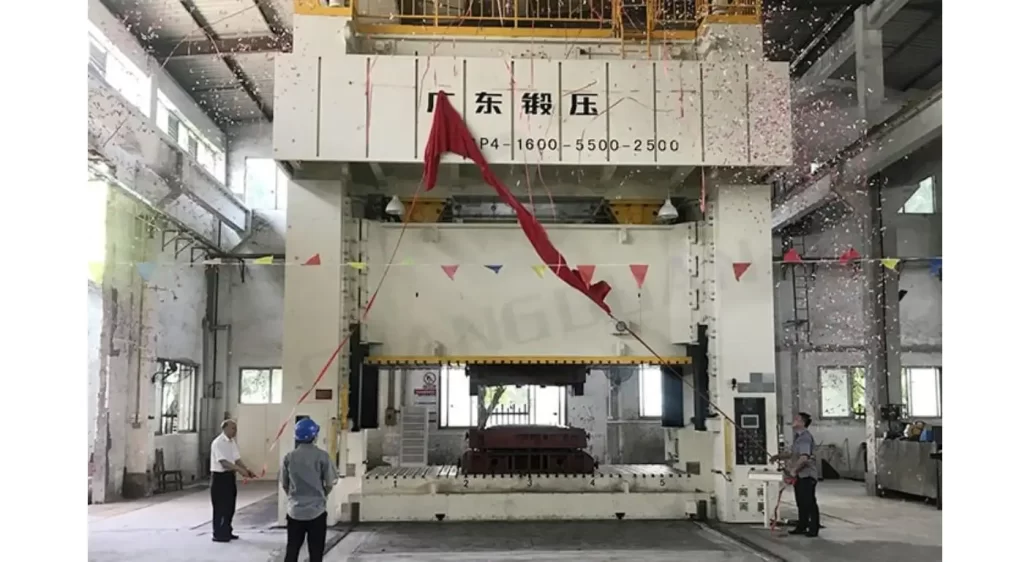
The large four-point press tested with vehicle sunroof tooling as part of Guangduan’s GP4-1600 automotive press project is a case in point of the usefulness of application-based machine testing.
Conclusion
Choosing a press machine to produce automotive parts is not just about tonnage and a broad part description. Each Body Panel, each chassis structure, each small stampings, each drivetrain forgings and each EV components present a unique production requirement.
A component-based specification is a specification that links the material, process, tooling and output target to the appropriate machine. Furthermore, it also minimizes the chances of purchasing equipment that is strong yet improper for the particular parts.
FAQs
Q1. What type of press is normally used for automotive parts?
Mechanical presses are commonly used for repetitive stamping of sheet metal. Deep drawn or formed components which are structural or forged in nature may be more suited to hydraulic or forge presses.
Q2. Does one press make multiple auto components?
Yes, if there are no gaps in the part range. Changing of tools and flexibility of automation also have to be taken into account.
Q3. What is the unit for Press Tonnage?
Tonnage varies depending on the material to be formed, its strength and thickness, and on the type of process and cutting perimeter. Also die-cushion force and combined operations should be added.
Q4. Which automation is necessary for the automotive manufacture?
Coil feeding, blank destacking, transfer robots, lubrication and part discharge may be included in the system. The level required will vary according to the material, part size and output.
Q5. Why is it important to test the press with tooling?
The real load distribution and the forming conditions are created by tooling. Representative testing is used to determine problems that are not apparent when the element is unloaded.
CONTACT US


Guangdong Metal Forming Machine Works Co., Ltd.
We are always providing our customers with reliable products and considerate services.
If you would like to keep touch with us directly, please go to contact us
-

Home
-

Tel
-

Email
-

Contact